
*Upholds Bans On Transgender Athletes In Female School And College Sports
THE United States (US) Supreme Court, on Tuesday, June 30, ruled that babies born in the country have a constitutional right to citizenship, rejecting President Donald Trump’s bid to end the 150-year-old policy.
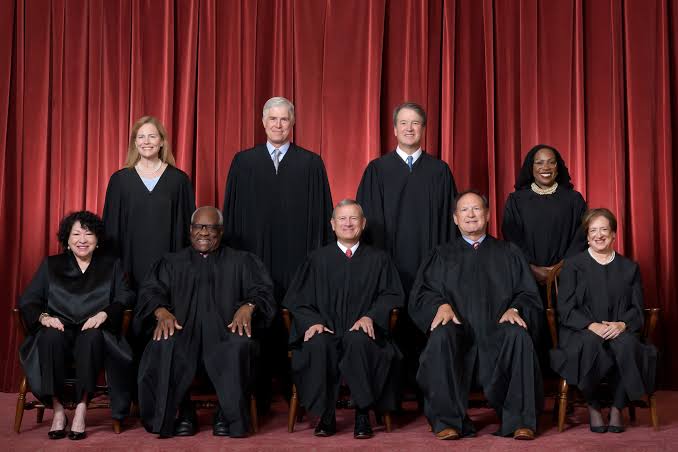
According to BBC/Reuters reports, in a 6-3 decision, Chief Justice John Roberts ruled that children born in the US “to parents unlawfully or temporarily present” are “citizens at birth” under the 14th Amendment.
Trump had sought to limit the right through an Executive Order, arguing that children of undocumented immigrants and some temporary visitors were not “subject to the jurisdiction thereof,” and thus not eligible for birthright citizenship.
The ruling is a major setback for Trump’s immigration agenda and has been welcomed by civil rights groups.
Five of the justices, including Roberts, agreed that Trump’s Executive Order violates the Constitution’s 14th Amendment.
Justice Brett Kavanaugh wrote separately to say the order is in violation of federal law.
On Truth Social, Trump said that the court’s decision was “too bad” and vowed to continue to fight to end birthright citizenship through legislation.
“No long and unwieldy constitutional amendment is necessary. Congress should today start work on ending expensive, and unfair to our country, birthright citizenship,” he said.
The US has granted citizenship to everyone born in the country since 1868, with the right enshrined in the 14th Amendment of its Constitution, and bolstered by later US Supreme Court rulings.
Passed in the aftermath of the US civil war, the 14th Amendment, which was originally intended for recently freed slaves, reads that “all persons born or naturalised, and subject to the jurisdiction thereof, are citizens of the United States.”
“Citizenship, then and now, was the right to have rights, to freely participate in our political community,” Roberts wrote in the majority opinion, adding: “The Framers of the Fourteenth Amendment extended that promise to ‘every free-born person in this land.
“We keep that promise today.”
The Trump administration argued that the “jurisdiction thereof” mentioned in the 14th Amendment should exclude children of people who do not live in the country permanently.
Three of the court’s nine justices- Clarence Thomas, Neil Gorsuch and Samuel Alito- dissented from the decision.
Thomas argued that the 14th Amendment was being “repurposed for political projects” and that the freed slaves it was originally intended for “were Americans” with no allegiance to other countries.
Another of the dissenting justices, Alito, described the ruling as a “serious mistake” that “confers citizenship on virtually anyone who happens to be born in this country,” including those who come to the US with the explicit purpose of giving birth to a child and then returning to their country of origin.
The case was of enormous significance to Trump, who made a brief, but historic appearance at the court to watch oral arguments in April.
On X, White House Chief of Staff, Stephen Miller, a vocal proponent of stricter immigration rules, called it “one of the most destructive and outrageous decisions” in the Supreme Court’s history.
“American citizenship is not the birthright of the world,” he said. “No provision of the Constitution can be read to require our national self-obliteration.”
But immigration advocates and detractors of the administration celebrated the ruling.
Hakeem Jeffries, who leads Democrats in the US House of Representatives, said that by applying the law and being guided by the Constitution, the top court “finally affirmed that all persons born in the United States are American citizens.
“There is, and shall be, no question.”
Dariely Rodriguez, chief counsel at the Lawyers’ Committee for Civil Rights Under Law, said that the ruling “solidifies what we have known to be true for over a hundred years.”
She added: “Anyone born on American soil, regardless of the legal status of their parents, is born an American citizen.
“We have endured an incredible test of our collective will as a nation and have prevailed.”
In a related development, the Supreme Court ruled that states can ban transgender women from competing in female school and college sports.
The court considered cases from students in two different states who had challenged bans on participation.
The two states, Idaho and West Virginia, enacted laws that required public school and college sports teams to compete in accordance with their sex recorded at birth.
One of the two challenges said the ban violates equal rights protections in the US Constitution, while the other said it contradicts civil rights laws.
Over two dozen states have enacted bans since Idaho did so in 2020.
Trump celebrated the decision in a social media post as a “BIG WIN.”
Under those state bans, a transgender woman, a biological male who identifies as a woman, is not permitted to compete in female sports at schools and colleges.
All nine justices on the court decided the state bans do not violate a civil rights law, called Title IX, that prohibits sex-based discrimination in schools.
But they were split along ideological lines on whether the bans contravene the Constitution’s 14th Amendment guarantee of equal protection under the law.
The six conservative justices said it did not violate the constitution, while the three liberal justices disagreed.
“The Constitution and Title IX do not require an overhaul of women’s and girls’ sports throughout America,” wrote Justice Brett Kavanaugh, who wrote the ruling.
In her partial dissent, Justice Sonia Sotomayor said the majority opinion had applied “a diminished view of equal protection” to sports.
The challenge, launched in Idaho, came from a transgender woman, Lindsay Hecox, a long-distance runner, who lodged it shortly after the law was enacted.
She was later granted an injunction by both a district court and an appeals court.
State lawmaker, Barbara Ehardt, who introduced the law, said at the time of its passing that it would ensure “boys and men will not be able to take the place of girls and women in sports, because it’s not fair.”
But in the appeals ruling, a panel of three Judges found that the Idaho law violated constitutional rights, saying the state had failed to provide evidence that its ban protects “sex equality and opportunity for women athletes.”
The plaintiff in West Virginia was 16-year-old Becky Pepper-Jackson, who challenged that state ban on equal-protection grounds.
West Virginia Attorney General, JB McCuskey, said Tuesday’s ruling was a victory for common sense and would give all states “the clarity and confidence to ensure fairness and safety for female athletes today and for generations to come.”
But the Human Rights Campaign (HRC), which advocates for the LGBT community, criticised the decision.
“This ruling is heartbreaking for transgender student athletes who are being forced to sit on the sidelines simply for who they are,” said HRC president, Kelley Robinson.
Trump made the issue of transgender athletes in women’s sports a focus of his 2024 election campaign.
Last year, he signed an Executive Order that aimed to ban transgender women from on sports teams in schools and colleges.
Following that decision, the NCAA, the governing body for US college sports, banned transgender women from competing in women’s sports.
US First Lady, Melania Trump, celebrated Tuesday’s ruling as a victory for women in sports, while adding that she supported the rights of gay and transgender Americans.
“America, we can support the rights of the LGBTQIA+ community and also protect opportunities for female athletes.
“Respect everyone and keep girls’ sports fair. Both ideals are essential,” she wrote on social media.
Supporters of the bans argued that transgender women had a biological advantage over athletes who were recorded female at birth.
When the International Olympic Committee (IOC) announced in March it was going to limit the women’s category of Olympic sports to biological females, it said its working group reviewed the latest scientific evidence over the previous 18 months and had concluded there was a “clear consensus” that “male sex provides a performance advantage in all sports and events that rely on strength, power and resistance.”
Those who opposed the bans argue that they unfairly discriminated against transgender students and dispute whether there is a scientific consensus that transgender women and girls have an inherent advantage.


