

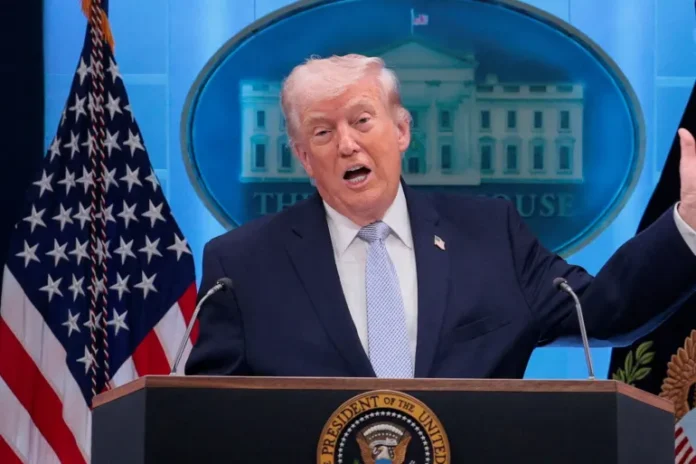
UNITED States (US) President, Donald Trump, said he won’t be rushed into a deal, warning that Iran’s efforts to outlast him won’t work, because he doesn’t “care about the midterms.”
The White House dismissed Iranian state media reports that a memorandum of understanding being negotiated would lift the US blockade of Iranian ports in exchange for the reopening of the strait.
Trump’s position came just as the US military carried out new strikes in Iran, targeting a site around the Strait of Hormuz that it said posed a threat to its forces and commercial traffic.
Reuter quoted an official as saying that the US also shot down four Iranian attack drones that posed a threat.
US forces also reportedly struck an Iranian ground control station in Bandar Abbas that was about to launch a fifth drone.
These actions were measured, purely defensive and intended to maintain the ceasefire, they added.
In the early hours of Thursday morning local time, three explosions were heard to the east of Bandar Abbas, a strategic Iranian port city and naval base near the Strait of Hormuz.
A US official confirmed the US military had shot down four Iranian drones and struck an Iranian ground control station in Bandar Abbas that was about to launch a fifth drone.
The blasts were reported at around 1:30a.m. local time and caused the air defence systems of Bandar Abbas to be briefly activated, according to Fars, a media outlet with links to Iran’s Islamic Revolutionary Guard Corps (IRGC).
“The exact location and source of these sounds are still unknown and follow-ups are continuing to determine them,” Fars reported.
In retaliation, Iran’s IRGC launched an attack targeting an American air base they said was the source of the US strikes on Iranian targets hours before aimed at Iranian drones and a launch site around the Strait of Hormuz early Thursday local time, state-linked Iranian media reported.
The IRGC did not specify which air base it targeted among the US air bases in a number of countries in the Middle East region.
“Following the aggression carried out at dawn today by the invading US military against a location on the outskirts of Bandar Abbas Airport, using aerial projectiles, the American air base identified as the source of the attack was targeted at 4:50 a.m.,” Fars News Agency reported, citing a statement from the IRGC’s public relation’s office.
The IRGC said its response was “a serious warning” to the US, saying its “aggression will not go unanswered.”
Around the same time Iran said the attack was launched, Kuwait’s Army reported its air defences were intercepting “hostile” drones and missiles, though did not state the origin of the attacks.
Kuwaiti air defences have been activated to confront “hostile” missile and drone attacks, the Gulf nation’s army said early Thursday local time.
“The General Staff of the Army notes that any explosion sounds heard are the result of air defense systems intercepting the hostile attacks,” the Kuwait Army said in a post on X, without disclosing where the attacks were coming from.
State news agency KUNA also reported sirens blasted in the country.
In a related development, four vessels that tried to transit the Strait of Hormuz were fired upon by Iran’s military and forced to turn around early Thursday morning local time, Iranian state-linked media outlets reported.
“Four vessels attempted to pass through the Strait of Hormuz and enter the Persian Gulf without coordinating with the security forces responsible for the strait,” multiple Iranian state-affiliated media reported on Thursday, citing a military source.
“They were warned, and after ignoring the warning, warning shots were fired toward them, forcing them to turn back,” according to the reports.
The Tasnim News Agency reported that the IRGC Navy had fired a warning shot at “American oil tanker” forcing it to turn around.
“In response,” Tasnim said, the US military “fired at a barren area near Bandar Abbas,” a strategic port city where explosions were reported early on Thursday morning local time.
Earlier this week, the US also launched strikes targeting Iranian missile launch sites and boats around the Strait of Hormuz in attacks it said were within the bounds of the ceasefire agreement, but Iran condemned as a violation of the ceasefire and the IRGC warned that it will retaliate against any violations.
US and Iranian forces have previously exchanged fire during the ceasefire.
Meanwhile, Iran’s newly created body to force shippers to comply with its rules around the Strait of Hormuz has been added to a US Treasury sanctions list.
The Persian Gulf Strait Authority has been placed on the Treasury’s Specially Designated Nationals list, which will generally prohibit US persons from dealing with it.
The Treasury said the creation of the authority was a new attempt by Iran’s Islamic Revolutionary Guard Corps (IRGC) to “monetise its campaign of state-sponsored terror by extorting vessels transiting the Strait of Hormuz,” in a statement on Wednesday.
Iran has been trying to implement a new protocol for transiting the Strait of Hormuz since effectively closing the critical waterway after the US-Israeli war with Iran began on February 28.
The organisation was established on May 5 as a “legal body and official representative of the Islamic Republic of Iran responsible for issuing permits and regulating maritime traffic” through the strait, the Iranian state-linked Nour News outlet said.
Earlier this month, Tehran laid out a set of new rules for vessels seeking to transit the strait, according to a document seen by CNN, pressing ahead with efforts to formalize control over the waterway in defiance of US warnings.
Entitled ‘Vessel Information Declaration,’ the document is an application form issued by the Persian Gulf Strait Authority (PGSA) and must be completed by all transiting vessels to ensure safe passage.
It was shared with CNN by Lloyd’s List and another shipping industry source who wished to remain anonymous.
In another development, Trump has racked up an astonishing list of countries he’s both threatened to attack and actually attacked by adding a new entry to that list on Wednesday, threatening to strike Oman if it tries to control the Strait of Hormuz along with Iran.
“Oman will behave just like everybody else, or we’ll have to blow ‘em up,” he said. He later added: “They understand that. They’ll be fine.”
Iran has disclosed that 23 vessels passed through the Strait of Hormuz under its “security protection” over the past 24 hours, but it warned earlier Wednesday that ships belonging to “hostile countries” are blocked from traversing the vital waterway, according to state-sponsored media.
“Over the past 24 hours, 23 vessels, including oil tankers, container ships and other commercial vessels, passed through the Strait of Hormuz after obtaining authorization, in coordination with and under the security protection of the IRGC Navy,” the Mehr News Agency reported Wednesday.
However, ship-tracking services could not confirm that number, partly because vessels that currently transit the strait invariably turn off their automatic identification system (AIS) transponders, which show their location.
IRGC navy said: “The Persian Gulf is a body of water belonging to the Muslim nations of the region, and the aggression and provocations of the terrorist U.S. military are the main cause of insecurity in these days.”
Earlier Wednesday it said “vessels belonging to ‘hostile countries’ are prohibited from passing through the Strait of Hormuz,” adding that Tehran will continue its “cooperation” with countries that comply with the “Iranian order,” according to a report by the official Islamic Republic of Iran Broadcasting (IRIB).
Despite optimism that a proposed US-Iran deal could increase the flow of commercial traffic through the strait, Tehran still appears to want to maintain a greater degree of control over the waterway than existed before the conflict.
Trump said Wednesday that the Strait of Hormuz will be “open to everybody” and that the US will “watch over it,” adding that those terms are a part of negotiations with Iran.
“The strait is going to be open to everybody,” he said. “Nobody’s going to control it. We’re going to watch over it. We’ll watch over it, but nobody’s going to control it,” he stressed.
The US and Israel attacked Iran on February 28, starting a monthslong war that spread to neighbouring countries.
In response, Iran closed the strait, a key passageway for global commerce, rocking the financial markets.
Despite talks about a potential deal to quickly reopen the strait, the likelihood of a swift diplomatic breakthrough seemed dim Wednesday after the US and Iran ratcheted up hostilities this week.
Published:

Related articles

Recent articles
