
* Akpabio Swears In Four New Senators
THE Senate, on Wednesday, June 24, passed the Bill seeking to further amend the 1999 Constitution to provide for the establishment of State Police across the country, thereby paving the way for the replacement of the existing Nigeria Police Force with a dual structure, comprising Federal Police Service and State Police Services.
The Bill was considered for passage after Senate Leader, Opeyemi Bamidele, presented its general principles.
It subsequently scaled Second Reading, was considered clause-by-clause and passed Third Reading, following a rigorous clause-by-clause consideration, with over than two-thirds of the senators voting in support.
A major provision of the Bill empowers state governors to appoint commissioners of Police for their respective states, subject to confirmation by the state Houses of Assembly.
Clause 17 of the proposed amendment says: “A State Police Service shall be headed by a Commissioner of Police of the State appointed by the Governor of the State on the recommendation of the National Police Council, subject to confirmation by the House of Assembly of the State and to such qualifications and national minimum standards as may be prescribed by an Act of the National Assembly.”
The Bill also defines the operational relationship between governors and state Police Commands under Section 17(6), which provides that: “A governor may issue lawful written directives of a general policy nature to the Commissioner of Police on matters relating to the maintenance of public safety and public order within the state.”
To allay fears of possible abuse of the proposed structure, the senators incorporated safeguards aimed at protecting political freedoms and civil liberties.
Section 17(7), specifically stating that: “A state Commissioner of Police shall not arrest, detain, investigate or deploy force against any person, political party or group merely for criticising the government, except in accordance with the law.”
This is designed to prevent state Police formations from being used against political opponents, activists, journalists and other dissenting voices, while ensuring that any action taken complies with due process and existing legal provisions.
Section 214 states that: “The Federal Police Service may temporarily intervene in the internal security affairs of a state and may, to the extent necessary, assume specified operational responsibility, including temporary operational command of a State Police Service or any part thereof, only where, (a) there is an actual or imminent breakdown of public order or public safety which the State Police Service is unable or unwilling to contain; (b) the Governor of the state requests federal intervention, etc.
“An intervention under Subsection (10) of this Section shall be authorised in writing by the President and shall state the grounds, territory, functions and duration of the intervention; and notice of the intervention shall be given to the Governor of the state, Speaker of the House of Assembly of the state, National Police Council and the National Assembly within forty-eight hours of the start of any intervention.
“No intervention under Subsection (10) of this Section shall continue beyond such period as may be prescribed by an Act of the National Assembly, unless approved by resolution of the Senate in the manner prescribed by that Act.”
The passage came a day after President Bola Tinubu transmitted the Bill as part of efforts to reform Nigeria’s Police architecture by providing a legal framework for a dual policing structure, allowing states to establish and operate their own police services, alongside the federal Police.
Tinubu stated that the proposed amendment was a critical component of ongoing efforts to reorganise the country’s policing system, enhance security and better protect citizens, adding that communities, municipalities and local government areas would play more active roles in policing responsibilities under the new arrangement.
The current policing system is controlled by the Federal Government through the Nigeria Police Force (NPF), but worsening security challenges have made a decentralised policing structure inevitable.
Critics have voiced concerns over possible political interference by state governors, funding constraints and the risk of worsening ethnic or communal tensions.
The Bill now requires passage by the House of Representatives, presidential assent and approval by a majority of state Houses of Assembly to become law.
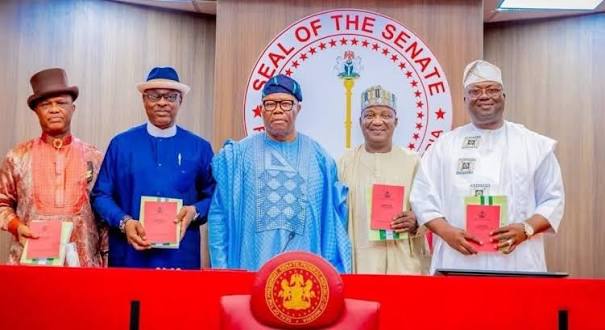
Meanwhile, Akpabio, during plenary, swore in four newly elected senators, following their victories in recent by-elections conducted by the Independent National Electoral Commission (INEC) to fill vacant seats across the country last Saturday, June 20.
The new senators are Olaka Wogu of the Peoples Democratic Party (PDP), representing Rivers South East; All Progressives Congress’ (APC) Envulu Anza (Nasarawa North); Ikeje Asogwu (Enugu North); and Dayo Faduyile (Ondo South).
Wogu succeeds the late Barinada Mpigi; Anza takes over from the late Godiya Akwaashiki; Asogwu from the late Okechukwu Ezea; and Faduyile takes over from Jimoh Ibrahim, who has been appointed as Nigeria’s Permanent Representative to the United Nations (UN).
Akpabio welcomed the new senators to the Red Chamber, which he described as “a family of the most elite club in the world.”
He urged them to remain committed to national development, and to see themselves as now representing the Federal Republic of Nigeria, rather than their political parties.
He advised them to study the 1999 Constitution (as amended) and the Senate Standing Orders (as amended in 2023) to effectively discharge their legislative responsibilities.


