
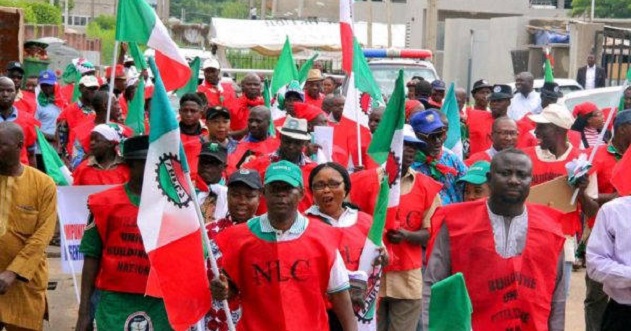
PUBLIC servants, under the aegis of Joint National Public Service Negotiating Council (JNPSNC), on Wednesday, September 30, threatened to embark on nation-wide strike from Friday, October 2, if President Bola Tinubu failed to respond to its demand in his Independence Day broadcast tomorrow.
Meanwhile, the Nigeria Labour Congress (NLC) expressed its support of the threat.
The workers had on September 30, issued an ultimatum to the Federal Government over the rising cost of Premium Motor Spirit (PMS), otherwise known as petrol, demanding a wage award and commencement of negotiations for a new national minimum wage , following their September 21 letter to the President on the issues.
JNPSNC, made up of eight public sector unions, threatened to embark on warning strike if government failed to reduce the pump price of petrol to N500 per litre, announce a wage award and introduce other measures to cushion effects of excruciating hardship in the country.
JNPSNC members include the Nigerian Civil Service Union (NCSU); Medical and Health Workers Union (M&HWU); Association of Senior Civil Servants of Nigeria (ASCSN); National Association of Nigerian Nurses and Midwives (NANNM); Amalgamated Union of Public Corporations, Civil Service Technical and Recreational Employees (AUPCTRE); Nigeria Union of Public Service, Reportorial, Secretarial, Data Processors and Allied Workers (NUPSRAW); National Union of Printing, Publishing and Paper Products Workers (NUPPPPROW); and National Union of Agriculture and Allied Employees (NUAEE).
JNPSNC, in a statement, by its National Secretary and General Secretary of NCSU Nigeria Civil Service Union, Olowoyo Gbenga, said the September 30 deadline remained sacrosanct, saying: “The three critical issues requiring urgent attention are as follows: Reduction of Fuel Price to N500 per Litre. The Federal Government should take urgent steps reduce the price of PMS to N500 per litre.
“This can be achieved through the provision of an intervention fund to address landing costs and support oil and gas operators.
“It is equally important for the federal government to ensure the sale of crude oil to the Dangote Refinery and operators of modular refineries at appropriate terms, in order to facilitate increased domestic refining and help bring down the price of petroleum products.
“The current price of PMS, ranging from N1, 450 to N2, 000 and, in some locations outside major communities and cities, as high as N2, 500 per litre, is unacceptable to Nigerian workers.
“The council maintains that the economic hardship occasioned by the high cost of fuel is placing the survival of Nigerian workers, their dependents and the general populace under severe pressure, making it increasingly difficult for Nigerians to live normal and dignified lives.
“The Federal Government should urgently approve a wage award for Nigerian workers to cushion the effects of the prevailing harsh economic conditions being experienced by workers, their dependants, and vulnerable Nigerians.
“The council believes that urgent action on this demand will further enable public servants consolidate their loyalty, commitment and productivity within the public service ecosystem.
“The Federal Government should urgently establish a Tripartite Committee to commence and facilitate negotiations for the new national minimum wage expected to become due in 2027.
“The Nigerian workers’ demand for the immediate constitution of the committee is informed by the need to avoid any administrative or procedural delay that could affect the implementation of the new national minimum wage once it is eventually negotiated and passed into law by the National Assembly.”
He stressed: “Consequently, the council states that failure by the Federal Government to take necessary steps to address these issues on or before September 30, 2026, will leave Nigerian workers with no option but to commence a three-day warning strike, with effect from Friday, October 2, 2026, to press home their demands.
“It is imperative to state clearly that the Independence Day address of the President of the Federal Republic of Nigeria should adequately address these critical issues.
“Failure to address the concerns raised, according to the council, will attract the displeasure of Nigerian workers and their dependents, as well as other vulnerable Nigerians who continue to bear the brunt of the prevailing economic hardship.”
NLC, in supporting the action, lamented that the hardship in country had gone so bad.
Its Assistant General Secretary, Chris Onyeka, told Vanguard: “We are in support of the actions being taken by the public sector unions. Most of them are our affiliates. The situation in the country has become so bad.
“What public sector workers are going through and feeling is what other Nigerians, whether private-sector workers, state workers, or informal-sector workers, are also feeling and experiencing.
“That is why we are surprised that the government has not rolled out immediate cushioning measures to mitigate the suffering, hardship and pain across the country, which have been exacerbated by the recent hike in the pump prices of fuel, especially petrol and cooking gas.
“We expected the government to show more concern about the hardships being experienced by Nigerians. The fact that the government has not done anything about the high cost of fuel up till now is very disappointing and shocking.
“Equally worrying is that the government has not responded to the NLC’s letter requesting the constitution of a National Minimum Wage Negotiation Committee to commence negotiations for a new minimum wage, when everyone knows that this is very imperative and urgent, given the socioeconomic realities of today.
“It is common knowledge that the value of the N70, 000 minimum wage had already been eroded by inflation, even before its implementation began.
“So, we are fully behind every legal and legitimate action by the public sector unions on these issues of fuel prices, wage awards, and a new minimum wage. We have to state here that if the demands of the public sector unions are not met as quickly as possible, it may snowball into a national strike involving all workers. “We, therefore, advise the government to address their demands and ensure that any measures taken reflect the needs and realities of all Nigerians, especially the masses.”


