
.
*Russia Says Attack Unprovoked, Illegal
*Israel Shuts Embassies
*Special IAEA Board Meeting Underway
*IAEA Chief Travels To Iran To Assess Situation
*Oil Prices Surge
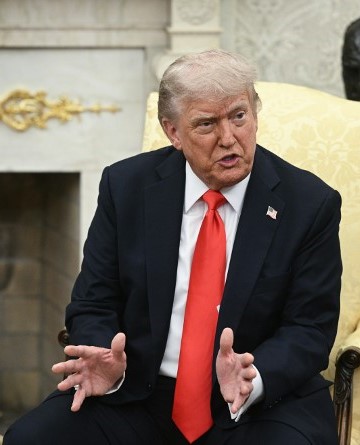
UNITED States (US) President, Donald Trump, on Friday, June 13 said the Israeli attack on Iran has been “excellent” and warned there was much more to come, according to an interview with ABC News.
“I think it’s been excellent. We gave them a chance and they didn’t take it. They got hit hard, very hard. They got hit about as hard as you’re going to get hit. And there’s more to come. A lot more,” Trump was quoted as saying by an ABC reporter on X.
Israel launched a barrage of strikes across Iran on Friday morning, saying it had attacked nuclear facilities and missile factories and killed a swathe of military commanders in what could be a prolonged operation to prevent Tehran building an atomic weapon.
Trump, Israel’s main ally, suggested that Iran had brought the attack on itself by resisting a US ultimatum in talks to restrict its nuclear programme.
However, as expected, Russia said on Friday Israeli strikes on Iran were unprovoked and in breach of the United Nations (UN) Charter, accusing Israel of wrecking diplomatic efforts to reach a deal to allay Western concerns about Tehran’s nuclear programme.
Israel launched strikes against Iran on Friday, saying it had targeted nuclear facilities, ballistic missile factories and military commanders during the start of an operation to prevent Tehran from building a nuclear weapon.
Following thea ttack, Israel shut its embassies around the world and urged citizens to stay alert and not display Jewish or Israeli symbols in public places, statements posted on embassy websites said on Friday.
The statements said Israel would not be providing consular services and urged citizens to cooperate with local security services if faced with hostile activity.
Meanwhile, head of the United Nations (UN) International Atomic Energy Agency (IAEA), Rafael Grossi, said on Friday he was ready to travel to Iran to assess the situation there after the Israel strikes that hit the sprawling nuclear complex at Natanz.
In a statement to a meeting of the IAEA Board of Governors, Grossi said the other main enrichment centre in Iran, Fordow, was not hit and neither was another nuclear facility in Esfahan, citing Iranian authorities.
In the interim, a special IAEA Board of Governors will be held to discuss Israel’s strikes on Iran after at least one country on the board requested one at Friday’s regular, quarterly session of the body, diplomats said.
Any country on the Board can call a meeting under its rules. Iran, which is not on the Board, requested a meeting and its call was supported by Board members Russia, China and Venezuela, diplomats said.
The diplomats gave differing accounts as to which Board member was the first to clearly make the request.
As tension escalates in the Middle East, oil prices jumped over $5 on Friday to multi-month highs after the Israeli strikes, sparking Iranian retaliation and raising worries about a disruption in volatile region’s supplies.
Brent crude futures were up $5.25, or around 7.6 per cent, to $74.61 a barrel at 1215 GMT, after hitting an intraday high of $78.50, the highest since January 27.
In Israeli, the streets of Tel Aviv were calm on Friday morning, even as the country’s leaders warned the public to brace for Iranian retaliation.
The military closed schools nationwide and banned public gatherings, cancelling the annual Tel Aviv Pride parade, which normally attracts tens of thousands of revellers to the city.
But in Iran, Iranians brace for more Israeli attacks, even as they expressed anger and fear on Friday, with some urging retaliation, while others worried the conflict would spell more hardship for a nation worn down by crises.
With Tehran and other cities shaken by a night of Israeli airstrikes, some said they planned to leave for neighbouring Turkey, bracing for escalation after Israel signalled its operation would continue “for as many days as it takes.”
“I woke up to deafening explosion. People on my street rushed out of their homes in panic, we were all terrified,” said Marziyeh, 39, from the city of Natanz, which is home to one of Iran’s nuclear sites and where explosions were reported.
“I am deeply worried about my children’s safety if this situation escalates,” said Marziyeh, one of 20 people Reuters contacted in Iran for this article.
In an initial wave of panic, some Iranians rushed to banks to withdraw cash on Friday morning.
Masoud Mousavi, 51, a retired bank employee, said he waited for the exchange offices to open, “so I can buy Turkish Lira and take my family there by land since airspace is close.”
“I am against any war. Any strike that kills innocent people. I will stay in Turkey with my family until this situation is over,” he said from Shiraz city.
Iranians have become accustomed to turmoil since the 1979 Islamic Revolution that ousted the US-backed Shah and brought the clerical establishment to power, from the 1980s war with Iraq, to heavy crackdowns on anti-government protests and years of biting Western sanctions.
Some opponents of Iran’s ruling clerics expressed hope that Israel’s attack might lead to their downfall, though one Tehran resident said he supported Iranian retaliation, even though he was not a supporter of the Islamic Republic.
“We can’t afford not to respond. Either we surrender and they take our missiles, or we fire them. There’s no other option, and if we don’t, we’ll end up surrendering them anyway,” he said, seething with anger at Israel’s attacks.
Two money changers in Tehran said they were busier than usual, as people rushed to buy foreign currency following the attack. But one of them said people were not too panicked.
“We have been through so much already. I don’t support Israel’s attack and I understand that Iran’s leaders feel the need to retaliate,” said retired teacher, Fariba Besharati, 64, who lives with her children and two grandchildren in Tabriz.
“But what about us? Haven’t we endured enough suffering?” she queried.
Many Iranians still believe in Iran’s right to a civilian nuclear programme, but some said it was now costing the country too much.
“The price we are paying is too high. And now, a military attack, no, I don’t want more misery,” said Mohammadreza, 29, a teacher in the northern city of Chalus.
Economic hardship, political and social restrictions have fuelled protests against the clerical rulers in recent years, notably in 2022, when a young woman died in Police custody after being arrested for allegedly flouting conservative dress codes.
Witnesses in several cities, including Tehran, said plainclothes agents and Police forces had deployed in the streets on Friday.
Iran’s rulers are facing myriad other crises, from energy and water shortages, to a collapsing currency and growing public anger over economic hardships, caused largely by US sanctions over its nuclear programme and economic mismanagement.
But the clerical leadership still has a tight grip on the country, underpinned by loyal security forces.
Ali, whose father was killed during the eight-year Iran-Iraq war, said he was ready to sacrifice his life for the Islamic Republic.
“I am a member of (volunteer militia) Basij. I will fight and die for our right to a nuclear programme. Israel and its ally, America, cannot take it away from us with these attacks,” he said from the holy city of Qom by phone.


