
*Audacious Attack Sends Critical Message To Russia, The West
*Starmer Unveils Defence Spending Plans, Says UK Moving To ‘War-fighting Readiness’
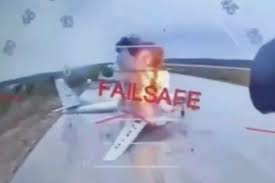
UKRAINE, on Sunday, June 1, staged a series of strikes across Russia, deploying drones hidden in trucks to hit strategic airfields, damaging over 40 Russian aircraft and causing losses of at least $2billion.
Russia launched a drone and missile attack against Kyiv, killing at least 12 people, and Ukraine’s Ground Forces Commander announced his resignation due to the casualties.
According to Bloomberg News, the incidents occurred ahead of crucial peace talks in Turkey, where delegations from Moscow and Kyiv will discuss issues, including a full and unconditional ceasefire, prisoner release and the return of abducted children.
Ukraine’s dramatic strikes across Russia, deploying drones hidden in trucks deep inside the country to hit strategic airfields as far away as eastern Siberia.
Around the same time, Moscow launched one of its longest drone and missile attacks against Kyiv, escalating tensions ahead of crucial peace talks this week.
The over 40 Russian aircraft affected, including the Tu-95 and Tu-22 M3 long-range bombers capable of deploying conventional and nuclear weapons, as well as the A-50, were reportedly damaged in Sunday’s operation, an official in Ukraine’s Security Service said on condition of anonymity as the details are not public.
Ukraine’s Security Service chief, Vasyl Malyuk, led the operation and losses are assessed to be at least $2billion, it was gathered.
Drones were released remotely from wooden mobile houses that were transported on trucks inside Russian territory, according to the official.
Ukrainian President, Volodymyr Zelenskiy, revealed details of the operation, saying it was “one year, six months and nine days from the start of planning to effective execution.
“Our most long-range operation. Our people involved in preparing the operation were withdrawn from Russian territory in time.”
In a separate post on Telegram, Zelenskiy said Ukraine used 117 drones, with people operating inside Russia across three time zones, adding that “34% of strategic cruise missile carriers at the airfields were hit.”
Russia’s Defense Ministry confirmed in a Telegram statement that attacks occurred at five military airbases across the country from the Far East and eastern Siberia to locations just several hundred miles from Moscow.
Authorities claimed, however, that only “a few aircraft units” were damaged at two military bases in the Murmansk and Irkutsk regions, insisting the attacks “were repelled at the Ivanovo, Ryazan and the Amur regions.”
These claims could not be independently verified immediately.
Earlier on Sunday, Ukraine came under one of the longest barrages from Russian missiles and drones, with air sirens lasting for more than nine hours.
At least 12 people were killed in a strike on a military training centre, prompting Ukraine Ground Forces Commander, Mykhaylo Drapatyi, to announce his decision to resign due to the casualties.
The incidents occurred just as Moscow and Kyiv prepare to send delegations to Turkey for a second round of peace talks on Monday, June 2. The opening round on May 16, the first in over three years, ended with a prisoner exchange agreement and discussions on a potential ceasefire.
So far, Russia has not signaled if the attacks may affect the talks.
Zelenskiy, on Sunday, confirmed that Defence Minister, Rustem Umerov, will lead a delegation to Istanbul to discuss issues, including a full and unconditional ceasefire, release of prisoners and the return of abducted children.
The delegations should also discuss the prospects of a high-level meeting, as key issues can only be resolved by leaders, Zelenskiy added.
Separately, Russia’s main investigating authority on Sunday initiated criminal probes after two bridges blew up in regions bordering Ukraine, crushing passing trains that caused at least seven fatalities and widespread injury.
Authorities have classified the incidents as “terrorist attacks,” the country’s Investigative Committee spokeswoman, Svetlana Petrenko, said in comments broadcast by state TV channel Rossiya 24.
A section of the road bridge in the Bryansk region, which borders Ukraine, struck a passenger train en route to Moscow shortly before midnight on Saturday, the regional governor, Alexander Bogomaz, said in a Telegram post, adding that the number of injured stands at over 70.
Hours later, a similar incident occurred in Kursk, which also borders Ukraine, where a railway bridge collapsed as a freight train was passing, with the engine crew was hospitalised, according to Governor Alexander Khinshtein.
It’s unclear whether there is a connection between the two.
Russia’s government, including Prime Minister Mikhail Mishustin, has been notified of the two incidents, state news agency, Tass, reported, citing Transportation Ministry head, Roman Starovoit.
Ukraine has so far made no official comment on the bridge incidents, but Andriy Kovalenko, head of the Ukrainian Center for Countering Propaganda, said on Sundaythat the Kremlin may be “preparing the ground for disruption of the talks,” adding it’s not the first time Russia conducts “false-flag” attacks.
“Ukraine has no motive to disrupt the Istanbul summit. On the contrary, Ukraine agreed to a ceasefire long ago,” Kovalenko said in a Telegram post.
Meanwhile, Ukraine’s Military Intelligence Service said a military train exploded in the Zaporizhzhia region, which is partially occupied by Russia, without giving details on how the blast occurred.
The explosion disrupted logistics between the area and the Crimea peninsula, annexed by Russia in 2014, the service said.
It’s hard to exaggerate the sheer audacity, or ingenuity, that went into Ukraine’s countrywide assault on Russia’s air force.
We cannot possibly verify Ukrainian claims that the attacks resulted in $7bn (£5.2bn) of damage, but it’s clear that ‘Operation Spider’s Web’ was, at the very least, a spectacular propaganda coup.
Ukrainians are already comparing it with other notable military successes since Russia’s full-scale invasion, including the sinking of the flagship of Russia’s Black Sea fleet, the Moskva, and the bombing of the Kerch Bridge, both in 2022, as well as a missile attack on Sevastopol harbour the following year.
Judging by details leaked to the media by the Security Service of Ukraine (SBU), the latest operation is the most elaborate achievement so far.
In an operation said to have taken 18 months to prepare, scores of small drones were smuggled into Russia, stored in special compartments aboard freight trucks, driven to at least four separate locations, thousands of miles apart, and launched remotely towards nearby airbases.
“No intelligence operation in the world has done anything like this before,” defence analyst, Serhii Kuzan, told Ukrainian TV.
“These strategic bombers are capable of launching long-range strikes against us. There are only 120 of them and we struck 40. That’s an incredible figure,” he said.
It is hard to assess the damage, but Ukrainian military blogger, Oleksandr Kovalenko, said even if the bombers and command and control aircraft were not destroyed, the impact is enormous.
“The extent of the damage is such that the Russian military-industrial complex, in its current state, is unlikely to be able to restore them in the near future,” he wrote on his Telegram channel.
The strategic missile-carrying bombers in question, the Tu-95, Tu-22 and Tu-160, are, according to him, no longer in production. Repairing them will be difficult, replacing them impossible, while the loss of the supersonic Tu-160, he said, would be especially keenly felt.
“Today, the Russian Aerospace Forces lost not just two of their rarest aircraft, but truly two unicorns in the herd,” he wrote.
Beyond the physical damage, which may or may not be as great as analysts are assessing, ‘Operation Spider’s Web’ sends another critical message, not just to Russia, but also to Ukraine’s western allies.
Svyatoslav Khomenko, writing for the BBC Ukrainian Service website, recalled a recent encounter with a government official in Kyiv, who expressed frustration.
“The biggest problem,” the official told Svyatoslav, “is that the Americans have convinced themselves we’ve already lost the war. And from that assumption, everything else follows.”
Ukrainian defence journalist, Illia Ponomarenko, posting on X, puts it another way, with a pointed reference to Zelensky’s infamous Oval office encounter with Donald Trump.
“This is what happens when a proud nation under attack doesn’t listen to all those: ‘Ukraine has only six months left’. ‘You have no cards.’ ‘Just surrender for peace, Russia cannot lose.”
Even more pithy was a tweet from the quarterly Business Ukraine journal, which proudly proclaimed: “It turns out Ukraine does have some cards after all. Today, Zelensky played the King of Drones.”
This, then, is the message Ukrainian delegates carry as they arrive in Istanbul for a fresh round of ceasefire negotiations with representatives from the Kremlin: Ukraine is still in the fight.
The Americans “begin acting as if their role is to negotiate for us the softest possible terms of surrender,” the government official told Khomenko.
“And then they’re offended when we don’t thank them. But of course, we don’t, because we don’t believe we’ve been defeated.”
Despite Russia’s slow, inexorable advance through the battlefields of the Donbas, Ukraine is telling Russia, and the Trump administration, not to dismiss Kyiv’s prospects so easily.
Meanwhile, British Prime Minister, Keir Starmer, has stated that the United Kingdom (UK) military was moving to “war-fighting readiness” as he unveils the government’s defence spending plans.
Speaking in Glasgow, Starmer added that the government will “innovate and accelerate innovation at a war-time pace”
Earlier, the premier stated that the UK must prepare for conflict, in order to deter conflict, and the threat from Russia cannot be ignored. But he declined to set a precise date for when UK defence spending would hit three per cent of GDP.
The UK has already committed to increasing defence spending to 2.5 per cent of GDP by 2027


