
*Voids Imo Acting CJ’s Appointment
*Uzodimma Bows, To Replaces Nzeukwu
THE National Judicial Council (NJC) is to investigate 27 Judges for alleged acts of judicial misconduct, even as it announced the suspension of three others for one year without pay for the same allegation.
In addition, the Council declared the appointment of Justice Theophilus Nzeukwu as acting Chief Judge (CJ) of Imo State void, directing Governor Hope Uzodinma to immediately reverse the decision and appoint the most senior judicial officer in the state, in line with the provisions of the 1999 Constitution (an amended).
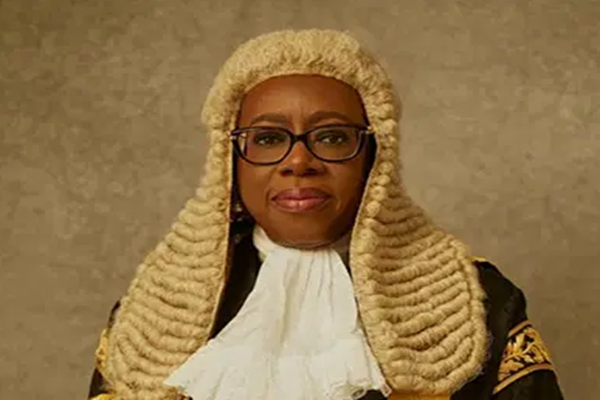
The NJC, chaired by the Chief Justice of Nigeria (CJN), Justice Kudirat Kekere-Ekun, at its 108th meeting in Abuja, also dismissed 29 petitions against Judges across the country.
A statement released by the Council’s Deputy Director of Information, Kemi Ogedengbe Babalola, read: “Specifically, in its resolution, the Council suspends Justice Jane E. Inyang, Court of Appeal, Uyo Division, for one year without pay, as the Investigation Committee found Her Lordship to have breached Rule 3 (5) of the Revised Code of Conduct for Judicial Officers.
“Justice Inyang was found to have abused her office by issuing inappropriate ex parte orders for the sale of Udeme Esset’s petrol station and other businesses at interlocutory stage of the case.
“The act of judicial misconduct occurred while His Lordship presided over suit No. FHC/UY/CS/46/2023 at the Federal High Court, Uyo Judicial Division, before her elevation to Court of Appeal.
“Furthermore, Justice Inyang Ekwo of the Federal High Court, Abuja Division, has been placed on suspension for one year without pay. His Lordship was also placed on Watch-List for five years and barred from elevation for five years.
“The complaints against Justice Ekwo arose from charge No. FHC/ABJ/CR/184/2021, wherein His Lordship delivered a ruling in a pending application without hearing the parties.
“His Lordship ignored an application to set aside the proceedings of the court conducted in the absence of the parties. Subsequently, His Lordship proceeded to deliver a ruling dismissing the charge against the defendants.
“Consequently, His Lordship was found to have violated Rule 3.1 and 3.3 of the 2016 Revised Code of Conduct for Judicial Officers of the Federal Republic of Nigeria.
“The Council also suspended Justice Aminu Baffa Aliyu of the Federal High Court, Zamfara Division, for a period of one year without pay for judicial misconduct in breach of Rule 3 (1) and 5 of the 2016 Code of Conduct for Judicial Officers.
“It also placed His Lordship on the Watch-List for three years, within which period he is barred from elevation.
“Justice Baffa was found liable for act of judicial misconduct in Suit No. FHC/GS/CS/30/2021, the Government of Zamfara State vs EFCC, wherein His Lordship granted an order restraining security agencies from carrying out their statutory duties and disregarded the doctrine of stare decisis in adjudication of the case.”
In addition: “The Council also issued a letter of caution to Justice A. Awogboro of Federal High Court, Lagos Division, in a petition filed by one Kasali Olagoke and S. Hamza, in Suit No. FHC/CS/2021, between Chief Adesanya Musediku and Assistant General of Police, Onikan, Zone 2.
“The petition against Justice Othman Musa of the High Court of the Federal Capital Territory (FCT) was put in abeyance, pending the outcome of the decision of the Court of Appeal arising from Suit No. FCT/HS/BW/2274/15.
“Another petition against Justice Inyang Ekwo, in Suit No FHC/ABJ/CS/321/2015, was put in abeyance, pending the outcome of appeal before the Court of Appeal.
“The Council, at its meeting, resolved that the constitutional provision on appointment of an acting Chief Judge of a State does not give room for discretion.
“Section 271(4) of the Constitution provides: ‘If the office of the Chief Judge of a State is vacant or if the person holding the office is, for any reason, unable to perform the functions of the office, then, until a person has been appointed to and has assumed the functions of that office, or until the person holding the office has resumed those functions, the Governor shall appoint the most senior Judge of the High Court to perform those functions.’
“Council also resolved that Justice Nzeukwu should be issued a query to show cause within seven days why disciplinary action should not be taken against him for presenting himself to be sworn in as the acting Chief Judge of Imo State.
“Justice V. Okorie, the President of the Customary Court of Appeal, Imo State, who acted as Interim Chairman of Imo State Judicial Service Commission and recommended the appointment of Justice Nzeukwu, is required to show cause within seven days why disciplinary action should not be taken against him for his complicity in the recommendation.
“Three petitions against Justice Abubakar Babashani of the High Court of the Federal Capital Territory (FCT), Justice Isaac Essien of the National Industrial Court (NIC) and Justice A. Musa of the High Court of the Federal Capital Territory (FCT) by Henry Okoro, Ikemefuna Nwoye and Lassborn Orjiugo, respectively, were put in abeyance, pending the decisions of the Court of Appeal.
“Council also considered a petition by one Mahmud Aliyu against the appointment of three Judges to the High Court of Zamfara State.
“The petitioner complained that the exercise conducted in 2022 by the Zamfara State Judicial Service Commission, which led to the emergence of shortlisted candidates, was not transparent and was characterised by nepotism, high-handedness and non-compliance with Rules 4, 5 and 6 of the 9 NJC guidelines for the appointment of Judicial Officers 2014.
“That the nominees were unilaterally picked by the Chairman of the Zamfara State Judicial Service Commission, in disregard to the NJC guidelines on merit-based assessment.
“Council, however, deliberated on its Committee’s findings on the petition and resolved that the Petitioner was an interested party who had indicated interest, but was not selected as a candidate.
“Council noted that the petitioner’s allegations were unsubstantiated and substantially based on falsehood.
“It, therefore, resolved that the Petitioner, who was a candidate for judicial appointment and intentionally peddled falsehoods against another aspiring judicial officer, will be barred from participation in any future exercise.
“In a petition to probe the recruitment exercise for the appointment of six Federal High Court Judges in 2021 10 by one Abdullahi Liman, the Council noted that the petition violated Section 11 (1) of the Judicial Discipline Regulations, which stipulated that a complaint must be filed within six months of the occurrence of the event or matter complained of, whereas the Petitioner filed his complaints on January 22, 2025.”
To make the appointment of judicial officers more transparent in the future, NJC resolved to invite public input.
It stated: “Henceforth, the names of candidates being considered for appointment as judicial officers to superior courts of records will be published for information and comments by the public, to solicit comments from the public where there is objection to the integrity, reputation and/or competence of the candidates by opening the process to public participation and scrutiny.”
NJC accepted the voluntary retirement of Justice Babatunde Bakre and approved a name change for Justice I. A. Osayande of the Edo State High Court, now to be known as Hon. Justice I. A. Dika.
Following the NJC resolution, Uzodimma has agreed to reverse the controversial appointment of Justice Nzeukwu.
Commissioner for Information and Strategy, Mr. Declan Emelumba, who disclosed this on Thursday evening, May 1, said the state had reviewed the NJC’s resolutions and would comply accordingly, even as he stated that Justice Nzeukwu’s appointment was made in “good faith” and based on available intelligence at the time and the governor’s decision and circumstances surrounding it were “duly communicated to the NJC.”
He said because of the Uzodimma-led administration’s respects due process and the constitutional role of the NJC in judicial appointments: “The government acknowledges and accepts the Council’s latest position on the matter.
“While the appointment was made within the bounds of the law, the Government of Imo State will, in line with its longstanding respect for due process and the judiciary, comply with the NJC’s recommendation.
“Accordingly, steps are being taken to implement the decision of the National Judicial Council.”


