
*Scraps Tourism, Niger Delta, Downgrades Two Ministers
*Returns National Sports Commission
*Seals Beta Edu’s Fate
*NDDC Not Scrapped, Momoh Assures
*Clark Expresses Shock, Disappointment Over N’Delta Ministry Scrap
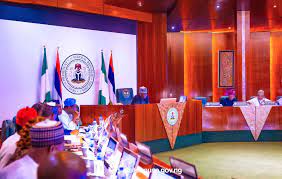
PRESIDENT Bola Tinubu, on Wednesday, October 23, sacked five ministers, appointed seven new ones and restructured ministerial portfolios to reinvigorate his government capacity to deliver on his promises to Nigerians.
His Special Adviser on Social Media, Dada Olusegun, in a statement, said the “President has approved the immediate implementation of eight far-reaching actions to reinvigorate the administration’s capacity for optimal efficiency pursuant of his commitment to deliver on his promises to Nigerians.”
Tinubu’s Special Adviser on Information and Strategy, Bayo Onanuga, while briefing State House Correspondents after the Federal Executive Council (FEC) meeting, named the offloaded ministers as Uju-Ken Ohanenye (Women Affairs); Lola Ade-John (Tourism); Tahir Mamman (Education); Abdullahi Gwarzo (State, Housing and Urban Development) and Jamila Bio Ibrahim (Youth Development).
The newly appointed ministers already assigned portfolios, subject to confirmation by the Senate, include Nentawe Yilwatda (Humanitarian Affairs and Poverty Reduction); Muhammadu Dingyadi (Labour and Employment); Bianca Odumegu-Ojukwu (State, Foreign Affairs); Jumoke Oduwole (Industry, Trade and Investment); Idi Maiha (Livestock Development); Yusuf Ata (State, Housing and Urban Development) and Suwaiba Ahmad (State, Education).
In the same vein, Tinubu appointed Shehu Dikko as Chairman of the National Sports Commission and Sunday Dare, his former aide minister of Sports in the President Muhammadu Buhari administration, as Special Adviser on Public Communication and Orientation, working from the Ministry of Information and National Orientation.
The President equally restructured the Ministry of Niger Delta Development, which is christened Ministry of Regional Development to oversee the activities of all the regional development commissions, such as the Niger Delta Development Commission (NDDC); South-East Development Commission; North-East Development and North-West Development Commission.
He also approved the immediate winding up of the Ministry of Sports Development and transfer of its functions to the National Sports Commission in order to develop a vibrant sports economy.
In addition, the President approved the merger of the Federal Ministry of Tourism and Federal Ministry of Arts and Culture to become Federal Ministry of Art, Culture, Tourism and Creative Economy.
In light of this, Tinubu re-assigned 10 ministers to new ministerial portfolios, with formerly Minister of State for Education, Yusuf Sununu, now Minister of State Humanitarian Affairs and Poverty Reduction; former Minister State for Health, Morufu Alausa, now Minister of Education; former Minister of State, Water Resources and Sanitation, Bello Goronyo, now Minister of State, Works; and former Minister of Niger Delta Development, Abubakar Momoh, now Minister of Regional Development.
Minister of State, Steel Development, Uba Ahmadu, is now Minister of State, Regional Development; Minister of State, Police Affairs, Imaan Sulaiman-Ibrahim, is now Minister of Women Affairs; Minister of State for Youth Development, Ayodele Olawande, is now Minister for Youth Development, while Minister of State, Environment, Salako Adeboye, is now Minister of State, Health.
Under the cabinet restructuring, two ministers were downgraded. They are Minister of Industry, Trade and Investment, Doris Uzoka-Anite, who is now Minister of State, Finance, and Minister of Sports Development, John Enoh, now Minister of State, Trade and Investment (Industry).
The President thanked the outgoing members of the FEC for their service to the country, wishing them the best in their future endeavours, while charging the newly appointed ministers and those reassigned to see their appointment as a call to serve the country.
He stated that all appointees must understand the administration’s eagerness and determination to set Nigeria on the path to irreversible growth, urging them to invest the best of their abilities into the actualisation of the government’s priorities.
Meanwhile, Momoh has clarified that NDDC is still in place and not scrapped, as being speculated, explaining that the Ministry of Niger Delta Development was renamed and given a greater responsibility under the Ministry of Regional Development.
Giving more insight into the realignment of three ministries, the minister reiterated that the new ministry was created to superintend over all the development commissions and agencies, adding: “For our people over there in the Niger Delta region, I would like them to know that that has not removed anything from them.
“The NDDC is still very much in place, which is still under the Ministry of Regional Development, and all other such agencies are there. It’s just a question of change of nomenclature.”
He said that nobody from the Niger Delta region should feel that the Ministry of Niger Delta has been scrapped and no longer in existence, noting: “All the structures and everything about the Niger Delta remains. It’s just a change of nomenclature and, of course, expansion of activities of the ministry.
“So, I think it’s something worth to be commended.”
In a related development, elder statesman and Ijaw leader, Chief Edwin Clark, has expressed shock and disappointment over the scrapping of Niger Delta Affairs Ministry, recalling that the ministry was created by the late former President, Umaru Musa Yar’Adua, specifically to address the pressing security and development challenges in the region.
The leader of the Pan Niger Delta Forum (PANDEF) said there was no justification for the decision, noting that the ministry had a clear mandate to promote peace and development.
He criticised the lack of development plans and funding from the government, lamenting that critical projects, such as the East-West Road remained unaddressed since its transfer back to the Federal Ministry of Works.
Clark questioned the federal government’s commitment to regional development, wondering whether multiple development commissions would effectively serve the needs of the regions, even as he recalled that agreements were made to increase revenue allocation to the Niger Delta and establish funding for post-conflict recovery at the 2014 national conference, which he said have not been honoured.
He stressed the necessity for government to engage with leaders from the Niger Delta and South-South region to ensure their perspectives are included in future plans and called for transparency regarding the government’s strategy for regional development, saying the interests of the Niger Delta cannot be sidelined.


