
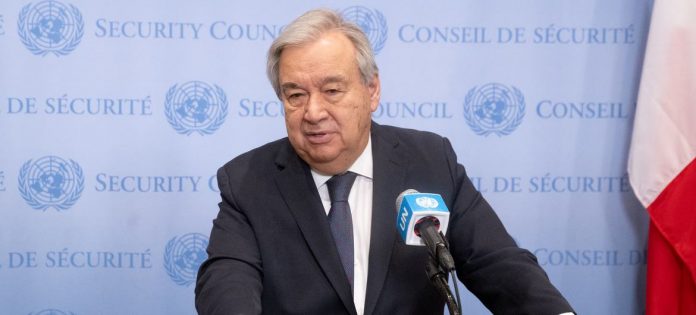
THE United Nations (UN) Secretary General, Antonio Guterres, had called for actions to de-escalate tension in Rafah, which boiled over on Sunday with Hamas attacks on the Israeli border crossing town of Kerem Shalom, killing four Israeli soldiers.
In response, Israel on Monday, May 6, commenced the evacuation of the city of Rafah, southern Gaza Strip, ahead of an expected military operation in the area.
“For the sake of the people of Gaza, for the sake of the hostages and their families in Israel and for the sake of the region and the wider world, I strongly encourage the Government of Israel and the Hamas leadership to reach now an agreement,” he said, while speaking to journalists in New York, according to UN News.
He expressed fear that without an agreement, “the war, with all its consequences both in Gaza and across the region, will worsen exponentially.”
Nearly seven months have passed since the brutal Hamas-led attacks on Israel that sparked the current hostilities.
Recent weeks have seen airstrikes on the Rafah area in southern Gaza, where over 1.2 million people are now sheltering, with limited access to food, medical care and other services and with nowhere safe to go.
Guterres cautioned that a military assault there “would be an unbearable escalation, killing thousands more civilians and forcing hundreds of thousands to flee” and would have a devastating impact on Palestinians in Gaza, with serious repercussions in the occupied West Bank and across the wider region.
“All members of the Security Council, and many other governments, have clearly expressed their opposition to such an operation. I appeal for all those with influence over Israel to do everything in their power to prevent it,” he said.
Turning to the north, where vulnerable people are already dying of hunger and disease, he urged the international community to “do everything possible to avert an entirely preventable human-made famine.”
Although incremental progress has been made, much more is urgently needed, including the promised opening of two crossing points between Israel and northern Gaza, so that aid could be brought in from Ashdod Port and Jordan.
Lack of security remains a major obstacle to distributing aid across Gaza, and the UN scribe stressed that humanitarian convoys, facilities and personnel, as well as people in need “must not be targets.”
“We welcome aid delivery by air and sea, but there is no alternative to the massive use of land routes,” he said, before again calling on Israel to allow and facilitate safe, rapid and unimpeded humanitarian access throughout Gaza, including for the UN’s Palestine relief agency, UNRWA.
Guterres also addressed how the war has “decimated” the health system in the enclave, where two-thirds of hospitals and health centres are out of commission, while many of those remaining are seriously damaged.
“Some hospitals now resemble cemeteries,” he lamented, voicing deep alarm over reports of the discovery of mass graves at several locations, including at Al-Shifa and Nasser hospitals.
Over 390 bodies have been reportedly exhumed at Nasser Hospital alone and “there are competing narratives around several of these mass graves, including serious allegations that some of those buried were unlawfully killed,” he added.
The UN chief said it is imperative that independent international forensic investigators are allowed immediate access to these sites to determine the precise circumstances under which hundreds of Palestinians lost their lives and were buried or reburied, noting: “The families of the dead and missing have a right to know what happened, and the world has a right to accountability for any violations of international law that may have taken place.”
The secretary general ended his remarks by drawing attention to UNRWA and its “irreplaceable and indispensable work” supporting millions of Palestinians in Gaza, the West Bank, Jordan, Syria and Lebanon, adding: “UNRWA’s presence across the region is a source of hope and stability.
“Its education, healthcare and other services provide a sense of normality, safety and stability to desperate communities.”
The agency recently appealed for $1.2billion to address the humanitarian crisis in Gaza and the needs in the West Bank, where violence is rising.
UNRWA largely depends on donors and some 16 countries halted their contributions earlier this year following Israeli allegations that 12 staff were involved in the October 7 Hamas attacks.
The UN subsequently appointed an independent body to review the agency’s efforts to ensure the humanitarian principle of neutrality. The panel, headed by former French foreign minister, Catherine Colonna, recently published its report,which found that “the set of rules and the mechanisms and procedures in place (at UNRWA) are the most elaborate within the UN system.”
Guterres said an action plan was being put in place to implement the report’s recommendations and appealed for cooperation from donors, host countries and staff.
Meanwhile, most countries that suspended contributions to UNRWA have resumed them, and the secretary general said “we are optimistic that others will join.”
In addition, some UN member states have made donations to the agency for the first time, while private donors have also provided support.
However, as a funding gap persists, Guterres urged member states and donors to pledge generously to ensure the agency’s work continues, saying: “This is the moment to reaffirm our hope for and contributions to a two-state solution- the only sustainable path to peace and security for Israelis, Palestinians and the wider region.”


