
*Says Lagos An Example Of How Vision Exalts Democracy
*Sanwo-Olu: Rail Accomplishments, Results Of Our Painstaking Reforms
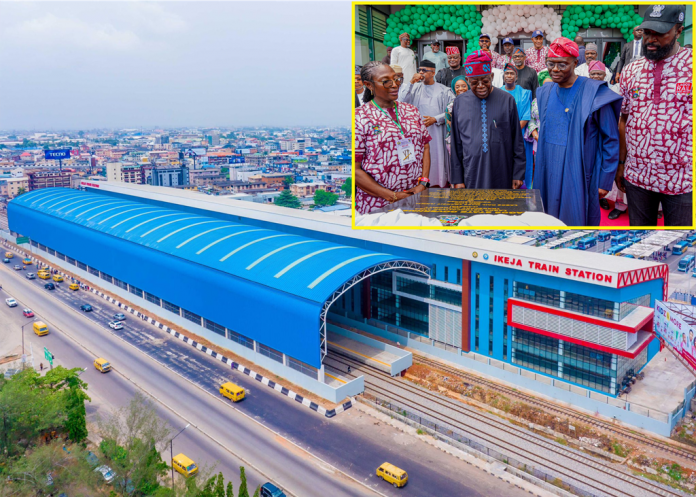
PRESIDENT Bola Tinubu, on Thursday, February 29, formally inaugurated the Lagos Rail Mass Transit (LRMT) Red Line executed by the administration of Governor Babajide Sanwo-Olu to give urban commuters in the Nigeria’s economic metropolis a new transport option.
This is the second sub-national rail infrastructure to be completed and opened by the state government within one year.
The first phase of the 37-kilometre rail line, constructed by the Lagos Metropolitan Area Transport Authority (LAMATA), was commissioned with seven stations built along its corridor, traversing Agbado, a boundary town in Ogun State, to Oyingbo in Lagos Central.
The event came exactly 12 months after the first light rail (Blue Line), which was inaugurated by former President Muhammadu Buhari.
The 13-kilometres project, started by former governor, Mr. Babatunde Fashola, traverses five stations between Mile 2 and Marina.
His successor, Mr. Akinwunmi Ambode, continued the project and improving on the scope.
The inaugural ride took off from the Ikeja mega station on Thursday, to the excitement of residents elated by the second intra-city rail network.
Six state governors, led by the Chairman of Nigeria Governors Forum (NGF) and Governor of Kwara State, Dr. AbdulRahman AbdulRazaq, were among the first set of passengers that joined the President and Sanwo-Olu in a ride on the train.
Also on hand were some members of the Federal Executive Council (FEC), Lagos cabinet members, business leaders, members of the diplomatic corps, political leaders, traditional rulers, traders and students.
An elated Tinubu, himself a former governor of the state , who laid the state’s strategic development blueprint, commended Sanwo-Olu for the “giant stride” and for his faith in the blueprint passed down to successive governments
The President said the inauguration marked another milestone in the state’s infrastructural progress and further validated his belief that democracy would work in society where leaders showed dedication to governance vision.
He noted that Lagos stood out as shining example of working democracy because its leadership made people’s welfare the central priority of its overarching vision and planning.
“Today, we are gathered for the inauguration of the second of the six rail lines planned in our strategic transportation master plan. I commend the Lagos State Government under the leadership of Babajide Sanwo-Olu for this giant stride. He was part of this vision some 20 years ago, running around the world to look at working systems and come up with ideas to replicate here.
“I am delighted that we are inaugurating the first phase of the Red Line. Today is a day to be remembered for the infrastructural progress of our country, particularly Lagos.
“LAMATA has demonstrated that agency can work for people if it is guided by a vision and commitment to noble values. Much work still needs to be done in fostering strong working partnership between between federal government and state governments,” he stated.
Tinubu added: “We thank Lagosians and our political leaders in the state for believing in us. We said we can do it, you believed in us. We said we would be focused on the people, you believed in us. We said our efforts would end up in making people’s lives better, you believed in us.
“The progress of Lagos over the last 24 years is a constant reminder that true change is possible.”
He said the history would be kind to everyone involved in infrastructural transformation witnessed in Lagos, noting that any deviation from the state’s development master plan could derail the progress, even as he urged its leadership to persevere in the face of opposition to the ideas, while staying focused on the goals.
Sanwo-Olu, on his part, described the ceremony as a “culmination of long, painstaking journey” of reforms in the transportation sector of the state, saying the inauguration of the rail system, once again, breathed life into Tinubu’s vision of integrated transport connectivity.
He explained that the Strategic Transport Master Plan (STMP) of Lagos State outlined six integrated rail lines, one monorail, 14 BRT
corridors, over 20 water routes and a vast network of major and inner roads.
He announced that two of the rail lines have now been completed, even as he acknowledged the contributions of his predecessors- Fashola and Ambode- towards the accomplishment of the state’s rail projects.
He said: “Today, we mark a historic milestone in the annals of Lagos and indeed, our nation, with the commissioning of the Red Line, a 37-km marvel of modern engineering that stretches from Agbado in Ogun State to the iconic National Theatre in Iganmu.
“The segment we are inaugurating today spans an impressive 27-km from Agbado to Oyingbo, featuring state-of-the-art stations at Agbado, Iju, Agege, Ikeja, Oshodi, Mushin, Yaba and Oyingbo.
“For the first time in the history of Lagos State, we have a system comprising and integrating all three modes of transportation- road, rail and waterways.
“We started construction of the rail infrastructure mid-2021 and I am happy that our administration has been able to complete for operations.
“At full capacity, this first phase of the Red Line will transport 250,000 passengers daily, which will grow to 750,000 passengers daily when we have the full complement of rolling stock on the line.”
Before the inauguration, Sanwo-Olu, in successive months, commissioned five separate T-shaped bridges built by the state government along the rail corridor to limit vehicular interference on the tracks.
As part of the ceremony, LAMATA and China Civil Engineering Construction Corporation (CCECC) signed an agreement contract for the construction of the Phase Two of the Red Line, which would extend the project to Marina and National Theatre stations of the Blue Line.


