
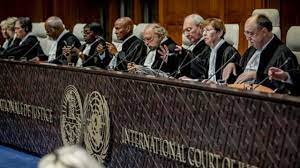
THE United Nations’ (UN) International Court of Justice (ICJ) at The Hague, Netherlands, yesterday, ruled that Israel must prevent genocidal acts in Gaza and facilitate “urgently needed” humanitarian aid into the occupied territory.
The court urged Israel to refrain from any possible genocidal acts as it presses its military operation in the Gaza Strip, but stopped short of ordering an expected ceasefire.
It said Israel must take “immediate and effective measures to enable the provision of urgently needed basic services and humanitarian assistance to address the adverse conditions of life faced by Palestinians.”
The court at this stage was not considering whether Israel was actually committing genocide in Gaza, as such process takes several years, but warned Israel to “take all measures in its power to prevent” acts that could fall under the UN Genocide Convention, set up in 1948, as the grappled with the horrors of the Nazi Holocaust.
It also said Israel should “prevent and punish” any incitement to genocide, in a matter brought before it by South Africa, which accused Israel of breaching the Convention.
Following days of hearings earlier this month in the gilded hall of the Peace Palace, where the court sits, lawyers from both sides battled over the interpretation of this Convention.
South Africa accused Israel of “genocidal” acts that were intended to cause the “destruction of a substantial part of the Palestinian national, racial and ethnical group” and urged the court to order Israel to “immediately suspend” its military operations in Gaza and allow humanitarian aid to reach the civilians there.
However, Israel dismissed the case as a “grossly distorted story,” insisting that if any genocidal acts had been carried out, they had been executed against Israel during the October 7, last year’s Hamas attacks.
Israel’s top lawyer, Tal Becker, said: “What Israel seeks by operating in Gaza is not to destroy a people, but to protect a people, its people, who are under attack on multiple fronts.”
Although the court’s rulings are legally binding, the question remains whether the latest rulings would be obeyed, as the court has no mechanism of enforcing such rulings, which are sometimes completely ignored, its order for Russia to stop its invasion of Ukraine being an example.
Prime Minister Benjamin Netanyahu has already hinted that Israel would not abide by any ruling, saying “no one will stop us,” not even a verdict in The Hague.
But experts believe that aside from the significant symbolic impact of the ruling, there could be tangible consequences on the ground.
“It makes it much harder for other states to continue to support Israel in the face of a neutral third-party finding there is a risk of genocide,” said international law expert from the University of South Australia, Juliette McIntyre.
“States may withdraw military or other support for Israel to avoid this,” she added.
The October 7 Hamas attack led to the death of over 1,140 people in Israel, most of them civilians, including foreigners, according to an AFP tally based on official Israeli figures.
Conversely, at least 26,083 Palestinians, about 70 per cent of them women, young children and adolescents, have been killed in the Gaza Strip in Israeli bombardments and ground offensive since then, according to the Hamas government’s health ministry.


