
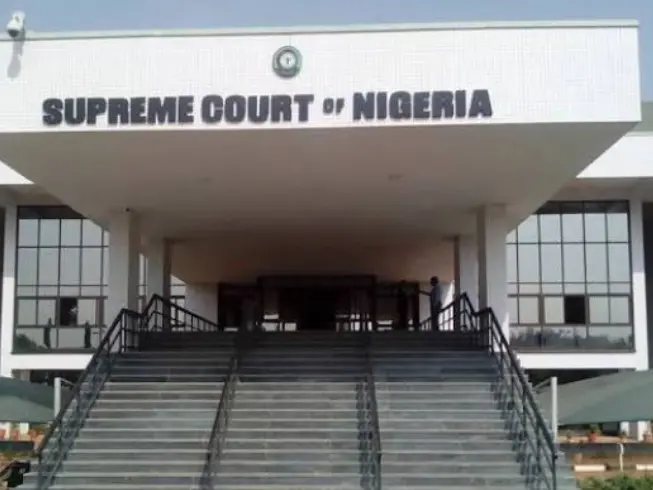
THE Supreme Court, on Friday, January 12, amidst tight security in and around the court complex in the Three Arms zones of Abuja, affirmed the election of Governors Babajide Sanwo-Olu (Lagos State), Abba Yusuf (Kano), Bala Mohammed (Bauchi); Dauda Lawal (Zamfara) and Francis Nwifuru (Ebonyi) in the March 18, last year governorship election.
There was palpable apprehension especially in the cases of Yusuf and Plateau State Governor Caleb Mutfwang.
Yusuf and his New Nigeria Peoples Party (NNPP) had filed an appeal against the judgment of the Court of Appeal, which upheld his sacking by the Kano State Governorship Election Petitions Tribunal, which ordered the Independent National Electoral Commission (INEC) to withdraw his Certificate of Return and issue same to Nasir Yusuf Gawuna of the All Progressives Congress (APC).
Dissatisfied, with the lower courts judgment, the governor approached the apex court to upturn the rulings.
Mutfwang, whose election was upheld by the Plateau State Governorship Election Petitions Tribunal in Jos, was sacked by the Court of Appeal, which declared Nentawe Goshwe of the APC as the winner of the election over the failure of the PDP to comply with the order of the Plateau State High Court in Jos directing it to conduct valid ward, local governments and state congress.
The Justices started reading the judgments around 9.45 am, starting with the appeal by the Labour Party (LP) governorship candidate in Lagos State, Gbadebo Rhodes-Vivour, and his PDP counterpart, Azeez Adediran, against Sanwo-Olu’s election.
Justice Mohammed Lawal Garba, who read the judgment on behalf of a five-man panel of Justices, headed by Justice John Okoro, ruled that the petitions lacked merit and accordingly dismissed them.
Rhodes-Vivour and Adeniran had filed separate appeals against the judgments of the Court of Appeal affirming the two rulings of the governorship election petition tribunal in the state, which had earlier dismissed their petitions challenging Sanwo-Olu’s victory.
In the case of Mohammed, the court dismissed the appeal of APC’s Sadique Abubakar and upheld the victory of Mohammed of the PDP in the lead judgment read by Justice Mohammed Musa Saulawa.
Mohammed had earlier won at the tribunal and appellate court.
The contentious case of Kano State governorship election was put to rest, as the court ruled in favor of Yusuf, thereby averting looming crisis and violence in the state.
The Supreme Court reversed the judgments of the court of appeal and the state governorship election petition tribunal, both of which nullified the governor’s election.
Justice Okoro, who read the lead judgment, held that the law and natural justice were turned upside down by the two courts below to arrive at their decisions.
Justice Okoro, while voiding and setting aside both lower courts judgments, said miscarriage of justice in the ways and manners the petition against the governor was handled was manifesting.
The apex court ruled that two major fundamental flaws were discovered in the tribunal and appellate court findings, leading to a miscarriage of justice.
It held that APC’s allegations that Yusuf was not a member of the NNPP at the time he stood for the election, and upon which the tribunal overturned his victory, was against the provisions of the law, adding that the governor’s membership of the NNPP cannot be challenged by APC, being an internal affairs of the party.
Justice Okoro ruled that the issue of party membership cannot be raised as a post-election matters, as done by the APC and its governorship candidate, and wrongly upheld by the tribunal and the appellate court, as his nomination was submitted to the INEC in an NNPP letterhead paper jointly signed by the party’ national chairman and national secretary, more as no member of the NNPP had queried the nomination, except the APC in its petition before the tribunal.
The court reversed the unlawful removal of 165, 616 votes from the total votes cast for the NNPP and its governorship candidate in the election, saying there was no basis for the action, as the ballot papers used for the election were duly issued by INEC.
It dismissed the allegations that the ballot papers were not signed and stamped at the back, noting
that there was no scintillating of evidence from any witness or documentary exhibits that the ballot papers were illegal and unlawful, as erroneously concluded by the appellate court.
The apex court agreed with the governor that miscarriage of justice was perpetrated against him in the ways and manners his election was nullified and ordered that the 165, 616 votes unlawfully deducted be returned to him.
While, therefore, allowing the appeal of the governor and his party, the court dismissed the two judgments earlier granted in favour of the APC and its candidate on the ground that the judgments were erroneously entered in their favour.
In the Zamfara governorship election dispute, the apex court upturned the decision of the lower court and affirmed Lawal’s election.
In the judgment by Justice Emmanuel Agim on behalf of the panel, the apex court held that the court of appeal decision, which sacked Lawal of the PDP and ordered INEC to conduct fresh elections in Maradun Local Council, in four wards in Birnin Magaji Local Council and some polling units in Bukkuyum Local Council, was perverse and cannot stand.
Justice Sybil Nwaka-Gbagi, who read the judgment, said INEC should not have used IREV for the collation of results when the Supreme Court had ruled that it was not a result collation system, but only for public viewing.
The three-member panel upheld four out of seven issues brought forward by the APC candidate and Minister of State for Defence, Bello Matawalle
INEC had declared Lawal as winner of the election with 377,726 votes, against APC’s Matawalle’s 311,976 votes. But the apex court specifically said the decision of the appeal court to order the conduct of election in some local councils and wards has no merit and consequently set it aside.
In the case of Ebonyi, the Supreme Court, in the judgment read by Justice Tijjani Abubakar, while upholding the election of Francis Nwifuru of APC, dismissed the appeal by the PDP and its candidate, Chukwuma Odii, for lacking merit.
The Court of Appeal in Lagos had earlier affirmed the governor’s election in a unanimous decision by the three-member panel, led by Justice Jummai Sankey, which dismissed Odii’s appeal, having resolved all five issues raised against the appellant.
Justice Sankey held that Odii and his party lacked the legal right to meddle in APC’s internal affairs as it relates to the nomination of candidates.
Meanwhile, Sanwo-Olu has described his victory as not just for his Deputy, Obafemi Hamzat, but for democracy, adding that it was for the rule of law and the entire people of Lagos state.
“Like I said in my acceptance speech after the results of the election were declared, there was no victor or vanquished. I, therefore, invite those who are still standing on the fence to show their love for our dear state by joining the train of progressive governance. We do not profess a monopoly of ideas,” the governor said.
“Let me reiterate that this judicial victory will spur our government to continue on the trajectory of progress that we started in 2019, which has resulted in many achievements across many areas of lives.
“For us, our aim in governance is about service and ensuring that we are not distracted from all the promises we made to our people. The judgment will now allow us to accelerate our interventions to ensure that we continue to deliver more dividends of democracy to residents, in line with our developmental agenda,” he added.


