
*Drops 20% Fee On Hormuz Cargo Threat As Iran Ports Blockade Resumes
*Iran Says Strait Closed, Vows To Retain Control
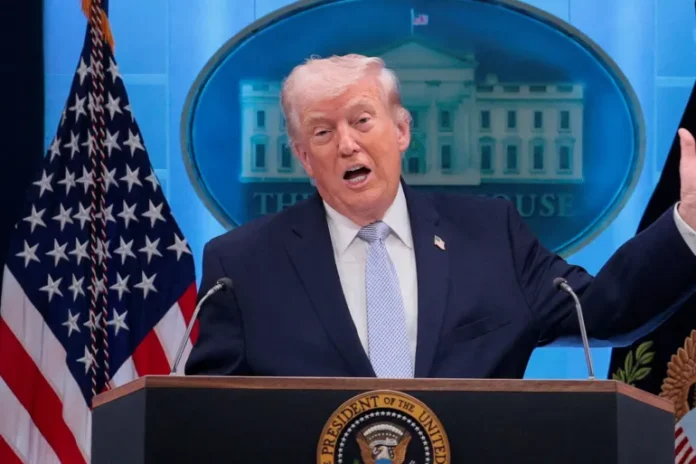
UNITED States (US) President, Donald Trump, has threatened to strike Iran’s bridges and power plants next week if the country does not return to talks.
The comments, made in a Fox News interview, aired as the two countries exchanged fire for the fourth day in a row.
Trump earlier reversed a threat of a 20 per cent fee on all Strait of Hormuz cargo shipping but resumed blockading Iranian ports.
“Next week, it gets really bad for them,” Trump said. “We’re going to knock out all their power plants. We’re going to knock out all their bridges unless they get to the table and negotiate.” Shipping data shows traffic through the Strait has slowed dramatically
Back in April, Trump threatened to bomb civilian infrastructure in Iran, including bridges and power plants.
The United Nations (UN) human rights chief, Volker Türk, responded at the time by saying: “Under international law, deliberately attacking civilians and civilian infrastructure is a war crime.”
The 1949 Geneva Conventions on humanitarian conduct in war prohibit attacks on sites considered essential for civilians.
“I’ll save the energy targets for last, but ultimately we’ll hit energy targets,” Trump said in an interview on Special Report with Bret Baier that aired on Tuesday night, July 14.
He said US negotiators had conveyed to their Iranian counterparts on Tuesday evening that they “‘better make a deal or you’re not going to have anything left.”
The escalation in rhetoric comes after Trump said a 20 per cent toll he had threatened to impose in the Strait of Hormuz would be replaced by “massive” trade and investment deals with Gulf states.
The announcement came hours before the US military carried out a seven-hour wave of strikes on Iran and resumed a blockade of its ports.
US Central Command (Centcom) said it hit “dozens” of Iranian military targets near the Strait of Hormuz, with the aim to “further degrade Iran’s ability to threaten commercial shipping and civilian crews.”
At least seven Iranian military personnel were killed in US strikes on a base in the southeastern city of Bampur, Iran’s army said on Wednesday, July 15.
Meanwhile, Tehran fired missiles and drones on US targets in Jordan, Kuwait and Bahrain, Iranian state-run television, IRIB, reported.
The BBC and Reuters reported that in the early hours of Wednesday, Kuwait’s military said it was intercepting Iranian attack drones, while Bahrain activated air raid sirens.
“Kuwaiti air defences are currently engaging hostile drone attacks following the nefarious Iranian aggression,” the Kuwaiti army said, while Bahrain’s Interior Ministry urged citizens and residents to remain calm and head to the nearest safe place.
The US also said Iran had “intentionally targeted civilians” in the region by attacking seven commercial ships, which had resulted in “nearly a dozen civilian crew members killed, missing or injured,” the commander of Centcom said in a statement late on Tuesday.
The United Arab Emirates (UAE) said on Monday night that Iranian cruise missiles had targeted two national tankers, killing an Indian crew member and wounding eight others, four of them seriously.
Iran’s Islamic Revolutionary Guard Corps (IRGC) later confirmed the strikes via a statement to Telegram, where it said two tankers had ignored warnings, turned off navigation systems and attempted to pass through a mined route.
It was unclear which other attacks the Centcom statement was referring to. The IRGC did not immediately comment.
Renewed strikes between the US and Iran triggered a sharp rise in oil prices, as tanker traffic through the Strait has virtually stalled.
It underscores the strategic importance of the waterway, with Iran accusing the US of interfering in its management of Hormuz, but controlling it means Tehran can also threaten the global economy.
On Monday, Trump declared that the US was now the “guardian” of the Strait of Hormuz and vowed to impose a 20 per cent charge on all cargo shipped through the waterway to pay for protecting it.
Raising the stakes further, Trump said the US would also re-impose its naval blockade on Iran in a bid to further squeeze the country’s struggling economy.
In his latest post on Truth Social, Trump wrote: “I have decided to replace the 20 per cent United States Reimbursement Fee with Trade and Investment Deals that the various Gulf States will be making into the United States.
“Those Investments will be MASSIVE, but at the same time, extraordinarily good for them and their future.”
The US leader provided no further details, but added “is open to ALL Ship traffic except for Iran” and “oil is flowing like never before, thanks to the awesome Power of the United States Military.”
Speaking later, after talks in Washington with the new Iraqi Prime Minister, Ali al-Zaidi, Trump said: “I don’t like the concept of a fee, but at the same time, it’s not fair that we’re protecting this Strait for the entire world.”
He said he had changed his initial fee plan after receiving numerous calls from Gulf leaders.
In response to Trump’s announcement, Iran said it would remain in control of the Strait of Hormuz. Its Deputy Foreign Minister, Kazem Gharibabadi, said Trump’s blockade decision “has, in a way, dismantled” an earlier agreed truce deal, the AFP news agency reported.
Gharibabadi also told state television, as quoted by Reuters news agency: “If the US thinks that by tightening its measures against us, its military actions and its economic blockade, we will return to negotiations, it is making a mistake.”
The US first imposed a naval blockade of all Iranian ports in April to put pressure on Tehran. Roughly five weeks later, its military said it had redirected 100 commercial vessels and disabled four under the blockade.
The US lifted the blockade in June as part of a deal, known as a Memorandum of Understanding (MoU), between the two countries that aimed to end the conflict, but a dispute over the strait has become a key point of contention.
Meanwhile, shipping data shows traffic through the strait has slowed to a two-month low. The benchmark Brent Crude oil price has also risen sharply.
Trump retreat over Hormuz tolls suggested he was struggling to end Iran war. His latest Iran war demand lasted all of 24 hours and suggests a President searching for unorthodox ways out of a difficult position.
On Monday morning, in a social media post announcing the resumption of an American naval blockade on Iranian shipping, he said that all vessels transiting the Strait of Hormuz, including those of US allies, must pay a 20 per cent fee to reimburse the US “for any and all costs necessary to do the job of providing safety and security to this very volatile section of the world.”
The following day, he abandoned that proposal completely, offering instead that he would strike “trade and investment deals” with America’s Gulf allies, implying the US would offer them safe passage through the Strait in return.
On Monday, after Trump’s Truth Social post, the price of a barrel of oil jumped nearly 10 per cent, the biggest one-day increase in six years.
The first time around, Trump’s blockade helped pressure the Iranians to the negotiating table and set the table for the memorandum of understanding and a framework for a more lasting peace.
The latest target Trump has suggested is Pickaxe Mountain, a heavily fortified nuclear research site south of Tehran. But there is conflicting evidence of the value of the site, or of whether US airstrikes can cause significant damage to the tunnels which are deep beneath granite rock.
The US military said late on Tuesday that it hit dozens of military targets near the Strait of Hormuz and Iranian coastal areas in a wave of strikes that lasted seven hours, the Central Command said in a statement.
Iranian government spokesperson, Fatemeh Mohajerani, said at least 30 civilians had been killed in recent days due to the US strikes on southern Iran, state media reported on Wednesday.
Iran’s army said at least seven active-duty and conscript personnel were killed in overnight US strikes on the Bampur military base in the country’s southeast.
The IRGC said on Wednesday that the Strait of Hormuz would remain closed until what it described as “the end of America’s evils.” Before the war began in February, about a fifth of global oil and gas shipments passed through Hormuz each day.
IRGC said they had targeted what they described as command-and-control, logistics, fuel and military equipment facilities belonging to the US Fifth Fleet in Bahrain, in response to the latest US strikes in the Strait of Hormuz.
They also said they had set fire to and destroyed what they described as a US logistics facility in Kuwait’s Mina Abdullah and that their air force had struck what they described as a US base at Azraq in Jordan, targeting aircraft hangars, alleging some of the US attacks had been launched from bases on Jordanian territory.
Earlier on Wednesday, Kuwait’s state news agency reported that a fire was brought under control at a site targeted in Iranian attacks. It was not immediately clear whether the fire was at the same site referred to in the IRGC statement.
Jordan’s air defence intercepted and shot down three ballistic missiles that entered the country’s airspace from Iranian territory early on Wednesday.
The hostilities between Iran and the US re-ignited last week, fraying an already fragile truce reached in June after several months of fighting that has killed thousands.


