
*Burnham Puts Himself Forward As Successor
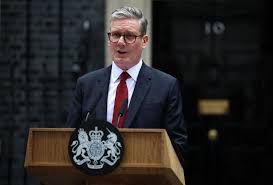
BRITISH Prime Minister, Keir Starmer, on Monday, June 22, announced that he will resign, but remain in place until a new Labour Party leader emerges.
In an emotional speech made on the steps of his Downing Street office and London residence, Starmer said he had listened to his party and realised that he was no longer the man who should lead it into the next national election, due in 2029.
Starmar’s exit comes less than two years after he won a landslide election victory that promised to end Britain’s chaotic politics, and paves the way for Britain’s seventh leader in a decade.
The BBC reported that threat to Starmer has been building for months, but it increased sharply last week when Manchester (now former) mayor, Andy Burnham, decisively won an election to return as a lawmaker.
Burnham has, meanwhile, confirmed he is running for leader, while the man considered his main rival for the role, Wes Streeting, ruled himself out and came out in support of Burnham.
Streeting, who announced his support for Burnham in a letter posted on X, had previously said he would take part in any contest to become prime minister.
“Andy has shown what Labour can be when we are inclusive, united and in touch with the lives of the people this party was founded to represent,” he wrote.
Streeting said that since he left Starmer’s cabinet last month, he had been speaking to activists and voters and also setting out his ideas for the country, including for economic growth, “progressive capitalism” focused on wealth creation as much as wealth distribution, and on modernising public services.
“Having spoken at length with Andy (Burnham) in recent days, I’m convinced that there is a place for those ideas under his leadership; that he is committed to building an inclusive party that draws on the best of our political traditions,” Streeting wrote.
“We were elected (to) change our country, to show that politics can be a force for good, and to spread opportunity for everyone. With Andy, we still can.”
“We could spend the summer exaggerating small differences, or we can roll up our sleeves and help him (Burnham) deliver the change our Party and our country needs.
“That is the choice that I am making and I hope that everyone else will back Andy, too,” he added.
Streeting was the Health minister in Starmer’s cabinet until he resigned on May 14, citing a loss of confidence in Starmer.
Burnham was to be sworn in as a member of parliament on Monday, after he comfortably won the parliamentary seat of Makerfield in northwestern England last week.
With Starmer having announced his resignation and Streeting, throwing his support behind Burnham, all eyes are now on Burnham.
Asked by a BBC journalist as he arrived in London whether he would call a national election if he became prime minister, Burnham responded: “You’re jumping several hurdles ahead there,” saying his priority for the day was to be sworn in as a lawmaker.
“It’s been very, kind of, sad for me to leave Greater Manchester … I hope I leave Manchester in a better place,” he added, referring to his years as mayor of the conurbation in northwestern England.
According to Reuters, the former mayor of one of Britain’s biggest cities and regions wants to draw on lessons from the area’s rapid economic rise to rewire Britain’s economy.
Burnham’s vision is clearest on devolution: Accelerating the shift of power away from London, which has increasingly dominated Britain’s economy in recent decades.
He has yet to set out how he would balance tax, spending and borrowing, but said years of privatisation and deregulation have not only stripped the government of control over its costs and services, but also saddled it with inefficiencies.
He has vowed to keep within the existing fiscal rules and to honour Labour’s 2024 manifesto promise not to raise taxes on working people.
Burnham campaigned for Britain to stay in the European Union (EU) at the time of the Brexit referendum in 2016.
Last year, he said he wanted to see Britain rejoin the EU in his lifetime, but he has since said that seeking EU membership was not a priority.
Burnham is a career politician who first rose to prominence when he held several ministerial positions under then Labour prime minister, Gordon Brown, between 2007 and 2010.
The 56-year-old has previously contested the Labour leadership twice, losing to Ed Miliband in 2010 and Jeremy Corbyn in 2015.
He later left parliament and was elected mayor of Greater Manchester, and proved popular and effective in that job, including by standing up to Boris Johnson’s Conservative government in 2020, when it wanted to impose stringent COVID restrictions on Greater Manchester with insufficient compensation.
That particular episode won hearts in England’s north, earning him the nickname, “King of the North,” and revived his national standing.
There has been talk in Labour ranks for months that he would be a potential successor to Starmer. But he was not in a position to mount an immediate challenge against Starmer, because he was no longer a member of parliament- a prerequisite to be prime minister under Britain’s political system.
That changed last week when he decisively won an election for the parliamentary seat of Makerfield in northwestern England.
Among some Labour supporters, he is now seen as the “Reform slayer,” the politician who has a chance of keeping the populist party of veteran Brexit campaigner, Nigel Farage, at bay.
Over the weekend, before Starmer’s resignation announcement, The Times newspaper reported that Burnham would sack Finance Minister, Rachel Reeves, should he become prime minister.
The report said Burnham would replace Reeves after his advisers concluded that keeping her in the job would not represent a sufficient change of direction. Reuters could not immediately verify the report.
Reeves was appointed after Labour’s 2024 election win. Her time as Chancellor of the Exchequer, the official title of British Finance Ministers, has been marked by very constrained public finances, limiting her margin for maneuver.
As a result, she has been closely associated with some of Starmer’s most divisive moves, such as an attempt to cut welfare spending and an increase in business taxes.
Just three days ago, Starmer said he would not walk away from the job, vowing to fight any challenge to his leadership.
“If there is a contest … I will stand, and I’ve said repeatedly I’m not going to walk away,” Starmer told reporters in London on Friday, just after Burnham won a decisive victory in a special election for a parliamentary seat in northwest England and signalled that he would capitalise on that success to enter any contest to replace Starmer.
The scale of Burnham’s victory prompted more Labour lawmakers to say Starmer should consider stepping down to enable an orderly handover to him.
In the lawmakers’ eyes, Burnham’s comfortable victory over a candidate from Reform UK, the populist party led by veteran anti-Immigration campaigner, Nigel Farage, demonstrated that he was better placed than Starmer to keep Reform at bay.
Farage’s party has been well ahead of Labour in opinion polls for many months.
In recent months, as the pressure on Starmer grew and former allies went public with their dissatisfaction with him, he had increasingly turned to his wife, Victoria, for advice.
On May 12, days after Labour’s disastrous local election results prompted calls for him to resign, he emerged from a long lunch with Victoria, determined to fight on.
But things turned out differently after Burnham’s victory was announced on Friday.
Starmer and his wife spent the weekend at Chequers, the official prime ministerial country residence. By the time he headed back to London, he had been persuaded to bow to the inevitable and resign.
It is just less than two years since Starmer guided the Labour Party into power in 2024 with the biggest parliamentary majority in Britain’s modern history.
Long known for enduring stability, Britain has experienced one crisis after another in the past decade, since the 2016 Brexit referendum upended the political status quo and exposed deep divisions in society and government.
The turbulence has resulted in a rapid turnover of prime ministers unable to finish their terms. As we’ve been reporting, Starmer’s exit paves the way for Britain’s seventh leader in 10 years.
The last one to serve a full five years was Conservative leader, David Cameron, who was elected in 2010 and won re-election in 2015.
However, he was unable to finish his second term. He resigned after voters opted to leave the EU in a 2016 referendum.
Cameron had called the referendum and campaigned for Britain to stay in the bloc.
He was succeeded by Theresa May, who took over, but stepped down three years later after failing to deliver Brexit on schedule or find a way to get parliament to approve her exit plan.
Then came Boris Johnson in 2019, who also lasted three years before a ministerial rebellion forced him to quit, following scandals that included breaches of COVID-19 pandemic lockdown rules, a luxury renovation of his official residence and the appointment of a minister who had been accused of sexual misconduct.
He was succeeded in 2022 by Liz Truss, who resigned after just six weeks in office over her economic programme that triggered a financial market meltdown.
She is widely remembered as the prime minister who failed to outlast a lettuce.
In 2022, Rishi Sunak, who has Indian roots, became Britain’s first prime minister from an ethnic minority when his party ditched Truss in his favour.
However, a general election was due in 2024, which Starmer’s Labour Party won by a landslide, forcing Sunak to resign.


