
*Trump: US Strikes Seven Iranian Boats
*Warns Iran Will Be ‘Blown Off Face Of Earth’ If US Ships Targetted
*UAE Says Defences Engaged 15 Iranian Missiles, Four Drones Monday
*IDF Says ‘Monitoring’ Situation
UNITED States (US) guided-missile destroyers have passed through the Strait of Hormuz and entered the Gulf as part of a new mission to restore maritime traffic in the vital waterway, the US military said Monday, May 4.
The warships “are currently operating in the Arabian Gulf after transiting the Strait of Hormuz in support of Project Freedom,” US Central Command (CENTCOM) said on X, referring to the operation announced by President Donald Trump on Sunday, May 3.
“American forces are actively assisting efforts to restore transit for commercial shipping,” CENTCOM said, adding that “two US-flagged merchant vessels have successfully transited through the Strait and are safely headed on their journey.”
According to Reuters report, Tehran’s forces effectively closed the strait, a key route for oil and gas shipments, in response to the US-Israeli military campaign that began on February 28, while Washington is maintaining a blockade of Iranian ports.
Iran said earlier Monday that it had fired missiles at a US warship in the Strait, but CENTCOM said “no US Navy ships have been struck.”
Trump has indefinitely extended what was an initial two-week ceasefire that brought a halt to the fighting, but the conflict, and its widespread economic fallout, remains unresolved.
Trump said the US struck seven Iranian “fast boats” after vowing to help stranded vessels out of the Strait.
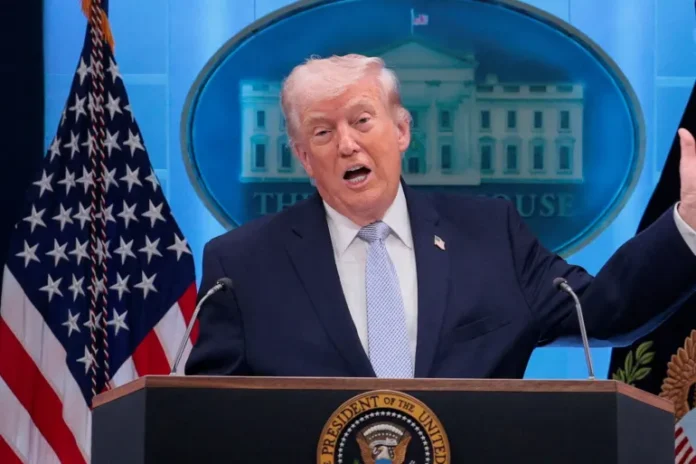
Trump, speaking to several dozen officials and visitors at an event focused on domestic issues and the administration’s policies, however, began his remarks by mentioning a “little detour” in Iran, saying it’s “working out very nicely.”
He dismissed polls showing the war is unpopular as “fake,” arguing the media is downplaying concerns about a nuclear-armed Iran.
Iran’s military claimed in state media that its missiles hit a US destroyer as warning shots, a claim the US Central Command has denies.
The Islamic Revolutionary Guard Corps (IRGC) has, according to Iranian state media, shared a warning with vessels in the strait that any who pass through the “closed” waterway will be “struck and destroyed.”
Meanwhile, the UAE said it is defending itself against “missile and drone attacks originating from Iran,” but Tehran has yet to comment
Officials stated that a drone attack sparked a large fire at UAE’s biggest oil port in Fujairah
In a published a summary of its defence actions on Monday, the Ministry of Defense said its air defence systems had engaged “12 ballistic missiles, three cruise missiles and 4 UAVs launched from Iran, resulting in three moderate injuries”.
This follows several reports of attacks in the UAE earlier, including a reported drone strike in Fujairah, where three Indians were said to be injured.
The ministry stated that this brings the total number of people injured in the country since the start of the conflict to 227, with three killed.
But Iranian state television quoted an unnamed “senior military official” as saying that “Iran has had no plans to target the UAE.”
A group representing independent oil tanker operators has called for “clear, verified information” on how Trump’s so-called “Project Freedom” will work in practice.
Recall that on Sunday, Trump said the US would help guide stranded ships out of the closed Strait of Hormuz, a process he has termed “Project Freedom”.
It’s been a day of back-and-forth claims and denials between the US and Iran over action in the Strait, as tensions have reignited in the vital waterway.
Trump has also warned Iran that its forces will be “blown off the face of the earth” if they attempt to target US vessels guiding ships through the Strait as part of “Project Freedom.”
He told Fox News that he saw two paths forward in his war- either reaching a good faith deal or resuming military operations, adding thyat ongoing US naval blockade was “one of the greatest military maneuvers ever done” and that the Iranians were being “far more malleable” in recent talks than before.
Speaking at a small business summit at the White House, Trump reiterated his view that “we can’t let Iran have a nuclear weapon.”
He repeated his usual claims about the US decimating Iran’s capabilities, claiming Tehran has “no navy, no air force, no anti-aircraft equipment, no radars, nothing- they have no leaders, actually, the leaders happen to be gone also.
“But [you] can’t let them have a nuclear when or you’d have problems like nobody would believe, and it’s going very well.”
Admiral Brad Cooper, head of Central Command, declined to comment to Reuters on whether he thought a ceasefire begun on April 8 remained in effect, as Iran lashed out in region, including with drone and missile attacks on the UAE on Monday.
But he acknowledged ongoing Islamic Revolutionary Guard Corps efforts to “interfere” with Trump’s operation, noting: “The IRGC has launched multiple cruise missiles, drones and small boats at ships we are protecting.
“We have defeated each and every one of those threats through the clinical application of defensive munitions.”
As events unfold, the Israel Defence Forces (IDF) said it was closely monitoring the situation in the Gulf, adding: “Our air defence systems and offensive capabilities remain at a high state of readiness, which has not changed since the ceasefire came into effect.”
In Iran, Aljazeera reported that armed, state-backed motorcades continue to roam the streets of Tehran and other cities at night, and government supporters hold demonstrations in major city squares and intersections where they often play religious chants from loudspeakers and wave flags while guarded by armoured vehicles.


