
*Osifo: Even N1m Minimum Wage Will Mean Nothing Without Fixing Naira Value
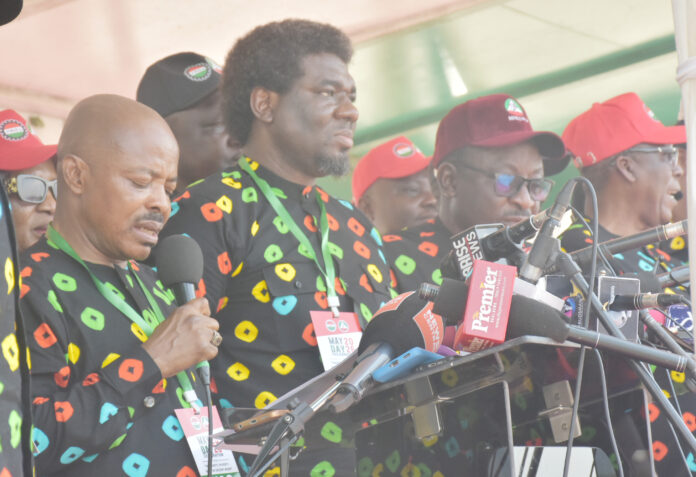
LEADERS of the Nigeria Labour Congress (NLC), Joe Ajaero, and his Trade Union Congress (TUC) counterpart, Festus Osifo, in a delivered a joint speech to mark this year’s Workers Day on May 1, described Nigeria as a country where “poverty tightens its grip daily,” institutions weakening and citizens increasingly left to fend for themselves in the face of violence and economic hardship.
The Labour leaders reminded the country of the central role workers play in sustaining the economy, in sharp contrast with their current condition, noting: “Workers remain at the very heart of every industry, every economy and every success story known to humanity.
“Without workers, no wheel can turn; without workers, no nation can be built.”
They lamented that those same workers “create immense wealth, yet receive only a fraction of it,” enduring exploitation while “poverty tightens its grip around them.”
Nigerian workers, they stated, are people who “rise before dawn and return home at dusk, exhausted yet unbroken,” but increasingly unable to meet basic needs despite their efforts.
They described government’s economic narrative as growth without relief, reform without impact, arguing that macroeconomic indicators have become disconnected from reality.
“We are told that GDP growth may reach about 3.6%… yet poverty continues to rise. We hear official inflation figures… but these numbers do not reflect the reality experienced daily by workers,” the labour leaders argued.
They argued that Nigeria’s economic model has produced a distorted outcome, noting: “Paper growth without jobs, stability without prosperity, and reform without relief.”
They lamented that the benefits of economic policies are being captured by a narrow elite, adding: “An economy that serves only the top one per cent, while leaving the 99 per cent behind cannot be sustainable. Perhaps, it is working for the ultra-few one per cent and not the 99 per cent majority.”
The organised labour also lamented that Nigeria was sliding deeper into poverty, as living conditions across the country dip, citing data that shows poverty now affects about 65 per cent of Nigerians, which is roughly 150 million of its population, saying approximately 10,000 people are pushed into poverty every day, warning that deprivation has reached alarming levels.
They bemaoned Nigeria’s overcrowded cities strained by rural displacement, rising food insecurity and the re-emergence of diseases linked to extreme poverty in internally displaced persons camps.
While announcing that negotiations for a new national minimum wage begins in July this year, adding that beyond future negotiations: “We demand that from July of this year, every worker be paid 100 per cent of his basic salary… to cushion the effects of the renewed crisis of survival.
“We demand a living wage, not a minimum wage.”
On insecurity, labour stated: “The scale of violence, the frequency of attacks and the mounting loss of lives… place Nigeria among the most dangerous places to live on earth. It is a war against our people.
“People are no longer safe in their homes, on the roads or even in their workplaces. Daily life has become a gamble with fate.”
Labour warned that it may take the step of directing workers to stay home if insecurity persists, noting: “Nigerian workers may no longer continue going to work with this level of insecurity.
“We may be forced to advise our members… to stay at home to avoid being kidnapped, abducted or killed. The safety of workers is non-negotiable.”
The unions also described Nigeria’s power and oil sectors as symbols of policy failure and elite capture, saying: “Over a decade after privatisation, Nigerians have little to show but deepening darkness.”
“Despite over N10 trillion in public spending, power supply remains unreliable. What was promised as reform has become a burden.”
They highlighted the paradox of an oil-rich nation unable to protect its citizens from price shocks, noting that “the contradiction is stark and disheartening.”
In addition, Labour raised concerns over governance, accusing political leaders of being disconnected from the realities of ordinary Nigerians, noting: “When leaders seek better education abroad for their children, while neglecting domestic schools…, it raises fundamental questions about commitment.”
They criticised weakening democratic institutions, warning that the erosion of checks and balances threatens national stability, even as they described corruption and illicit financial flows as one of the greatest threats to Nigeria’s future.
The umbrella unions drew battle lines ahead of the next general elections, warning: “2027 will be different. No more will we be voting fodder. Those who have undermined workers’ rights cannot expect our support.”
To Nigerian workers, NLC and TUC said: “You are not victims; you are the engine of this nation. And engines do not beg; they move.”
They called for unity, organisation, and sustained action, adding: “The change we seek will not come from elsewhere; it must come from us.
“Let this May Day mark the turning point, where Nigerian workers stopped asking and started demanding… Our nation can be saved! But only by us! Only together! Only now!”
Meanwhile, in a television programme later, Osifo stressed the need for the Federal Government to ensure that the Naira is properly valued, arguing that the Nigerian currency was undervalued and any discussions on increasing the minimum wage should go hand in hand with efforts to fix the value of the naira.
Osifo stated that it is only when both issues are addressed simultaneously will they have a meaningful impact on the purchasing power of Nigerian workers, saying even an increase of the minimum wage to N1 million will not have much impact, if the naira value is not fixed.
“It is a double edge approach, even as we are fixing the value of the naira, we could also be having conversations around the minimum wage. It’s kind of mutually exclusive, they are not independent, you mustn’t finish one before progressing to the other.
“But what we are saying is that, if you address both of them at the same time it has a direct impact on the purchasing power of the naira because for us, it’s not just about the volume.
“You can come today and say that the Nigerian minimum wage is N1 million, but what is actually the value of that N1 million, can that N1 million purchase?
“If you don’t fix the fundamentals and you are just talking about minimum wage alone, it may not necessarily have the right purchasing power that it ought to have. So, what we are saying is that fix everything holistically and this can actually be done.”
He lamented that despite Nigeria’s oil production, rising global oil prices have not reduced workers’ hardship and cslled for increased inflation, weakened the naira and raised the cost of living; hence he called for stronger labour policies to address wage disparity and casualisation.


