

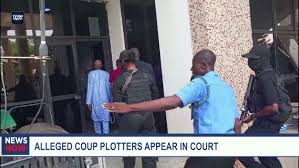
AT the resumed trial of six suspects in the alleged plot to overthrow the government of President Bola Tinubu, on Wednesday, April 29, at the Federal High Court in Abuja, one of the four prosecution witnesses called, a military officer, recounted how the plot was uncovered and what investigators found out.
Earlier, the prosecution called two Compliance Officers from Jaiz Bank, SunTrust Bank and a Legal Officer from Providus Bank.
The prosecution tendered, through the first witness, Munahura Anas, a Compliance Officer with Jaiz Bank, documents, including statement of account in relation to an account owned by the sixth defendant, Abdulkadir Sani.
It also tendered, through the second witness, Taiwo Adeola Wellington, a Compliance Officer with SunTrust Bank, documents relating to an accountant maintained by Purple Wave Limited.
The prosecution also tendered, through the third witness, Gideon Elijah, a Legal Officer from Providus Bank, documents, including account statement relating to an account owned by a firm, A & A Express Link.
The first three witnesses from the banks were thereafter cross-examined by the defence lawyers.
According to Vanguard, the prosecution’s application to shield the identities of some of the proposed witnesses, including the witnesses from the Nigerian Army to insulate them from “unnecessary attack,” anchored on Section 232 of the Administration of Criminal Justice Act (ACJA), 2015, was not opposed by the defendants.
The defence lawyers, however, argued that they should be allowed to know the witnesses to ensure a fair hearing, contending that shielding them from the public might be justified, but full anonymity from the defence would be prejudicial and would prevent proper testing of credibility.
They also argued that, though Section 232 of the ACJA allows protective measures in such cases, it does not remove the need for basic identification within proceedings; hence they urged the court to strike a balance between security concerns and fair trial rights and recommended that sensitive parts of the proceedings could be restricted from public access if necessary.
In her ruling, Justice Joyce Abdulmalik held that the prosecution’s request was justified in view of the sensitive nature of the case, which touches on terrorism, noting that the law permits protective measures, including non-disclosure of names, addresses and contact details, where the court is satisfied that security concerns exist.
She consequently granted the request to mask the identities of the witnesses, adding that their names must not appear in court records or proceedings accessible to parties or the public.
The ruling came after the prosection had produced three bank officials, who tendered in evidence documents, including letters obtained from the Economic and Financial Crimes Commission (EFCC).
The identity of the star witness of the day (PW-4), a soldier from the Nigerian Army Corps of Military Police (NACMP), was shielded and identified as “AAA.”
According to the Nation report, the witness told the court he was part of the team that investigated the case after the then Chief of Army Staff (COAS), Gen. O. O. Oluyede, received an intelligence report that Col. M. A. Ma’aji and some others were plotting to overthrow the government.
Led in evidence by the Director of Public Prosecution of the Federation (DPPF), Rotimi Oyedepo (SAN), he confirmed knowing the six defendants in the charge, marked FHC/ABJ/CR/206/2026, Maj-Gen. Mohammed Ibrahim Gana (rtd); Naval Captain Erasmus Ochegobia Victor (rtd); Police Inspector Ahmed Ibrahim; Zekeri Umoru; Bukar Kashim Goni; and Abdulkadir Sani.
A former governor of Bayelsa State and minister of State for Petroleum Resources under the late President Muhammadu Buhari administration, Timipre Sylva, was also mentioned in the charge filed by the Office of the Attorney General of the Federation (AGF) and Minister of Justice, but said to be at large, having fled the country before the alleged plot was exposed.
The witness said he knew the defendants, who he said were arrested in connection with the coup plot involving Ma’aji, some other serving military officers and civilians, adding that upon receiving the intelligence report by the then COAS, it was analysed, processed and found credible, before he (the COAS) gave a directive to his team to investigate the allegations in the report.
PW-4 said his team proceeded to arrest Ma’aji, recovered his Samsung Galaxy phone, conducted search in his residence and recovered a jotter, among other items, which, among others, contained operational plans, names and designations of ranking members of the current regime and officers to be assassinated in the course of the coup.
According to him: “Inside the jotter, we also found information about political and structural changes that were to be made upon the execution of the coup,” adding that when the phone recovered from Ma’aji, it was sent for forensic analysis and the result disclosed elaborate plans and links among Ma’aji, some of the officers involved in the plot and the defendants.
“We also found financial trails between Ma’aji, Sylva and some of the defendants here before the court.
“Also, inside the phone, we found code words known among the plotters, including some of the defendants before this court.
“We also observed financial trails between some of the defendants and Ma’aji. Monies were paid to some of the defendants in pursuit of the coup plot.”
The witness added that in the course of investigation, his team came across a company called Purple Wave, which he claimed “is one of the companies used as a conduit to sponsor the coup plot,” as well as the financial records of Purple Wave, which he later analysed when handed a copy of the company’s account statement earlier tendered in evidence by the prosecution, as provided by the Economic and Financial Crime Commission (EFCC), which investigated the financial transactions.
Oyedepo later took the witness through the account statement of Purple Wave, in which he identified how funds were allegedly disbursed for the purpose of the alleged coup.
The witness said two entries of September 19, 2025, showed a debit transaction of N100million and another N50million; on September 22, 2025, there were two debit transactions of N100million and N50million; on September 24, 2025, N100million and N50million; on September 26, 2025, N80million; on September 29, 2025, N70million; on September 30, 2025, N90million; and on October 2, 2025, N90million.
He explained that although the transactions carried narrations of what the funds were meant for, investigation revealed that the monies were used for the plot.
While the first debit entry of N100million was described as part payment for clearing of debris along the coastal corridor to Purple Wave, he said investigators found that it was not used for that purpose, but dispensed in pursuit of the plot.
His team, he stated, found out that several meetings were held in pursuit of the plot to in places, such as Green Land Apartment and BrookVille Hotel, both in Abuja, where anti-government rhetoric was exchanged, and “they discussed negative things about the government and concluded that there was the need for a regime change.”
The witness said the alleged plotters drew a plan for execution of the coup and identified key officers in the government and also identified the officers who will assassinate them.
He said the alleged the plotters also identified key targets to be attacked, including the Niger Barracks in Abuja, where senior military officers live, and planned to take over some key roads and streets in the course of the coup.
He added: “The plotters also shared appointments among themselves, including agencies to be set up and those to be merged after the coup.
“The plotters also did extensive consultation and divination, in which some of the defendants took part, knowing that a coup was ongoing. They received money for these purposes.
“They also bought vehicles, which were recovered from shops where they were being retrofitted for kinetic purposes.”
He said in the course of investigation, the team sighted the hotels and the rooms and spaces where the meetings were held and also recovered receipts used for payment for hotel reservations.
At that point, Oyedepo applied to tender a letter from BrookVille Hotel and attached documents, which include the payment receipts.
Defence lawyers objected to the admissibility of the documents, but said they would provide reasons at the final address stage, following which Justice Abdulmalik admitted the documents in evidence.
In addition, Oyedepo tendered extracts from the phone recovered from Ma’aji, which the court also admitted in evidence.
Contnuing, the witness said the defendants volunteered written statements before the special investigative panel that was set up and their statement taking sessions were also audio visually recorded, just as their voluntarily written statements before the Military Police were also captured on video.
He explained that Sani (the sixth defendant), who was the last to be arrested, did not make his statement before the special investigative panel, but did so before the Military Police.
Oyedepo then applied to tender a flash drive containing the audio visual recordings of the statement taking sessions, a move opposed by defence lawyers.
One of the defence lawyers, Paul Erokoro (SAN), objected on the grounds that the device was not front-loaded, a claim Oyedepo conceded, prompting the Judge to insist that the prosecution must serve the defence with the audio visual recordings before they could be played in court.
Further hearing was adjourned until May 4 and 5 at 11 am, during which the witness will resume his testimony.
The defendants are charged with treason, terrorism, failure to disclose security intelligence and money laundering in furtherance of terrorist acts.
Published:

Related articles

Recent articles
