
Vows To Review Buhari’s Naira Swap Policy
Old, New Notes To Remain
Ends Fuel Subsidy
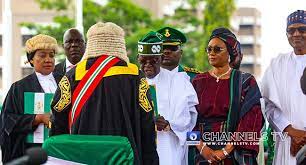
ASIWAJU Bola Ahmed Tinubu was on Monday, may 29 sworn in as President of the Federal Republic of Nigeria.
At a ceremony held at the Eagle Square in Abuja, the country’s capital city, the former Lagos State governor said his administration would review the recent currency swap policy of the Central Bank of Nigeria (CBN), assuring that the old and new notes will remain in circulation.
He stated that the implementation of the currency swap by the apex bank was too harsh, considering the number of unbanked Nigerians.
In a dramatic move, Tinubu announced that his regime has ended subsidy payment on fuel, especially as the 2023 budget made no provision for fuel subsidy, and more so as subsidy payment is no longer justifiable.
“The fuel subsidy is gone,” Tinubu declared in his inaugural speech after being sworn in as Nigeria’s 16th President by the Chief Justice of Nigeria (CJN), Justice Olukayode Ariwoola, in a colourful ceremony attended by local and foreign dignitaries in Abuja, noting that the money expended on subsidy would rather be used on other areas that would have a bearing on the lives of Nigerians.
Tinubu promised to run an inclusive government and ensure proper representation of women and young people, saying: “In our administration, women and youth will feature prominently.
“Our administration shall govern on your behalf, but never rule over you. We shall consult and dialogue, but never dictate. We shall reach out to all, but never put down a single person for holding views contrary to our own.”
He also mentioned the need for a “thorough housecleaning” of the country’s monetary policy, noting that the CBN must work towards a unified exchange rate, vowing to work towards unifying the exchange rate in order to direct funds into meaningful investments, as a unified exchange rate would be in creating equipment and jobs that would power the economy.
He also said interest rates would be reduced to increase investment in such a way that would sustain the economy at a higher level.


