
BY GODWIN IJEDIOGOR
PRESIDENT Bola Tinubu has assured the Organised Labour that an Executive Bill on the new national minimum wage would soon be sent to the National Assembly for passage.
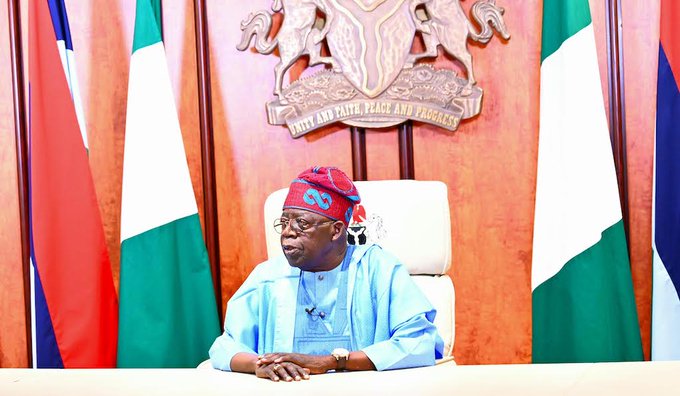
Tinubu, who disclosed this in his Democracy Day speech on Wednesday, June 12, said: “In this spirit, we have negotiated in good faith and with open arms with Organised Labour on a new national minimum wage.
“We shall soon send an Executive Bill to the National Assembly to enshrine what has been agreed upon as part of our law for the next five years or less.”
He noted that as a mark of the country’s democracy and respect for fundamental human rights, his government did not crackdown on Organised Labour over the strikes it had embarked upon since the inception of his administration.
Recall that the Repatriate Committee on National Minimum Wage submitted its report to the Secretary to the Government of the Federation (SGF), Senator George Akume, on Monday, June 10, for onward transmission to the President.
It was gathered that while the Federal Government and Organised Private Sector (OPS) proposed N62,000 minimum wage, Labour proposed N250,000 and state governors, N57,000.
There is no agreement yet on the figure and it was not clear which proposal the President would send to the National Assembly for enactment.
The Labour has insisted that its next line of action would be determined by whatever figure the Federal Government announces as the new minimum wage.
Recall that the Labour, made up of the Nigeria Labour Congress (NLC) and Trade Union Congress (TUC), “relaxed” its indefinite strike on Tuesday, June 4, just two days after it commenced, to allow all parties involved reach an agreement.
The last minimum wage legislation expired on May 31, after five years it was signed into law by former President Muhammadu Buhari.
Many Nigerians wonder how soon the President’s “soon” would be and whether his proposal would be acceptable to Labour and ultimately lead to an agreement that would see the end of strikes over the vexed issue.
In the speech, Tinubu also paid glowing tribute to the country’s past leaders and those who fought for a return to democracy, some of who were intimidated, arrested, maimed, killed or suffered one way or another from the government of the day.
He made particular mention of the late Chief MKO Abiola, the candidate of the defunct Social democratic Party (SDP) and presumed winner of the June 12, 1992 presidential election, which was annulled by then military dictator, Gen. Ibrahim Babangida, which was being commemorated.


