
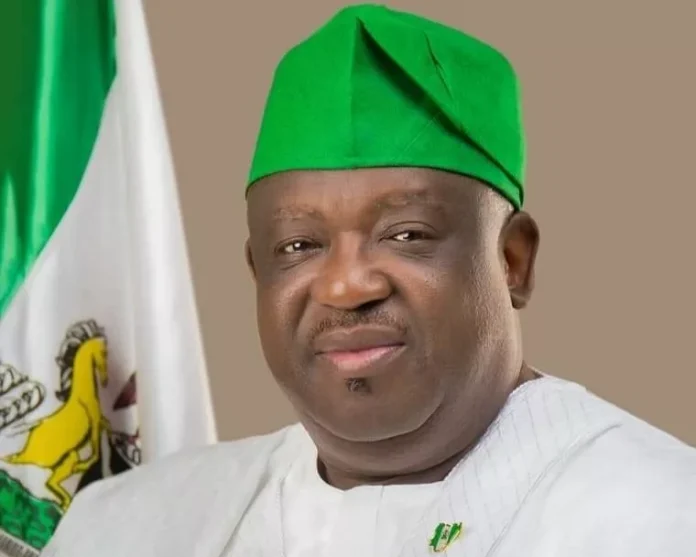
THE Supreme Court, on Tuesday, January 9, reserved judgment on a suit filed by Governor Caleb Mutfwang of Plateau State seeking to validate his mandate.
According to NAN, a five-member panel of Justices, led by Justice John Okoro, reserved judgment after taking arguments from lawyers to both parties in the case and is expected to deliver its verdict before January 16, when the appeal would expire, as stipulated by the Electoral Act 2022 (as amended).
Mutfwang of the Peoples Democratic Party (PDP) scored 525,299 votes to beat his closest rival, the All Progressives Congress (APC) candidate, Mr. Nentawe Yilwatda, who polled 481,370 votes during the March 18, last year governorship election in the state.
While Mutfwang’s election was upheld by the Plateau State Governorship Election Petitions Tribunal in Jos, the state capital, it was, however, overturned by the Court of Appeal in Abuja.
But Mutfwang challenged the verdict, urging the apex court to nullify the judgment of the three-man panel of the Court of Appeal, led by Justice Elfrieda Williams-Dawodu, which on November 19, last year nullified his election and ordered the Independent National Electoral Commission (INEC) to issue a Certificate of Return to Yilwatda.
The appellate court held that the appeal brought by Yilwatda was valid, as the qualification issue was both a pre and post-election matter under Section 177(c) of the Nigerian Constitution and Sections 80 and 82 of the Electoral Act, 2022.
But the governor challenged the ruling on eight grounds, arguing that the issue of nomination and sponsorship, which underpinned Ground One of the petition by the APC, is not only a pre-election matter, but within the internal affairs of the Fourth
Respondent (PDP), and as such the First and Second Respondents lacked the locus standi to canvass it.
He also argued that the judgment of the lower court is fatally flawed for want of jurisdiction regarding Section 285(2) of the Constitution (supra), insisting that disobedience of court order is not one of the grounds for maintaining an election petition under Section 134 of the Electoral Act (supra), nor is it part of Section 177(c) of the Constitution (supra), let alone disqualifying the appellant from contesting the election.
The governor further maintained that given the overwhelming oral and documentary evidence, including, but not limited to EXHIBITS U and 2RA3, the Fourth Respondent complied with EXHIBIT G1 by conducting a state congress on September 25, 2021 in the state.
He also contended that the evidence of the 16th prosecution witness was thoroughly discredited and controverted, and as such, the lower court was wrong to heavily rely on it against him.
He stated: “The First and Second Respondents woefully failed to discharge the requisite burden of proof on them and, as such, not entitled to the reliefs sought in their petition, more so that having impugned the election as invalid for non-compliance, it is absurd of them to lay claim to victory for the same election.
“The lower court was in grave error when it held that the tribunal was wrong in striking out the offensive paragraphs of appellant’s reply and utilising evidence of PW16, PW24, PW27 and PW28 as a tribunal of first instance.”


