
*Airports Grounded, Passengers Stranded
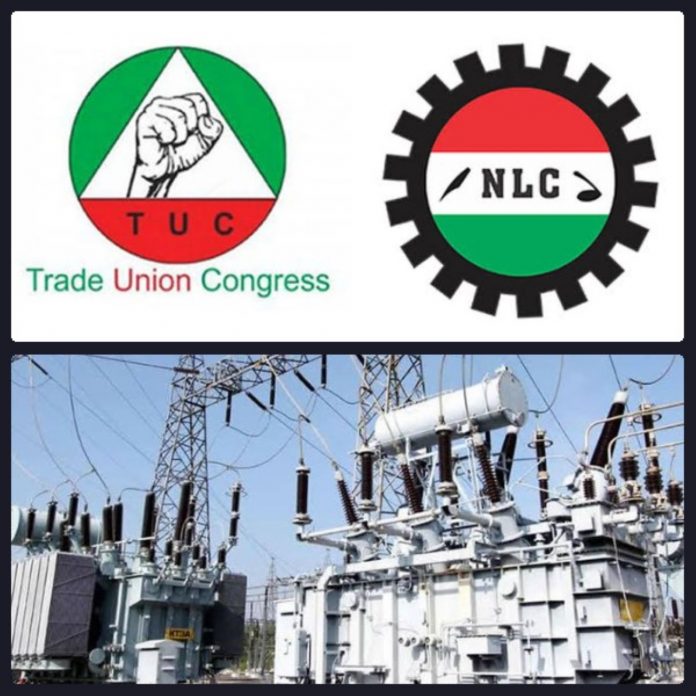
NIGERIAN has been thrown into darkness as the national grid was shut down at 2:19am on Monday, June 3, in compliance with the directive of the organised Labour to Nigerian workers to embark on indefinite strike in protest against the Federal Government’s N60,000 minimum wage proposal.
The grid system dropped to zero megawatts on Monday as a result of the complete disruption of power supply to all 11 electricity distribution companies in the country following the shutdown of the grid.
A statement from the General Manager, Public Affairs, Transmission Company of Nigeria (TCN), Ndidi Mbah, said the nationwide blackout was due to staff of the TCN, under the aegis of the National Union of Electricity Workers (NUEE), completely shutting down all power substations across the country at 2:19 AM on Monday, causing the national grid system to drop to zero megawatts.
The statement, titled, ‘Grid shutdown: Union deliberately shuts down the national grid,’ said: “The Transmission Company of Nigeria (TCN) hereby informs the general public that the labour union has shut down the national grid, resulting in a blackout nationwide. The national grid shut down occurred about 2.19am this morning, June 3, 2024.
“At about 1:15am this morning, the Benin Transmission Operator, under the Independent System Operations unit of TCN, reported that all operators were driven away from the control room and that staff that resisted were beaten, while some were wounded in the course of forcing them out of the control room. And without any form of control or supervision, the Benin Area Control Centre was brought to zero.
“Other transmission substations that were shut down by the labour union include the Ganmo, Benin, Ayede, Olorunsogo, Akangba and Osogbo transmission substations. Some transmission lines were equally opened due to the ongoing activities of the labour union.”
On the power generating side, TCN said the power generating units from different generating stations were forced to shut down some units of their generating plants, adding: “The Jebba Generating Station was forced to shut down one of its generating units, while three others in the same substation subsequently shut down on very high frequency.
“The sudden forced load cuts led to high frequency and system instability, which eventually shut down the national grid at 2:19am.
“About 3.23am, however, TCN commenced grid recovery, using the Shiroro Substation to attempt to feed the transmission lines supplying bulk electricity to the Katampe Transmission Substation. The situation is such that the labour union is still obstructing grid recovery nationwide.
“We will continue to make effort to recover and stabilise the grid to enable the restoration of normal bulk transmission of electricity to distribution load centres nation.
Entry points to the domestic terminal at Lagos Airport were inaccessible early in the morning, leaving passengers stranded due to the strike, with the suspension of all flight operations.
Meanwhile, details have emerged on why the last-minute intervention of the National Assembly failed to avert the strike.
Recall that the leadership of the National Assembly (NASS) and organised Labour,comprising the Nigeria Labour Congress (NLC) and Trade Union Congress (TUC), held a crucial meeting on Sunday, June 2, to stave off the strike.
Senate President, Godswill Akpabio; Speaker of the House of Representatives, Tajudeen Abass, and other principal officers of both chambers were at the meeting, while the executive arm of government, led by the Secretary to Government of the Federation (SGF), George Akume; including Ministers of Labour and Employment, Nkeiruka Onyejeocha; Finance, Wale Edun; Information and National Orientation, Mohammed Idris; Budget and National Planning, Atiku Bagudu; Science and Technology, Uche Nnaji; Agriculture and Food Security , Aliyu Abdullahi, and Head of Service of the Federation, Folasade Yemi-Esan.
The Labour was represented by NLC President, Joe Ajaero, his TUC counterpart, Festus Osifo, and other Labour leaders.
The meeting agreed on the need for ongoing negotiation to continue to allow for continuous engagement on the issue of wages, while the Labour gave the leadership of the National Assembly eight weeks to engage with stakeholders from the executive arm of government.
The Labour leaders, however, declined to call off the nationwide strike, requesting more time to consult their respective National Executive Councils (NEC) and organs, in adherence to the unions’ constitutions.
Akpabio, in his remarks, cautioned: “While addressing the legitimate concerns of Organised Labour is imperative, we must be mindful that an unsustainable wage increase could trigger inflationary pressures and potentially lead to layoffs.
“It is crucial that our approach balances the need for fair wages with the overall economic stability of the nation.”
Abbas added: “I am sure some would recall what I said during the independence anniversary lecture, that one thing that this government and this country can do to eliminate corruption in the long-run is to embrace a ‘living wage.’
“There are no two ways about it. But we should also be mindful that the issues of numerous decades cannot be repaired within one day. It will be a gradual process.”
At the end, the Federal Government committed to the immediate implementation of all previous agreements with Labour, as authorised by the President Bola Tinubu, including the recent Wage Award he announced and the bonus implemented by government, as negotiated by the previous administration (amounting to N72,000).
Government further committed to expediting the ongoing nationwide roll-out of conversion to CNG-powered vehicles and address all challenges relating to the supply chain to bring immediate succor on transportation to Nigerian workers.
The leadership of the National Assembly was asked to engage and brief the President on the position of Labour and the need to consider a marginal increase in the interim, to accommodate the position of Labour.
Organised Labour were charged to deepen advocacy with state governments and organised private sector to ensure viability and sustainability of the anticipated minimum wage increase.
At the end of the meeting, Akpabio appealled to Labour to suspend the strike for negotiations to continue in the interest of Nigerians and the country.
Idris echoed government’s intention to continue payment of the wage award started in October 2023 until negotiations are concluded, hoping that Labour would suspend the strike, following the lengthy conversation, insisting that Nigeria cannot not afford strike at this moment in view of the economic challenges facing the country.
However, Osifo said both parties were aware of what the issues were, noting that the leadership of the unions do not have the power to call off the strike, as there were processes to be followed in suspension of an industrial action.
“We have listened to them, we will take the request of the National Assembly leadership to our organs, because we don’t have power to call off strike; the power to call off strikes lies with our organs, who would sit to decide,” he stated.
Shortly after the failed dialogue, the Labour movement said there was no going back on the strike, barely three hours to its commencement.
According to Osifo: “We would have been much more happier if this evening, we had a great understanding that by tomorrow morning. We will sign off issues bordering on the minimum wage, because as at the last meeting, we were very close, in the sense that if the figures were agreed upon, it is just something to prepare report and sign, it is not something that is lengthy anymore.”


