
*Calls For International Investigation Into CAF’s ‘Corruption’
*FA To Appeal Decision before Court Of Arbitration For Sport
*Nigerian Judge In The Eye Of Storm
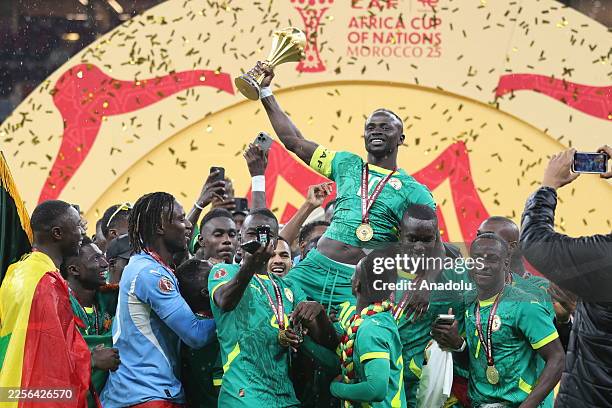
THE Senegalese Government has accused the Confederation of African Football (CAF) of corruption, following the ruling that stripped the country of last year’s Africa Cup of Nations (AFCON) victory.
Recall that on Tuesday, March 17, CAF Appeals Board ruled that the Senegal national team had forfeited the AFCON final after several players walked off the pitch to their dressing room in protest of a referee’s decision.
The decision, Senegal alleged, breached Sections of the AFCON regulations and named the second-palce team, Morocco, the champions, in the latter’s .
The verdict was made while addressing appeal challenging an initial decision by CAF’s Disciplinary Committee that dismissed the country’s plea to overturn the match.
In a statement on Wednesday, March 18, the Senegalese government said the Appeals Board’s decision “erases commitment, merit and sporting excellence” and is “grossly illegal and profoundly unjust.”
The Senegalese government called for an “independent international investigation into suspected corruption within the CAF’s governing bodies.
“This unprecedented decision, of exceptional gravity, directly contradicts the cardinal principles that underpin sporting ethics, foremost among which are fairness, loyalty, and respect for the truth of the game.
“It stems from a manifestly erroneous interpretation of the regulations, leading to a grossly illegal and profoundly unjust decision.”
The statement added: “By calling into question a result achieved at the end of a match that was properly played to its conclusion and won in accordance with the rules of the game, the CAF seriously undermines its own credibility, as well as the legitimate trust that the African people place in continental sporting institutions.
“Senegal cannot tolerate an administrative decision that erases commitment, merit and sporting excellence. Senegal unequivocally rejects this attempt at unjustified dispossession.
“It calls for an independent international investigation into suspected corruption within the CAF’s governing bodies.”
The Senegalese FA had earlier said it would appeal the decision before the Court of Arbitration for Sport (CAS) in Lausanne, Switzerland.
Meanwhile, it has been revealed that a Nigerian Judge, Roli Daibo-Harriman, is in the eye of the storm, as her panel overturned Senegal’s AFCON victory
In a landmark ruling, the appeals board overturned the result of a football match played and decided on the pitch two months earlier by furnishing Senegal for staging a walkout during the AFCON final held on January 18.
According to Cable and other online reports, Justice Daibo-Harrima, who presided over the legal controversy surrounding the nine-member CAF Appeals Board, was elected to the role in 2023 at CAF’s Ordinary General Assembly in Abidjan, Côte d’Ivoire, to replaced another Nigerian, Uthman Mustapha.
The 65-year-old Daibo-Harriman, who had adjudicated cases at Delta State High Courts for years, is one of the widows of late Nigerian businessman, Hope Harriman.
She is an Alternative Dispute Resolution (ADR) Judge and assisted in establishing the Delta State Multidoor Courthouse (DSMDC), a justice centre that offers clients and their counsel practical, faster alternatives for resolving disputes.
She was also a former senior lecturer at the Nigerian Law School.
The 2025 AFCON final became dramatic late in the game when the referee awarded Morocco a 94th-minute penalty at the Prince Moulay Abdellah Stadium in Rabat.
El Hadji Malick Diouf of Senegal appeared to have dragged Brahim Diaz to the ground in the Senegalese area, an incident that seemed to have escaped the match officials until the video assistant referee got involved.
After review, the referee pointed to the spot, and mayhem ensued from there, as Senegalese players and officials protested the call, arguing that an earlier goal scored by the team should have stood.
The Senegalese head coach, Pape Thiaw, called his players off the pitch and into the dugout, and the game was on hold for almost 20 minutes.
When the match resumed, Diaz eventually lost the contentious last-minute penalty into the palms of Edouard Mendy.
In extra time, however, Pape Gueye scored a thunderous shot to give Senegal victory on the pitch.
The fallout from the match led the CAF Disciplinary Committee to impose sanctions on officials and players from both teams.
In the initial ruling, the committee dismissed Morocco’s plea that Senegal’s national team players had breached Articles 82 and 84 of AFCON regulations by staging a walkout in the final.
AFCON’s Article 82 says: “If, for any reason whatsoever, a team withdraws from the competition or does not report for a match, or refuses to play or leaves the ground before the regular end of the match without the authorisation of the referee, it shall be considered the loser and shall be eliminated for good from the current competition.
“The same shall apply for the teams previously disqualified by the decision of CAF.”
Article 84 adds: “The team which contravenes the provisions of Articles 82 and 83 shall be eliminated for good from the competition.
“This team will lose the match by 3-0, unless the opponent has scored a more advantageous result at the time when the match was interrupted; in this case, this score will be maintained.
“The Organising Committee may adopt further measures.”
The Moroccan FA challenged the decision and filed a protest with the Daibo-Harriman-led CAF Appeals Board, which on Tuesday “set aside” the disciplinary committee’s initial decision and upheld Morocco’s appeal, holding that Senegal, “through the conduct of its team,” infringed on Article 82 of AFCON regulations and, as a result, Article 84 became applicable.
The Board ruled that Senegal “declared to have forfeited the final match” with the “result of the match being recorded as 3-0 in favour” of Morocco.
Justice Daibo-Harriman is not new to controversy. Indeed, she spearheaded several important rulings in Nigeria, particularly as a Judge in Delta State.
One of such was her decisions was in 2024, when she ordered blogger, Linda Ikeji, to pay N30million in general damages to the Neo Black Movement of Africa (NBM) for a libellous publication.
Ikeji had, in a publication on her blog in 2021, allegedly referred to NBM of Africa as a “dreaded cult group, black axe, and criminal organisation.”
NBM initially slammed a N1billion lawsuit against the blogger, and although Ikeji was neither present in court nor represented, Daibo-Harriman awarded NBM N30million in damages, and an extra N300,000 for the cost of litigation.
In 2024, Daibo-Harriman ordered the Nigerian Army to pay N1million for trespassing and encroachment on land owned by the Ohore 1 community in the Uvwie Kingdom of Delta State.
The land in contention was acquired by the Nigerian Army in 1975 from the then Midwestern State government, with a letter, with reference number, NAE/2801/26/1/G, saying the Army acquired the land for the construction of a barrack.
The complainants told the court that compensation was paid to the families who owned the land as required by the law.
After hearing all the prayers, Justice Daibo-Harriman declared the acquisition of parts of Ohore 1 land by the Army null and void.
In 2020, while at the Delta State High Court sitting in Otor-Udu, Justice Daibo-Harriman ordered the then Inspector General of Police (IGP), Mohammed Abubakar, and a host of other senior officers, to pay the sum of N350,000 to three journalists, Matthew Omonigho, Christopher Odamah and Onyekachukwu Meluwa, who were based in Delta State and unlawfully arrested and detained in Warri by the IGP monitoring unit, for their unlawful arrests and detention.
In her ruling, Daibo-Harriman said: “The actions of the respondents were calculated and did breach the fundamental rights of the applicants, and they are entitled to compensation.”
She subsequently ordered the IGP to tender an apology to the journalists in three national dailies within 14 days.


