
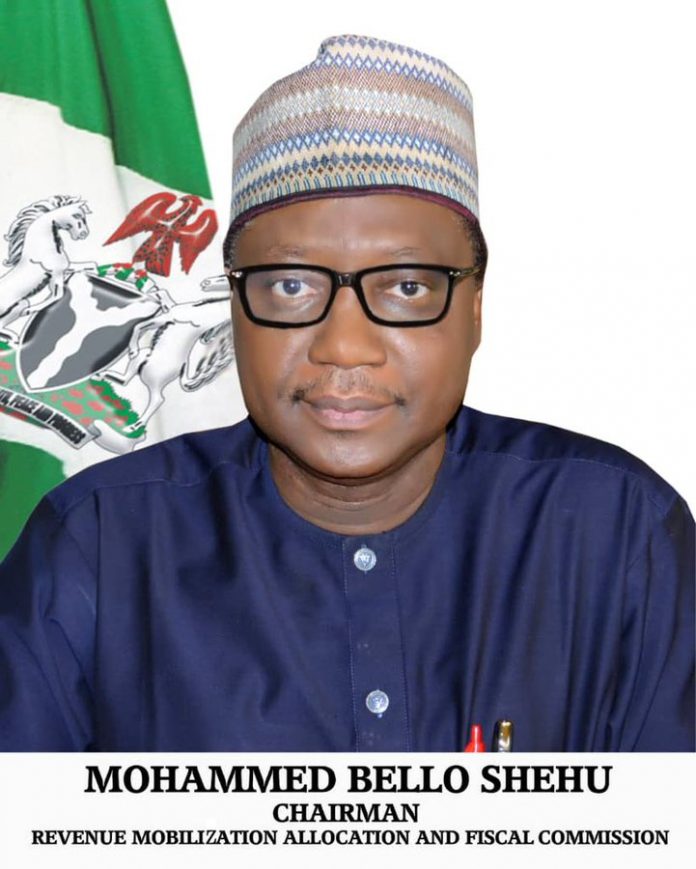
BY GODWIN IJEDIOGOR
THE Revenue Mobilisation Allocation and Fiscal Commission (RMAFC) has thrown its weight behind full autonomy for local governments in the country, just as it backed the Federal Government in its ongoing efforts to free local councils from the choking control of state governments through legal means by giving effect to the provisions of the 1999 Constitution (as amended).
The RMAFC Chairman, Mr. Mohammed Bello Shehu, in a statement, observed that local councils, as the third tier of government domesticated at the grassroots level, ought to be outside the control of state and federal governments, being solely established to ensure effective governance at the grassroots.
The 1999 Constitution recognises federal, states and local as three tiers of government and they are expected to draw funds for their operation and function from the Federation Account created by the constitution.
Shehu decried the stifling dominance of state governments over the affairs of local councils, thereby emasculating their political, administrative and fiscal independence; hence their inability to provide quality service delivery in the area of infrastructure and social services to the grassroots, as provided for in the constitution.
He noted that the political control of local councils has made it virtually difficult and almost impossible for the masses to decide who becomes their leaders at that level of governance, adding that the Commission believed that giving full autonomy to local councils would reduce the rate of poverty and rural urban migration.
This would also bring more dividends of democracy to the rural dwellers and attract more qualified candidates for council elections, thereby improving governance system at all levels in the long run.
He stated: “Full autonomy will engender good governance, transparency and accountability at the local level. Security challenges, like banditry, kidnappings, terrorism, electoral violence, etc, would be reduced to the barest minimum if the quantum of funds meant for local governments is channeled towards rural development.
“This will raise agricultural productivity, increase income generation, arrest rural-urban migration, create wealth and generally improve the socio-economic living conditions of the rural populace.”
The RMAFC chairman stated that the current spate of insecurity in all parts of the country could be arrested if local councils are granted full autonomy as local government administration, being the closest level of government for effective participation of the teeming population of the country in its governance system, would avail the local population greater independence to determine their development needs.
Shehu stressed the importance of granting full autonomy to local councils, allowing them to recruit, manage staff, raise finances, make by-laws and discharge their functions without State government interference, thereby ensuring their full bureaucratic autonomy.
He noted: “Financial autonomy of local government entails the freedom to impose local taxation, generate revenue within its assigned sources, allocate its financial and material resources, determine and authorise its annual budgets without external interference.
“It also relates to the disposition of tax powers, retention of revenue and methods adopted in sharing centrally collected revenue in accordance with the constitutional responsibilities of all levels of government.”
“It is worth noting that the constitution has made it explicitly clear that there must be a democratically-elected local government system in place; the constitution has not made provisions for any other systems of governance at the local government level other than democratically-elected local government system.”


