
*Military Not Aware Of Plan To Establish Base’
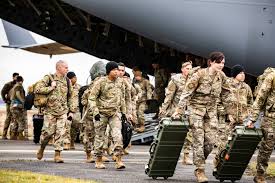
CRITICAL questions bordering on sovereignty remain unanswered concerning the latest deployment of 200 United States (U.S.) troops to Nigeria, as fears grow that America may be on its way to establishing a military base in Nigeria.
The Wall Street Journal broke the news during the week, saying the troops will supplement the small team of American soldiers already in the country to assist Nigeria with air strike targeting.
It said the additional troops are expected to arrive Nigeria in the coming weeks and will provide “training and technical guidance,” including assisting their Nigerian counterparts to coordinate operations that involve air strikes and ground troops simultaneously.
A US Africa Command spokeswoman also confirmed the details of the report to AFP.
Nigeria’s Director of Defence Information (DDI), Maj-Gen. Samaila Uba, confirmed the development to AFP, saying: “We are getting US troops to assist in training and technical support.
“These personnel do not serve in a combat capacity and will not assume a direct operational role.
“Nigerian forces retain full command authority, make all operational decisions and will lead all missions on Nigerian sovereign territory.”
He declined to say when the troops would arrive, but said the deployment formed part of ongoing cooperation under the US-Nigeria Joint Working Group.
However, Bashir Galma, a retired Major General, urged the Federal Government to exercise caution over the deployment, saying the country must tread cautiously.
Noting that the reported number of foreign troops was significant, he added that 200 personnel is gradually approaching what is considered a battalion-sized presence in military terms.
He told Daily Trust: “Initially, we thought it was going to be a minimal number, but from all indications, 200 military personnel amount to about one-fifth of a battalion.
“That is not a small training team, as we have been told. A battalion consists of about 1,000 soldiers. So, one-fifth of a battalion of US soldiers is coming.”
Galma questioned whether such a number could be considered a routine training mission when compared with established military practice, adding: “What I am trying to say is that we were told they are coming for training.
“Two hundred may not appear too large for training purposes, depending on the scope, but it should not be that 200 soldiers will come and form a camp or base. What we expect are training teams, as we have had with other countries.”
He stated that Nigerians should be fully informed about the arrangement, particularly regarding the number of troops involved, noting: “These are issues the population of this country should have been told, especially concerning the numbers.
“It should not be that when a certain percentage has already arrived, we are then informed. We may hear again that another 300 are coming, and before we realise it, a battalion has been deployed.”
He stated that it would be difficult for 200 foreign troops to operate in Nigeria without establishing a base, either within the country or in a neighbouring state; hence the need for government to be transparent and carry citizens along, as such a deployment could not occur without the knowledge and approval of the President, who is the Commander-in-Chief of the Armed Forces.
“This is what worries people. What is the objective? That is the question many are asking. If there are plans to grant them a base, or if they already have one in a neighbouring country, the government should say so instead of presenting it as a temporary training arrangement.
“Honestly, if that number comes in, I doubt it will be for a short stay. Everything happening is with the approval of the Nigerian government.
“If the government believes 200 is too large and that the population is uneasy about it, it has the authority to say so.
“But we have seen that the Commander of US AFRICOM recently visited the Commander-in-Chief of Nigeria’s Armed Forces. Perhaps everything has already been ratified.
“That is the nature of the presidential system of government. The commander-in-chief has the constitutional authority to make such decisions, and subsequent discussions may only amount to debate.”
Galma added: “It would have been better if the country had been carried along and properly informed, for instance, by stating that due to prevailing security concerns, the US is seeking a base, possibly around the Gulf of Guinea, which Nigeria had previously rejected.”
He argued that historical experience shows that the presence of American troops in developing countries often brings far-reaching consequences, citing South Korea, which benefited from hosting US troops.
But he stressed that concerns persist due to outcomes in other parts of the world, noting: “It is the negative experiences elsewhere that are making people jittery.
“In some cases, when they come, they exert their global influence and sometimes disregard local laws and traditions. History has shown that.”
He argued that while the deployment might turn out to be peaceful, Nigerians remain cautious about possible long-term implications, adding: “For whatever reason they are coming, perhaps they may have a peaceful stay, provided they do not interfere in how we live, our culture, religious matters and other aspects of our society.
“We do not want anyone to impose their ideology on us. We want to move at our own pace. With foreign ideas, we do not know how it may eventually end.”
A political and international affairs analyst, Abba Sadiq, a professor in the Department of Political Science, University of Abuja, harped on the need to carefully examine the implications of any US military deployment for Nigeria’s sovereignty and foreign policy.
According to him: “If this is at Nigeria’s request, it must be clearly defined within the framework of the Nigerian government’s objectives. Before seeking assistance, there should have been an internal analysis and assessment.”
Sadiq told Daily Trust that any such arrangement must be situated within the context of formal bilateral agreements, saying: “Military cooperation, whether in training, strategy or counter-insurgency, depends entirely on the formal agreements between Nigeria and the United States. That is standard practice globally.”
But he questioned the potential benefits for Nigeria. “Do we stand to benefit from this? In what specific ways? What is the level of expertise the American military brings to address Nigeria’s unique security challenges?
“At a time when some neighbouring countries are asking foreign troops to leave, Nigeria appears to be considering accepting them. What does that signal? Will Nigeria be able to enforce its internal rules and sovereignty? Are there clearly defined no-go areas?
“These are critical questions. If properly structured, it could serve as a workable model, but clarity is essential.”
On his part, a former ambassador to several West African countries and the United Nations mission, Mohammed Ibrahim, dismissed concerns that Nigeria’s alliance with the US could negatively impact its ties with BRICS.
While stressing that many Middle East countries maintain strong military partnerships with the US, noted: “Nigeria’s decision to accept or embrace foreign troops is a sovereign one, even as many neighbouring countries in the sub-Saharan region are expelling foreign forces.”
While the 200-troop deployment represents a scaling up of that collaboration, “US troops aren’t going to be involved in direct combat or operations,” Uba assured, saying Nigeria requested the additional assistance.
The troops will train Nigeria’s armed forces in their fight against jihadist groups, Nigerian and US officials said on Tuesday, as Washington increases military cooperation with the country.
The disclosure, last week, by head of the US Africa Command (AFRICOM), Dagvin Anderson, that his country had dispatched a “small team” of troops to Nigeria, following recent security cooperation between both countries, ellicited concern in Nigeria, being the first official acknowledgement of US boots on the ground in Nigeria since the Christmas Day strike.
Daily Trust reported the Director of Defence Media Operations, Maj-Gen. Michael Onoja, as saying the military high command was not aware of any plan to establish a base for foreign troops in Nigeria.


