

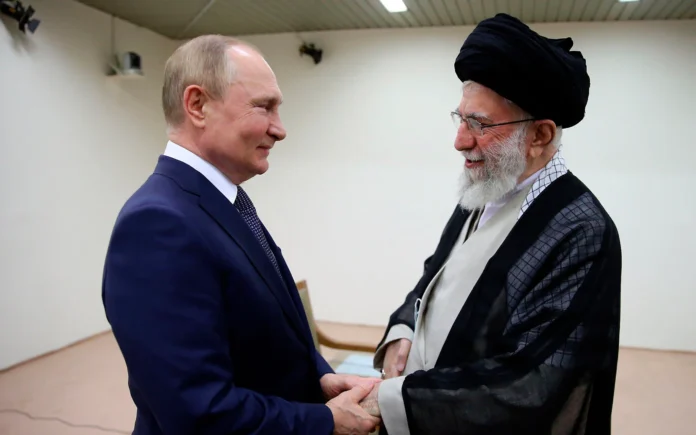
RUSSIAN President, Vladimir Putin, on Thursday, June 19, refused to discuss the possibility that Israel and the United States (US) would kill Iranian Supreme Leader, Ayatollah Ali Khamenei, saying the Iranian people were consolidating around the leadership in Tehran.
Israeli Prime Minister, Benjamin Netanyahu, has openly speculated that Israel’s military attacks could result in regime change in Iran, while US President, Donald Trump, said on Tuesday that the US knew where Khamenei was “hiding,” but that Washington was not going to kill him “for now.”
Asked what his reaction would be if Israel did kill Khamenei with the assistance of the US, Putin said: “I do not even want to discuss this possibility. I do not want to.”
When pressed, Putin said he had heard the remarks about possibly killing Khamenei, but that he did not want to discuss it. “We see that today in Iran, with all the complexity of the internal political processes taking place there… that there is a consolidation of society around the country’s political leadership,” Putin told senior news agency editors in the northern Russian city of St Petersburg.
“If I may, I hope that this will be the most correct answer to your question. I do not even want to discuss this possibility. I do not want to. I hear all this, but I don’t even want to discuss it.”
On possible regime change, he went further: “You always need to look at whether the goal is achieved or not when starting something. We see that today in Iran, with all the complexity of the internal political processes taking place there, we are aware of this, and I think there is no point in going deeper, but nevertheless there is a consolidation of society around the country’s political leadership.
“This happens almost always and everywhere, and Iran is no exception. This is the first thing.
“The second thing that is very important is that everyone is talking about it, I will only repeat what we know and hear from all sides, these underground factories, they exist, nothing has happened to them.
“And in this regard, it seems to me that it would be right for everyone to look for ways to end hostilities and find ways for all parties to this conflict to come to an agreement with each other in order to ensure both Iran’s interests, on the one hand, for its nuclear activities, including peaceful nuclear activities, of course (I mean peaceful nuclear energy and the peaceful atom in other areas), as well as to ensure the interests of Israel from the point of view of the unconditional security of the Jewish state.
“This is a delicate issue, and, of course, you need to be very careful here, but in my opinion, in general, such a solution can be found.”
On supporting Iran, the Russian leader stated: “We are in contact with our Iranian partners on an ongoing basis. Today in contact. I think tomorrow and the day after tomorrow. We continue our relationship.
“And secondly, as I have already said, our specialists are working in Bushehr, 250 people and other business travellers. The total number can reach 600. And we’re not leaving. Isn’t that support? Iran has not asked us for any other support.”
Regarding helping Iran with weapons, he noted: “We once offered our Iranian friends to work in the field of air defence systems, but our partners didn’t show much interest then, and that’s it.
“As for the agreement you mentioned about the strategic partnership, there are no articles related to the defence sphere…
“And thirdly, our Iranian friends don’t even ask us to do this. So, there’s practically nothing to discuss.
“Our proposal was to create a system, not separate supplies, but a system. We eventually discussed this once, but the Iranian side didn’t show much interest in it, and it all died down.
“As for individual deliveries, yes, of course, we carried out these deliveries at one time. This has nothing to do with today’s crisis. It was what is called regular cooperation in the military-technical sphere, and within the framework of international norms.”
With regards to relation with Trump and a possible meeting with him, Putin said it would certainly be extremely useful.
“I agree with the President of the United States, it must, of course, be prepared and end with some positive results…
“We have great respect for his intention to restore relations with Russia in many areas of security and economic activity.
“There are already contacts between our large companies that want to return. This, by and large, inspires such a certain restrained optimism, and I hope that both the President of the United States and his inner circle will see and hear this. And together with business representatives, decisions will be made aimed at restoring Russian-American relations.”
He stated regarding the North Atlantic Treaty Organisation (NATO): “We do not consider any NATO rearmament to be a threat to the Russian Federation, because we are self-sufficient, in terms of ensuring our security. And we are constantly improving our armed forces and our defensive capabilities.
“Whatever NATO does, of course, it creates certain threats, but we will stop all these threats that will arise. There is no doubt about it. In this sense, any rearmament and budget increase to five per cent of the GDP of NATO countries makes no sense.
“Secondly, over the centuries, unfortunately, in the West, from time to time, for decades, the question of the threat from Russia has always arisen.
“It was so convenient for the Western elites to build their internal policy, because on the basis of an imaginary threat from the east, they could extort money from taxpayers and all the time explain their own mistakes in the field of economics by the threat from the east.
“If the NATO countries want to further increase their budget, well, that’s their business, but it won’t do anyone any good. Of course, they will create additional risks.
“Well, yes, they will, but it’s not our decision. I think this is completely irrational and pointless. And, of course, there are no threats from Russia; it’s just nonsense.”
On relationship with the West, he stated: “It is clear that the current crisis in relations between Russia and Western Europe began in 2014. But the problem is not that Russia annexed Crimea, but that Western countries contributed to the coup in Ukraine.
“We’ve heard all the time before: you have to live by the rules. By what rules? Well, what kind of rule is this when three states, France, Germany, and Poland, came to Kyiv and, as guarantors, signed a paper of agreements between the opposition and the authorities led by President (Viktor) Yanukovich.
“A few days later, the opposition launched a coup. And no one even sneezed, as if nothing had happened.
“And then we hear: we have to live by the rules. What are the rules? What are you thinking of? Do you write rules for others, but you’re not going to follow anything yourself? Well, who’s going to live like this? That’s where the crisis started. But not because Russia acted from a position of strength.
“Our Western partners have always acted, at least from a position of strength, after the collapse of the Soviet Union. Because the world order after World War Two was based on a balance of power between the victors. And now one of the winners is gone, the Soviet Union has collapsed.
“Well, the Westerners began to rewrite these rules for themselves. What are the rules?”
On whether he had made mistakes in his time in power, Putin said: “Let him who is without sin cast the first the stone. Let’s leave it at that.”
Published:

Related articles

Recent articles
