
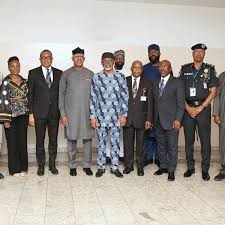
*NGF Backs Implementation, Says Time Has Come For Nigeria To Align With Global Practice
THE Federal Government, on Monday, August 3, commenced the process of developing the legal and operational framework for the implementation of State Police by announcing a seven-week programme to produce a comprehensive National Policing Bill that will guide the transition to a federal and state policing system.
Chairman of the Presidential Working Group on the National Policing Bill, and Chief of Staff to the President, Femi Gbajabiamila, disclosed this while briefing journalists after the inaugural meeting of the group at the Presidential Villa, Abuja.
He stated that although the senate approved the constitutional proposal on June 24, while the House of Representatives passed the Executive State Police Bill on July 23, no State Police service currently exists in Nigeria, and the Nigerian Police Force (NPF) remains the country’s only constitutionally recognised policing institution until the constitutional process is completed.
He, however, noted that the amendment would only become effective after securing the constitutionally required approval of state Houses of Assembly and the enactment of implementing legislation, noting: “The constitutional amendment creates the authority and broad architecture for federal and state policing, but it does not by itself provide the complete operating framework.”
Gbajabiamila stated that the amendment does not address critical issues, such as recruitment, training, funding, command structure, jurisdiction, complaints mechanisms, data management, firearms regulation, pensions, transition arrangements and inter-agency cooperation, which would be comprehensively addressed through the proposed National Policing Bill and accompanying legislative instruments.
He explained that President Bola Tinubu established the group to ensure Nigeria is fully prepared to implement state policing responsibly once the constitutional process is concluded.
The chief of staff said the group is to produce a technically robust, implementation-ready National Policing Bill and supporting legislative package, adding: “We are building the legal and operational framework required to move from one federal police institution to a workable dual policing architecture,”
including a comprehensive audit of the Police Act 2020, Police Service Commission laws, Police regulations and other legislation affected by the reform.
The draft legislation, he added, would establish national minimum policing standards, objective criteria for assessing state readiness, federal-state cooperation mechanisms, jurisdictional rules, independent complaints institutions, human rights safeguards, rank equivalence, pension portability, interoperable criminal data systems, firearms control, funding arrangements, federal intervention procedures and the transition of existing security outfits.
He said the group is made up of representatives of the Presidency, Federal Ministry of Justice, Office of the National Security Adviser (ONSA), NPF, Nigeria Governors’ Forum (NGF) and Nigerian Bar Association (NBA).
He disclosed that the President had also approved a multidisciplinary Policy Advisory Committee, chaired by retired Justice Mohammed Abdullahi Liman, to provide independent technical oversight, with representatives of the judiciary, academia, security agencies, public policy experts, technology specialists, National Assembly, NGF, NBA and state attorneys general, drawn from the six geopolitical zones.
“The committee will review policy proposals, test assumptions, identify gaps and validate the legislative package before it proceeds for executive consideration,” he explained.
He announced that the approved work programme would run from July 27 to September 14, this year, with legal drafting, policy research, implementation modelling and stakeholder engagement taking place simultaneously.
The final package would include not only the proposed Bill, but also explanatory memoranda, legal audits, consequential amendments, implementation plans, fiscal notes, state readiness frameworks, risk assessments and a comprehensive digital archive.
Gbajabiamila stressed that the Federal Government was guided by the principle that stronger local policing must be balanced with effective national safeguards, saying: “State Police cannot become 36 state militias, just as national standards cannot become a disguised method of centralising day-to-day state policing.
“No political office holder should be able to direct the arrest of political opponents, suppress lawful political activities or selectively enforce the law.
“Federal intervention must remain exceptional, evidence-based, proportionate, time-bound and subject to review.”
He added that no state would be allowed to commence policing operations unless it demonstrates sufficient capacity in recruitment, vetting, training, remuneration, pensions, equipment, complaints handling, discipline, firearms management, data systems, independent oversight and financial sustainability, stressing that while states could exceed national benchmarks, they would not be permitted to operate below nationally prescribed standards.
In furtherance of this, the Federal Government announced an open call for memoranda, policy papers and practical proposals from Nigerians, professional associations, civil society organisations, security institutions, sub-national governments and stakeholders at home and in the Diaspora.
All submissions would be documented, organised by theme and considered during the drafting process, while a nationwide consultation would be held before the final Bill is submitted to the President for approval and transmission to the National Assembly.
Gbajabiamila acknowledged concerns over possible political abuse, uneven state capacity, inadequate funding, ethnic bias and institutional duplication as legitimate issues that informed the comprehensive safeguards built into the reform process, saying the objective was not merely to establish State Police, but to create a lawful, professional and sustainable policing system that commands public confidence.
He stated: “This reform alone will not solve every security challenge facing Nigeria. No legislation can substitute for good leadership, professional policing, credible intelligence, adequate resources and public trust.
“But Nigeria now has an opportunity to build a policing architecture that reflects its size and diversity, a strong federal police service responsible for national and interstate security, alongside capable state police services responsible for local policing, all operating under common national standards that protect every Nigerian.”
He urged Nigerians to actively participate in the consultation process to ensure the emerging dual policing system reflects broad national consensus and serves the country’s long-term security interests.
Meanwhile, the NGF had expressed support for the implementation of State Police, declaring that the time had come for Nigeria to embrace a decentralised policing system in line with global best practice.
Speaking on behalf of the Forum at the unveiling of the website of the group at the State House, Abuja, Ogun State Governor, Dapo Abiodun, said there was an overwhelming national consensus that Nigeria must adopt State Police to effectively address its growing security challenges.
Abiodun argued that Nigeria remained an anomaly among federal systems by operating a predominantly unitary policing structure, saying virtually every federation across the world had some form of sub-national police.
He dismissed concerns over the proposed reform, saying Nigeria has reached a point where alternative approaches to policing had become imperative, adding: “I believe that more than at any other time, there is a national consensus on this issue.
“Most Nigerians now agree that the time has come for state police. You cannot continue doing the same thing over and over again and expect a different result.
“Even if this were an experiment, which I do not believe it is, it is time for us to explore better ways of securing the lives and property of our citizens, as guaranteed by the Constitution.”


