
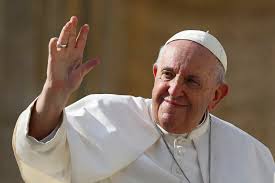
THE funeral of Pope Francis will take place on Saturday, April 26, at 10:00am (0800 GMT) in the square in front of St Peter’s Basilica, the Vatican has announced.
The coffin of the Argentine pontiff, who died on Monday, April 21 at the age of 88, will then be taken inside the church and from there to the Rome basilica of Santa Maria Maggiore for burial.
Tributes have continued to pour in as world leaders mourn the passage of the Bishop of Rome and Catholic leader worldwide, who had suffered various ailments in his 12-year papacy.
According to the Vartican, the Argentinian pontiff died of cerebral stroke and heart failure.
Pope Francis had on Easter Sunday, made a public appearance at Saint Peter’s Square, despite still recuperating from a severe illness.
Pope Francis died of a cerebral stroke and irreversible heart failure, Vatican doctor, Andrea Arcangeli, said in a death certificate released on Monday that the pope had fallen into a coma before his death earlier in the day and died of “cerebral stroke, coma, irreversible cardiocirculatory collapse.”
The certificate added he died at 7:35am local (0535 GMT) in his apartment at the Santa Marta residence in the Vatican.
The Vatican also released Francis’s spiritual testament, a written statement of faith, in which he said he wished to be buried in Rome’s Basilica of Saint Mary Major and not at St Peter’s Basilica in the Vatican, unlike many of his predecessors.
The text specified that Francis wanted to be buried “in the ground, without particular decoration” but with the inscription of his papal name in Latin: Franciscus.
President Bola Tinubu joined other world on Monday in mourning the death of the pope, describing him as “a humble servant of God, tireless champion of the poor and guiding light for millions.”
In a statement he personally signed, Tinubu called his death “a sacred return to his Maker at a time of renewed hope for Christians.”
He recalled: “His Holiness served the Church and the Master of the Church until the end. In 2013, he stepped onto the global stage with a message of mercy, urging us to see the face of Christ in the marginalised, the refugees, the migrants, and the forgotten.” .
The President commended the pope’s commitment to justice, environmental protection, and his efforts to build bridges across religious and socio-economic divides.
Italian Prime Minister, Giorgia Meloni, lamented the loss of “a great man, a great shepherd” and expressed deep sorrow,” adding: “I had the privilege of enjoying his friendship, his advice, his teachings, which never ceased, not even during times of trial and suffering.
“We say goodbye to the holy father with a heart full of sadness.”
President Javier Milei of Argentina, who previously clashed with the pope, while regreting the death of the first Argentine leader of the Catholic, praised his focus on inter-religious dialogue, encouragement of spirituality amongst the young, and focus on cost-cutting in the Vatican.
The White House shared a tribute on social media, writing, “Rest in Peace, Pope Francis,” alongside a photo of the pope meeting President Donald Trump and the First Lady.
Vice President JD Vance, who met the pope a day before his demise, said: “My heart goes out to the millions of Christians all over the world who loved him.”
Germany’s chancellor-in-waiting, Friedrich Merz, said Francis would be remembered for his unwavering commitment to the marginalised.
He wrote on his X handle: “He was guided by humility and faith in God’s mercy.”
King Charles of the United Kingdom (UK) said he was “most deeply saddened,” but lauded Francis’ compassion, commitment to unity and the environment, while Prime Minister Keir Starmer said the pope’s “tireless efforts to promote a world that is fairer for all” would be remembered.
European Commission President, Ursula von der Leyen, said Francis’s life was defined by his efforts to build a fairer and more peaceful world, noting: “He inspired millions, far beyond the Catholic Church, with his humility and love so pure for the less fortunate.”
Spanish Prime Minister, Pedro Sanchez, hailed Francis’s commitment to peace, social justice and the most vulnerable.
He stated on X: “I am sorry to hear of the death of Pope Francis. His commitment to peace, social justice and the most vulnerable leaves a profound legacy. Rest in peace.”
His Irish counterpart, Michael Martin, lauded the pope’s solidarity with the “poor, the marginalised, and the oppressed.”
He said “Pope Francis’ long and distinguished papacy was marked by his unwavering commitment to the principles of compassion, peace and human dignity,” adding that he would be remembered for his “expression of pain and shame” about historic child abuses in the Catholic Church during his 2018 visit to Ireland.
Russian President, Vladimir Putin, expressed his “sincere condolences,” praising the efforts of Francis to strengthen ties between the Russian Orthodox and Catholic Churches, recalling that the late pontiff had played a key role in advancing dialogue between the two branches of Christianity.
His Ukrainian counterpart, President Volodymyr Zelensky, said the Catholic leader had “prayed for peace in Ukraine and for Ukrainians.”
“We grieve together with Catholics and all Christians,” Zelensky wrote on social media.
Indian Prime Minister, Narendra Modi, said “Pope Francis will always be remembered as a beacon of compassion, humility and spiritual courage by millions across the world.
“He diligently served the poor and downtrodden. For those who were suffering, he ignited a spirit of hope.”
French President, Emmanuel Macron, praised the pontiff for his enduring solidarity with society’s most vulnerable, adding: “In this time of war and brutality, he had a sense for the other, for the most fragile.”
Polish President, Andrzej Duda, hailed Francis as “a great apostle of mercy,” saying his example offered answers to contemporary challenges, and “in his pastoral ministry, he was guided by humility and simplicity.”
Prime Minister Anthony Albanese said Francis would be mourned by Australians of all faiths, describing him as “a devoted champion and loving father” to Catholics. His compassion embraced all humanity.”
“He urged us to hear the cry of the earth and remember all we share,” he told ABC News:
Palestinian President, Mahmoud Abba,s remembered Francis as “a faithful friend” who recognised the Palestinian state.
Egyptian President, Abdel Fattah el-Sisi, described him as “a voice of peace, love and compassion.”
United Nations (UN) Secretary General, Antonio Guterres, in a statement, described Francis as a messenger of hope and man of faith for all faiths, noting that the world will be a much better place if his example of unity is emulated.
“His Holiness, Pope Francis, was a messenger of hope, humility and humanity.
“Pope Francis was a man of faith for all faiths, working with people of all beliefs and backgrounds to light a path forward.
“Our divided and discordant world will be a much better place if we follow his example of unity and mutual understanding in our own actions.”
Former US President, Barack Obama, said Francis was the rare leader who made us want to be better people.
“In his humility and his gestures at once simple and profound, embracing the sick, ministering to the homeless, washing the feet of young prisoners, he shook us out of our complacency and reminded us that we are all bound by moral obligations to God and one another.
“Today, Michelle and I mourn with everyone around the world, Catholic and non-Catholic alike, who drew strength and inspiration from the Pope’s example.
“May we continue to heed his call to ‘never remain on the sidelines of this march of living hope.”
Meanwhile, Francis’ funeral rites are to take place in three parts. Joanne M. Pierce, a professor emerita of religious studies at the College of the Holy Cross, wrote that the pontiff had been well aware of his fragile state and advanced age and as early as 2015, had expressed the desire to be buried in the Basilica of Santa Maria Maggiore, a fifth-century church in Rome dedicated to the Blessed Virgin Mary.
He was so devoted to Mary and her basilica that after each of his over 100 trips abroad, he would visit it after returning to Rome to pray and meditate.
No pope has been buried in Santa Maria Maggiore since the 17th century, when Pope Clement IX was laid to rest there.
The specialist in Catholic liturgical history recalled that in earlier centuries, papal funerals were elaborate affairs, ceremonies befitting a Renaissance prince or other regal figure, but in recent years, the rites have been simplified.
As Pope Francis has mandated, here are the steps that the ritual will follow.
First Station: Preparation Of The Body
THE funeral rites take place in three parts, called stations. The first takes place in the pope’s private chapel, after medical professionals have certified his death. Until recently, this stage had taken place at the pope’s bedside.
After the body lies in rest in the chapel, the Cardinal serving as the pope’s Camerlengo (chief of staff) will make the arrangements for the funeral. He is also tasked with running the Vatican until a new pope is elected. The current Camerlengo is Cardinal Kevin Joseph Farrell, appointed by Francis in 2019.
As has been done for centuries, the Camerlengo will formally call the deceased pope by the full name given to him when he was baptised as an infant, Jorge Mario Bergoglio.
There are narratives or legends stating that, at this time, the pope was also tapped three times on the forehead with a small silver hammer.
However, there is no documented proof that this was actually done in earlier centuries to verify a pope’s death.
Traditionally, another ancient rite will also take place after the declaration of the pope’s death: the defacing of the pope’s ring. Each pope wears a custom-made ring with an engraved image of a man fishing from a boat, hearkening back to the gospel of Matthew, where Jesus calls St. Peter a “fisher of men.”
This Fisherman’s Ring, with the name of the current pope engraved over the image, could act as a seal on official documents.
The Camerlengo will break Francis’ ring and smash the seal with a hammer or other instrument to prevent any other person from using it.
The pope’s apartments will also be locked, with no one allowed to enter. Traditionally, this was done to prevent looting.
Second Station: Viewing The Body
THE deceased pope will be dressed in his simple white cassock and red vestments, then placed in a simple wooden coffin. This will be carried in procession to St. Peter’s Basilica, where the public viewing will take place for the next three days.
The pope’s body will be left in the plain, open casket during this viewing period in order to emphasise his humble role as a pastor, not a head of state.
The earlier practice would have been to place the body on top of a tall raised platform, called a catafalque. This ended with the funeral of Pope Benedict XVI in 2022.
Pope Benedict was also the last pope to be buried in the traditional three coffins of cypress, lead and elm. Two coffins contained specific documents about his pontificate: The first coffin also held the traditional three bags of coins, gold, silver and copper, representing each year of his pontificate.
At Francis’ funeral, after the public viewing, a plain white cloth will be placed over the pope’s face as he lies in the oak coffin, a continuing part of papal funerals.
But this will be the first time that only a single coffin will be used; it will likely contain a document describing his pontificate and a bag of coins from his pontificate as well.
The funeral Mass will then be celebrated at St. Peter’s, most likely inside, because of the late winter weather, and there will likely be a crowd of believers outside, assembled on the plaza.
The Homily will reflect on the life and spirituality of the deceased pope. Francis himself preached at the funeral of his retired predecessor, Pope Benedict.
And the future Pope Benedict, as Cardinal Joseph Ratzinger, preached at the funeral of Pope St. John Paul II when Ratzinger was the leader, or the dean, of all senior church officials, what’s known as the College of Cardinals.
The current Dean is 91-year-old Cardinal Giovanni Battista Re, and it is unclear whether he will be able to continue this tradition due to his advanced age.
Masses will continue to be said in Francis’ memory for nine days after his death, a period called the Novendialis.
This ritual was inspired by an ancient Roman tradition prescribing a mourning period ending on the ninth day after a death.
Third Station: Burial
POPES in the past have been buried in several different places. Until the legalisation of Christianity in the Roman Empire in the early fourth century, popes would be interred in the catacombs, the burial grounds on the outskirts of Rome.
Afterward, popes could be buried in a number of different locations, such as the Basilica of St. John Lateran, the official cathedral of Rome, or other churches in and around Rome.
A few were even buried in France during the 14th century, when the papacy moved to the French border for political reasons.
Most popes are buried in the grottoes underneath St. Peter’s, and since Pope Leo XIII’s burial at St. John Lateran in 1903, every pope has been buried at St. Peter’s.
According to Francis’ wishes, however, there will likely be a procession across Rome to Santa Maria Maggiore, including the hearse and cars carrying others who will attend this private ritual.
After a few final prayers and sprinkling of holy water, the coffin will be placed in its final location inside the church. Only later will the area be opened to the public for prayers and veneration.
After so many journeys from Rome to visit Catholic communities in countries across the globe, and so many visits to this basilica for prayer and meditation, it seems fitting that, at the end of his life’s journey, Francis would make one last trip to the church he loved so much to be laid to rest forever.


