
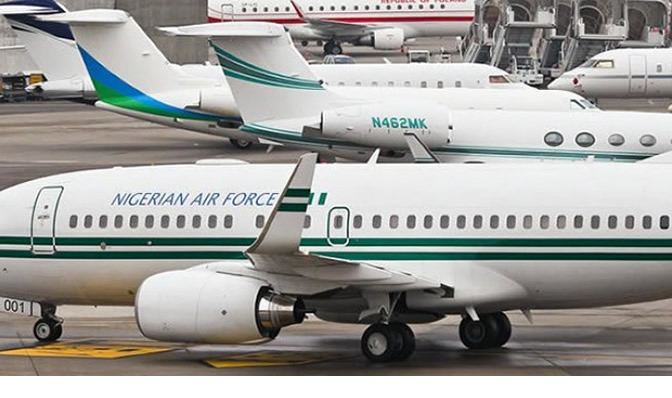
THE Presidency has moved against Chinese firm, Zhongshan Fucheng Industrial Investment Company, over the seizure of three presidential jets on the order of the Judicial Court of Paris, France.
It has also dismissed court orders against the Ogun State Government, which led to the seizure of the three presidential jets as an attempt to strip Nigeria of its assets.
Two of the jets, a Dassault Falcon 7X and a Boeing 737, are part of Nigeria’s presidential air fleet that were recently put up for sale, while the third, an Airbus 330, was purchased by Nigeria, but not yet delivered.
Consequently, both the Federal and Ogun State Governments are making frantic efforts to vacate the orders obtained by the Chinese firm on March 7, 2024 and August 12, 2024, respectively, with a view to securing the release of the planes.
This latest development, it said, was reminiscent of the order obtained by Process and Industrial Development Limited (P&ID) in London to secure $11billion judgment debt from Nigeria, which the Federal Government eventually got vacated.
The Chinese company has secured a court injunction to ground three presidential jets belonging to the Federal Government in Europe and initiated plans to seize other Nigerian assets in the United Kingdom (UK), United States (US) and in six other countries.
Like France, a US court has affirmed the firm’s $70million arbitration award against Nigeria over treaty violation.
In a 2-1 verdict delivered on August 9, the majority ruling affirmed the judgment of the US district court for the district of Columbia that held that the arbitration award is enforceable.
In January 2023, the presiding Judge of the lower court, Beryl Howell, dismissed Nigeria’s argument that the court did not have jurisdiction over the case since the country is a sovereign entity.
Howell insisted that the court has jurisdiction since the UK, where the $70million arbitration award was issued against Nigeria, is a signatory to the New York Convention.
In the majority judgment, the US appellant court held that the final arbitration award is enforceable under the New York convention since the dispute is between “persons” that share a legal commercial relationship.
The court ruled that the Foreign Sovereign Immunities Act (FSIA) arbitration exception stripped Nigeria of the sovereign immunity in the arbitration award case.
“For the foregoing reasons, we hold that the final award is enforceable under the New York Convention, because it arose out of differences between ‘persons’ that share a legal, commercial relationship.
“The district court, therefore, has jurisdiction over this case under the FSIA’s arbitration exception. The judgment of the district court is affirmed,” it ruled in the majority judgment issued by Patricia Millett and Julianna Childs.
In the dissenting judgment, Gregory Katsas argued that when the New York Convention was drafted, the word “persons” did not include a sovereign nation.
Katsas held that the action of Ogun State cannot be attributed to Nigeria, adding that the arbitration award “arises solely out of Nigeria’s sovereign acts governed by public international law.
“Text, legal context and drafting history all indicate that the word ‘persons,’ as used in the New York Convention, does not include signatory nations acting as sovereigns. I respectfully dissent.”
In 2010, Zhongshan, through Zhuhai Zhongfu Industrial Group Co. Ltd. (Zhuhai), its Chinese parent company, acquired rights to develop a free trade zone in Ogun State.
One year later, Zhongshan set up Zhongfu International Investment (NIG) FZE (Zhongfu), a Nigerian entity, to manage the project under the permission of the Ogun State government.
But the contractual relationship got sour in July 2016 when the investor accused the state government of abruptly moving to terminate its appointment while attempting to install a new manager for the free trade zone.
Subsequently, Zhongfu initiated an investment treaty arbitration against Nigeria under the bilateral investment treaty between the People’s Republic of China and Nigeria (the China-Nigeria BIT).
The arbitrators later ruled that Nigeria was in breach of its obligations under the China-Nigeria BIT and awarded Zhongshan a $70million compensation.
In January 2022, the company initiated a case to seek enforcement of the arbitration award. Nigeria pleaded state immunity, but was turned away by Sara Cockerill, a high court Judge in the UK, who said the country abused the time frame for appealing arbitral awards.
Barely three days after the judgment, a Paris court in France ordered the seizure of three jets belonging to Nigeria over the dispute.
However, Nigerian has accused the Chinese firm of attempting to use deceptive means to acquire the country’s offshore assets in Belgium, Canada, France, Singapore and the British Virgin Islands.
The French court, recently, authorised the seizure of .
Zhongshan had again dragged Ogun to court, where an independent arbitral tribunal, chaired by the former President of the UK Supreme Court, awarded the Chinese firm $74.5m compensation, which Ogun was yet to pay.
The court order prohibited Nigeria from moving or selling the presidential jets until the Chinese firm was paid the $74.5million by Ogun State, its sub-national.
The company had attempted to seize a jet being recovered by the country from Dan Etete as proceeds from fraudulent acts in Canada.
The Federal Government had tracked down and grounded the luxury private jet purchased by former Petroleum minister with some of the alleged proceeds of the notorious $1.3billion Malabu OPL245 oil deal, saying: “The goal is clear- that Etete will avoid the seizure of an asset he got with stolen Nigerian money, with Zhongshan’s connivance.”
According to available documents on the saga, Zhongshan was originally engaged as a developer and manager of Fucheng Industrial Park, but was asked to manage the facility after the government terminated the joint venture with CAI, because it didn’t meet the necessary requirements.
The document claimed that the Ogun State government cancelled the contract after it received a Diplomatic Note 1601 from the Economic and Commercial Section of the PRC Consulate in Lagos, alleging that Guangdong illegally held shares in China Africa Investment Limited, a state asset, and that entity (New South Group) was the company properly entitled to manage OGFTZ.
The document read: “In 2007, the Ogun State Government, in partnership with the Guangdong province in China, conceived and set up the Ogun Guangdong Free Trade Zone, which sits on 2,000 hectares in Igbesa, Ogun State.
“Ogun State signed a Joint Venture Agreement directly with China Guangdong Xinguang China-Africa Investment Limited, representing Guangdong Province in the joint venture.
“OGFTZ houses several enterprises, as well as sub-developments, including one Fucheng Industrial Park, measuring 224 hectares.
“In 2010, OGFTZ contracted Zhongshan to develop and manage Fucheng Industrial Park. However, in 2012, Ogun State terminated the joint venture with CAI, because CAI had not met obligations under the 2007 JVA.
“Ogun State then appointed Zhongshan as an interim manager of the Zone, since it was already managing Fucheng Industrial Park.
“In June 2012, Zhongshan assumed management control of a 51 per cent stake in CAI and subsequently signed another JVA with Ogun State Government in September 2013.
“As of August 2024, there are court proceedings in about eight jurisdictions of the world regarding this dispute. These include USA, UK, Belgium, Canada, France and the British Virgin Islands.
“Till date, Zhongshan has not realised a single penny from the award and all signs indicate that Zhongshan is unlikely to do so anytime soon.”
It added that the company was still tracking the location of Nigerian assets abroad.
Meanwhile, a court document has revealed that the Chinese company was demanding compensation of $130.6million due to a breach of contract by reneging on terms between both parties to create the Ogun Guangdong Free Trade Zone.
The document listed the Federal Government as the defendant, because the direct agreement was between Nigeria and China and not with the company, based on international treaty conditions.
The case, filed at the United States District Court for the District of Columbia (No. 1:22-cv-00170) was argued April 22, 2024 and decided August 9, 2024 by Circuit Judges Millett, Katsas and Childs.
In presenting its argument, the company stated that Nigeria violated the Investment Treaty with China in five ways “by failing to provide Zhongshan with fair and equitable treatment, engaging in unreasonable discrimination, neglecting to protect Zhongshan, breaching the contract and wrongfully expropriating investments without compensation.”
Giving details of the deal, the company said it invested millions of dollars and significant resources to develop and build infrastructure in the industrial park, including roads, utilities and opened services, such as a hospital, hotel, supermarket and bank.
By 2016, businesses had moved into the zone and Nigeria had collected approximately N160million in tax revenue from the free-trade zone.
“In the first half of 2016, however, Ogun State terminated its agreements with Zhongshan. Ogun claimed that a different Chinese company was legally entitled to Zhongshan’s share of the free-trade zone and that Zhongshan had defrauded Ogun.
“Things continued to deteriorate. One Ogun official texted a Zhongshan executive, urging him ‘as a friend,’ to ‘leave peacefully when there is opportunity to do so and avoid forceful removal, complications and possible prosecution.’
“The next month, Ogun issued an arrest warrant for two executives, alleging a ‘criminal breach of trust.’
“Nigerian federal Police arrested one Zhongshan executive at gunpoint and held him for 10 days. During that time, the Police denied the executive food and water, beat him, intimidated him and questioned him about the whereabouts of the other executive.
“Based on these findings, the arbitral tribunal found that Nigeria had breached its obligations under the Investment Treaty and that Zhongshan was entitled to $55.6million in compensation from Nigeria and $75,000 in moral damages, along with interest and legal and arbitral fees.”
(with additional reports from Punch, Cable)


