
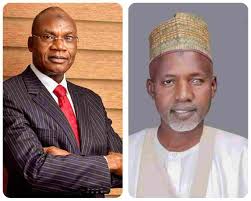
THE Federal Ministry of Education has clarified that it has not stopped students who are not up to 18 years old from writing the West Africa Senior School Certificate Examination (WASSCE) and the National Examinations Council (NECO) examinations.
The Minister of State for Education, Dr. Yusuf Sununu, who made the clarification in Abuja on Friday, September 6, while fielding questions from journalists at an event to mark this year’s International Literacy Day (ILD), expressed disappointment at public misconception and misinterpretation of the comments of the Minister of Education, Prof. Tahir Mamman, concerning the issue.
Sununu said Mamman was actually speaking on the 18 years entry age into the tertiary institutions, as was practiced in the 6-3-3-4 system of education, adding: “As regards this matter, we have made ourselves clear in different fora. But the issue kept recurring here and there. Actually, nobody among the two of us, the Minister of Education, Prof. Tahir Mamman, nor the Minister of State, stated anything about the age limit for WAEC, NECO or NABTEB.
“People just pick up some remarks the minister made, misinterpreted the statements to imply that age restriction has been placed for WAEC and NECO examinations.
“What we have been mentioning in the past was the entry age for university, candidates sitting for the UTME. We have made this clear several times, and this is in line with the National Policy on Education.
“The document stated that a child is expected to enter primary school at six years, and he’s expected to spend six years in that school making it 12 years, three years each in junior and senior secondary schools, making it 18 years. That’s what is contained in the National Policy on Education document.
“This is directly or otherwise related to the theme of this year’s World Literacy Day. The Policy further stated that a child should learn in the language of the immediate environment or mother tongue up till primary three before English Language could be introduced in subsequent years. That has facilitated learning at that level, because you can easily communicate.
“We have agreed that we are going to consider it as a work-in-progress. The National Assembly is working and we are also working.
“It was shocking to say that a university in this country gave admission to children at ages 10, 11 and 12 years. This is totally wrong.
“We are not saying that there are no exceptions, we know we can have talented students that have the IQ of an adult even at age 6 and 7, but these are very few.
“There must be a rule, and the ministry is looking at developing a guideline on how to identify a talented child, so that parents don’t say we are blocking their children’s chances.
“Nobody said no child will write WAEC, NECO or any other examination unless at age 18. This is a misconception and misrepresentation of what we have said.”
Speaking on the ILD, Sununu underscored the critical role of literacy in fostering mutual understanding, peace and socio-economic development, reaffirming the Federal Government’s commitment to addressing literacy challenges through the Education for Renewed Hope roadmap (2024-2027).
He highlighted youth and adult literacy as key components, while emphasising the importance of using learners’ mother tongues as a medium of instruction, saying: “We must focus on the role of a learner’s first language in becoming literate, which will foster mutual understanding and peace.”
Sununu stressed the need for well-trained educators, who should be equipped to teach in local languages, as well as the development of follow-up reading materials in these languages.
On his part, Executive Secretary, National Commission for Mass Literacy, Adult and Non-formal Education (NMEC), Prof. Simon Akpama, reaffirmed the Commission’s dedication to integrating multilingual education into schools’ literacy programmes.
He noted: “In an increasingly interconnected world, multilingual education is not just a necessity; it is a tool for fostering peace and cultural respect.”
The United Nations Educational, Scientific and Cultural Organisation’s (UNESCO) Country Representative, Mr. Diallo Abdourahamane, reiterated that literacy remained a fundamental human right; hence the need to create a just, peaceful and sustainable society.
The ILD, which is celebrated annually on September 8, is aimed at highlighting the importance of literacy to individuals, communities and societies.
The theme for this year’s celebration is, ‘Promoting Multilingual Education: Literacy for Mutual Understanding and Peace.’


