
*Advocates Tax Cut, Pension Reforms, Others
*Tinubu Pledges To Address High Living Cost, Fight Corruption
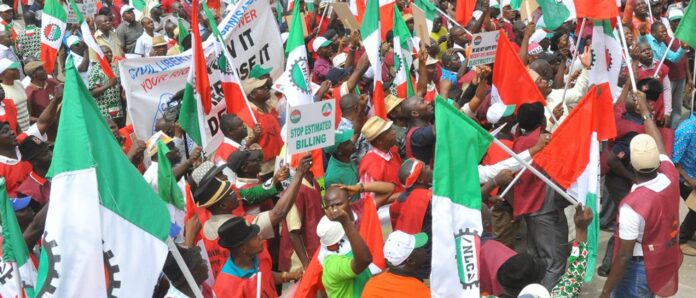
THE Nigeria Labour Congress (NLC) has advocated the pegging of 60 years as retirement age for all categories of civil servants in Nigeria.
NLC President, Joe Ajaero, who made the demand at the Eagle Square, Abuja, on Thursday, May 1, in commemoration of Workers (May) Day, said: “Tt is imperative to extend the revised retirement age of 65 years or 40 years of service currently enjoyed by teachers, health professionals and Judges to all public servants.”
Ajaero vowed that NLC would do everything to meet with President Bola Tinubu to press for the review, which was earlier approved in an Act signed into law by former President Muhammadu Buhari.
Other demands the Organised Labour presented a 20-point demand to the Federal Government as workers commemorated this year’s May Day in Abuja and across the country include better retirement package, reversal of the emergency declaration in Rivers State, withdrawal of the Tax Bills, reduction of telecommunication tariff from 50 per cent to 35 per cent and salary adjustment to reflect current economic realities, saying workers cannot continue to bear the brunt of inflation, rising costs and policy failures.
The NLC and TUC criticised the existing PAYE tax system, demanding transparency in how the deductions are calculated and applied, insisting that workers must have a seat at the table during the formulation of tax policies that will directly affect them.
Reading a speech he jointly signed with his TUC counterpart, Festus Osifo, the NLC leader expressed frustration with the continued prioritisation of corporate profits over the survival of the ordinary Nigerian, calling for reforms that would shift focus toward the people, especially in essential services, such as energy, infrastructure and public utilities.
The umbrella unions restated their earlier demand for a comprehensive review, with the ultimate aim of a reversal of the electricity sector privatisation, which it said has failed to improve service delivery, while deepening economic hardship for consumers.
The Labour also demanded democratic accountability, transparency and urgent electoral reforms, while condemning what they called a sustained suppression of civic space and dissent.
On security, they called for an immediate end to the widespread killings and bloodshed across the country, labelling the violence as genocidal and intolerable, just they expressed concern over the safety of Nigerian workers, both within their workplaces and in the general environment.
The union leaders decried the continued and indiscriminate registration of new unions in sectors where existing unions already have effective coverage, warning that such actions weaken the organised labour and threaten its coherence.
They demanded the immediate settlement of all outstanding allowances, pensions and gratuities across the country, stressing that retired public servants, who devoted decades to national service, deserve a dignified and secure retirement.
The Labour also knocked what it saw as dehumanising verification exercises faced by retirees, calling for more humane and efficient systems that respect the dignity of the elderly, even as it canvassed the establishment of a nationally accepted minimum pension that guarantees retirees a life of dignity, as well as that pensions be automatically adjusted following inflationary trends to protect their real value.
NLC and TUC reaffirmed their commitment to defending the rights and welfare of Nigerian workers, calling on government to engage in genuine dialogue and to treat workers not as adversaries, but as partners in the effort to build a just, prosperous and equitable nation.
According to Ajaero: “We make the following demands: An urgent reversal of the unconstitutional suspension of the elected government of Rivers State via a state of emergency, which is alien to our laws.
“That the federal and state governments should cease actions that erode the civic space, but should encourage and deepen it for the sake of our nation.
“That government explains what exactly it is taxing in the PAYEE. The withdrawal of the Tax Bills before the National Assembly to allow Nigerian workers to sit at the table where it is being conceived.
“An immediate implementation of the reduction of telco tariff from 50 per cent to 35 per cent, as agreed.
“Democratic accountability, transparent governance, electoral reforms and an end to the suppression of dissent. Energy, infrastructure and essential services must serve the people, not private interests. Regulators must work for the people.
“An end to the genocidal killings and bloodletting across the nation. Workers’ rights and security, safe workplaces, right to organise and protection from state and employer violence.
“An expansion of National Labour Advisory Council’s activities and increasing the meeting periods. The indiscriminate registration of new unions in areas with proper coverage should stop. Immediate payment of all outstanding allowances, pensions and gratuities across the nation.
“Restoration of gratuity payments. Public servants, who served diligently for decades, deserve a dignified exit, just like political office holders who serve for much shorter periods.
“Once again, we call for a review of the electricity privatisation exercise with the view to a reversal.”
In his speech at the event, President Bola Tinubu pledged better deals and protection for workers, saying his administration was determined to pursue a Labour-first agenda that prioritises tougher workplace protections, employment security and a frontal assault on under-employment.
Tinubu, who was represented by Minister of Labour and Employment, Mr. Maigari Dingyadi, described Labour as “the backbone of our society,” adding: “On our part as government, we will continue to strengthen labour protections, improve job security and ensure fair treatment for all workers in line with international best practices.”
The President promised to defend the right to organise, amplify marginalised voices and deepen transparency in government decision-making, adding: “Let me also express my profound appreciation to the leadership of the two national labour centres, Nigeria Labour Congress and Trade Union Congress of Nigeria, for their tireless efforts in organising this year’s May Day celebrations.
“The government recognises and respects your contributions in fostering dialogue, promoting workers’ rights, and ensuring that the voices of Nigeria’s workforce are always heard loud and clear.
“Your efforts and sacrifices have not only uplifted the lives of your members, but have also contributed to the betterment of our society.
“As we mark this day, let us reaffirm our shared commitment to a nation where workers are safe, empowered, and have the freedom to actively participate in shaping the future of our country.”
He reaffirmed his administration’s readiness to collaborate with labour unions, organised and informal private sector and civil society organisations to create policies and programmes that safeguard the rights and livelihoods of workers across all sectors of the economy.
The President noted that this year’s theme speaks to the challenges Nigeria faces and opportunities ahead of its people, adding: “The theme is one that demands our collective attention and serves as a stark reminder of the need to create an environment where every worker feels safe, valued and empowered to contribute productively to the growth and prosperity of our nation.
“As your President, I assure you that this administration is committed to creating such a utopic climate for the common good.
“Economic hardship, which today is a global phenomenon, cuts across all regions, testing the resolve of world leaders, but has not broken our spirit.”
He acknowledged rising food and fuel costs, sporadic insecurity and widespread pressure to provide necessities for families, but argued that his Renewed Hope Agenda, anchored in job creation, poverty alleviation and support for the most vulnerable, offers a road map out of crisis.
“I am well aware of the peculiarities of this economic hardship for Nigerians, which is occasioned by the struggles and challenges you workers and indeed many Nigerians face, ranging from rising costs of living, hunger, insecurity, unemployment, loss of livelihoods and the pressure to provide necessities for your families, amongst others.
“These challenges are real, critical and demand definite solutions, which I, as your President, am poised to address. It is in this regard that my administration is not only committed, but intentional in formulating and implementing policies that promote job creation, decent jobs, poverty alleviation, economic growth and stability, as well as supporting the most vulnerable among us.
“We must also reclaim the civic space, the space where ideas are exchanged, voices are heard and change is born.”
Noting that a vibrant civic space is the cornerstone of democracy and essential for holding leaders accountable, fostering innovation and ensuring that every Nigerian has a seat at the table, he added that to reclaim this space, the organised Labour must prioritise transparency, inclusivity, equity and dialogue.
“We must protect the rights of workers to organise, advocate and participate in decision-making processes. And we must ensure that the voices of the marginalised are amplified, not silenced, as it is through this space that we can build trust, unity and a shared vision for a brighter future.
“These we shall endeavour to pursue vigorously, noting that our workplace dynamics are evolving faster than ever before, recognising the emerging challenges, such as technological advancements, environmental hazards, shifts in work patterns and mental health concerns, which demand our innovative solutions.”
He pledged: “This administration shall continue to effect positive changes in the lives of average Nigerians, ensure that the downtrodden are elevated, and, most importantly, fight the intense pain of corruption, which has enriched the very few to the detriment of the majority of our citizens, who groan under the overwhelming weight of poverty and all the superstructural and infrastructural maladies resulting from corruption.
“It is against this backdrop that I urge you all to, on this Workers’ Day, reaffirm your commitment to the principles of fairness, equity, and justice.”
Tinubu urged the labour unions to work with his administration to ensure that every worker, regardless of their role or background, has access to opportunities that enable them to thrive.
Similar messages of goodwill and promises were made by state governors across the country.


