
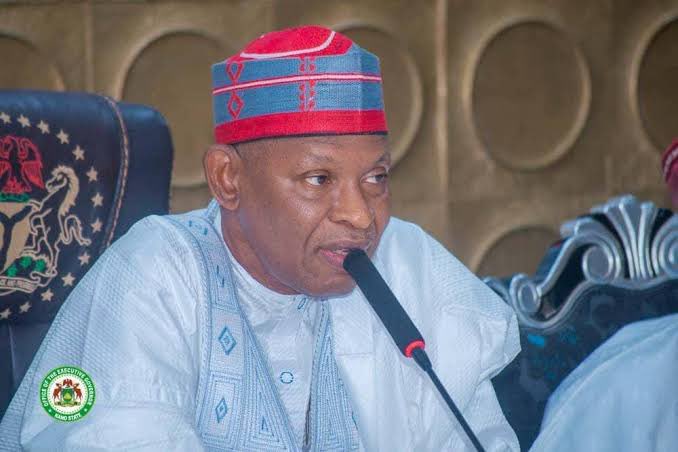
THE Kano State House of Assembly presided over by the Speaker, Jibrin Falgore, during plenary on Thursday morning, May 23, passed the Kano State Emirate Council (Repeal) Bill 2024, thereby repealing that created five emirates in the state, in what is largely seen as a move possibly to pave way for Muhammad Sanusi II to return as Emir of Kano.
Recall that in May 2019, the former Assembly passed the amendment of the Kano State Emirate Council Law, which ensured the balkanisation of the emirate, which was immediately signed into law by then governor, Dr. Abdullahi Ganduje, but was seen as aimed at whittling the powers of Sanusi, the then Emir of Kano, who was eventually dethroned.
That law split Kano into five emirates- Kano, Rano, Gaya, Karaye and Bichi, with new emirs appointed into each emirate.
In March 2020, Ganduje finally deposed Sanusi as Emir of Kano “for total disrespect to lawful instructions from the office of the governor,” after months of running battle and face-off between them.
However, during plenary last Tuesday, May 21, the Majority Leader, Lawan Hussaini Dala, moved a motion for the amendment of the law, saying it was not conceived in good faith, while raising concerns over the creation of the emirates.
Thereafter, the Assembly resolved to amend the law, which seeks to abolish the five emirates and “all the appointments or offices arising therefrom.”
The Bill also mandates the governor to restore the previous Kano emirate system.
Earlier, Deputy Speaker, Muhammad Butu, explained that repealing the law would revive the lost glory of Kano, as the division of Kano emirate to five reduced the capacity and dignity of the state at national level.
The Assembly also adopted a motion to create a new second-class emirate council in the state.
The Assembly had earlier initiated steps to amend the Kano State Emirs (Appointment and Deposition) Law.
Like his predecessor, with whom there is no love lost, G Governor Abba Yusuf was expected to immediately sign the Bill into law.
Once that is done, a new round of politicking begins, with the fate of the current emirs, who are not in the best of terms with the governor and his New Nigeria Peoples Party (NNPP), sealed and possibly a return of Sanusi to the throne.
But Kano being a volatile hotbed,it would not be surprise to see an outbreak of violence and clashes between supporters of the two parties on the one hand, and supporters and opponents of the new order on the other hand.
The Kano State Emirates Council Amendment Bill was passed after scaling the Second and Third Readings on Thursday morning.
The law creating the five new emirates was first assented to by Ganduje on December 5, 2019. He assented to an amendment to the law on October 14, 2020 and signed another amendment on April 11, 2023.
Section 3(1) of the law established five distinct emirates- Kano, Bichi, Rano, Gaya and Karaye, with Kano and Karaye having eight local government areas of jurisdiction each, while Bichi and Gaya emirates, nine local government areas of jurisdiction each, and Rano Emirate, 10 local government areas out of the 44 local councils in the state.
When Emir Muhammadu Sanusi, who chaired the council, was deposed on March 9, 2020, the law was amended to read: “There shall be the chairman of the council who shall be the emir, Kano Emirate.”
Section 12 provides that the governor may grade the office of an emir as first, second or third class, subject to the approval of the Assembly.
In January, a former governor of the state and leader of the Kwankwasiyya movement, Dr. Rabiu Kwankwaso, said the issue of Kano emirates would definitely be revisited.
Following NNPP’s victory in last year’s election, Kwankwaso had indicated that the Yusuf administration would review the dethronement and balkanisation of the emirate, noting: “Honestly it (the Kano Emirates issue) is one of the things that nobody has sat with me to discuss so far, but I am sure we are going to sit and see how to go about it.
“Is it going to be allowed, demolished, corrected, or whatever? It will be revisited, and what’s supposed to be done will be done.
“There were a lot of things and this was a trap. All these things were not done in good faith or intention. It was brought with some bad intentions which every one of you here and our listeners are aware of.
“Sometimes, you come with things that are good and they turn out to be bad while sometimes you bring bad things and they turn out to be good.
“So, all I know is that I was not consulted as of now but definitely, we will come to discuss and see what should be done.”


