
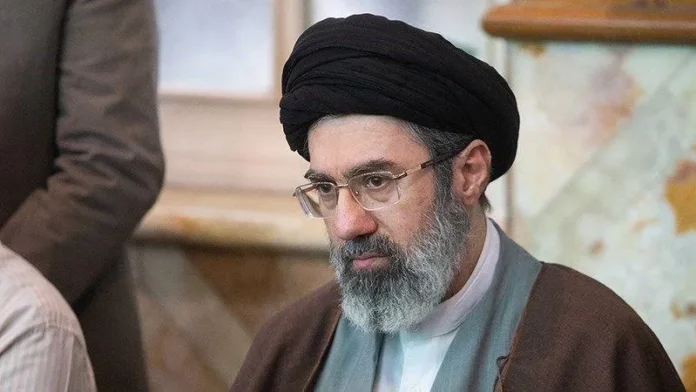
*Cleric Says Some Assembly Members Sidelined In His Emergence
*President Pezeshkian Pledges Unity Under His Command
*Speaker, Armed Forces Vow More Powerful Resistance Under Mojtaba’s Command
IRAN’S state television called Mojtaba Khamenei “Jaanbaz (injured war veteran) of Ramadan,” apparently suggesting he’s been wounded in the ongoing war.
It also claimed that Mojtaba was fluent in English and had completed psychology and psychoanalysis specialised courses and knowledgeable about modern technologies, military sciences and security affairs, as well as political principles and the country’s executive requirements.
Recall that Iran’s Assembly of Experts announced in a statement on Sunday, March 8, that Mojtaba Khamenei has been chosen as the country’s new supreme leader, days after Iran International first reported on Tuesday, March 3, that the Assembly had selected him under pressure from the Revolutionary Guards.
The body, in a statement, said:“In today’s extraordinary session, the Assembly of Experts, by the decisive vote of its members, selected and introduced Ayatollah Seyed Mojtaba Hosseini Khamenei as the third leader of the sacred system of the Islamic Republic of Iran.
“In conclusion… (the Assembly) calls on the noble people of Iran, especially the elites and intellectuals of the seminaries and universities, to pledge allegiance to the leadership and preserve unity around the axis of guardianship.”
Meanwhile, a member of the Assembly alleged that some clerics were not informed about the in-person meeting at which Mojtaba Khamenei was named the new supreme leader and therefore could not attend, despite being in the city of Qom.
Ayatollah Mohsen Heidari told state television that over two-thirds of the Assembly’s 88 members attended the session held in Qom on Sunday, March 8, meeting the quorum required for the vote.
“Some of the members were not informed about the meeting and could not make it to the session, even though they were in the city of Qom,” Heidari said.
He added that Mojtaba Khamenei received almost 85 per cent of the votes cast by those present.
The clerical body, elected for eight-year terms, is constitutionally responsible for appointing and overseeing Iran’s supreme leader. A minimum of two-thirds of its members must be present for such a decision to be valid.
If accurate, the figures would mean that at least about 59 members attended the meeting and that roughly 50 or more voted in favour of Khamenei.
Sources familiar with the discussions had earlier told Iran International that several members of the Assembly expressed objections to Mojtaba Khamenei’s selection earlier this week, warning that appointing the son of the late leader risks reinforcing perceptions of hereditary rule in the Islamic Republic.
Iran’s President, Masoud Pezeshkian, while congratulating Mojtaba Khamenei on his selection, said his appointment marked the beginning of a new era of strength and dignity for the country.
In a message released after the Assembly announced Mojtaba Khamenei as the third leader of the Islamic Republic, Pezeshkian said the decision reflected the “wise and decisive” choice of the clerical body, following the death of his slain father.
Pezeshkian said the selection would reinforce national unity and help Iran confront what he described as hostile plots by its enemies, adding that the legacy of Mojtaba Khamenei’s father had laid a strong foundation for the country’s future and Iran could achieve lasting independence, scientific and technological progress, and broad development under the new leadership.
Iran’s Armed Forces General Staff and the central command of Khatam al-Anbiya headquarters issued a statement confirming their allegiance to Mojtaba Hosseini Khamenei after his selection.
The statement congratulated the nation on the appointment, saying the armed forces and their commanders had pledged loyalty to Mojtaba Khamenei, vowing to carry out his orders and mobilize all capabilities to defend the Islamic Republic.
It added that the military would act “more powerfully and resolutely than before” to safeguard the achievements of the Islamic Revolution and warned enemies, particularly the United States, that Iran’s forces would resist any aggression and defend the country’s security and interests under the new leader’s command.
Similarly, Iran’s parliament Speaker, Mohammad-Bagher Ghalibaf, said he considers it his religious and national duty to follow Mojtaba Khamenei as the country’s new supreme leader.
Ghalibaf said there is no difference between loyalty to Mojtaba Khamenei and the loyalty previously given to his father and the founder of the Islamic Republic.
He called on officials and the public to unite around him to defend the legacy of the revolution and strengthen Iran.


