

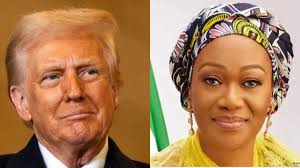
UNITED States (US) President, Donald Trump, has described Nigeria’s First Lady, Oluremi Tinubu, as a “very respected woman.”
Trump’s remarks while addressing participants at the National Prayer Breakfast in Washington, D.C, on Thursday, February 5, attended by political and civic leaders from across the world, which drew applause from the audience, underscores the First Lady’s growing influence and stature.
In his address, Trump recognised her role as a pastor in one of Nigeria’s largest churches, saying:
“We are honoured to be joined today by the First Lady of Nigeria, who also happens to serve as a Christian pastor at the largest church in Nigeria, a very respected woman.
“Thank you very much, it’s a great honour, a very respected person too.”
His remark placed Mrs. Tinubu among prominent global faith leaders present at the event meant for prayers and reflections on leadership, governance and national values.
The National Prayer Breakfast is a yearly held every February and attracts members of the US Congress, religious leaders and international guests.
The wife of the Nigerian leader told The Hill in an interview on Tuesday at the Four Seasons in Georgetown that global concern about persecution of Christians in the country is based on “propaganda.” Yet, she sees “divine intervention” in Trump’s focus on protecting Christians in the country, as it has created an opportunity to elevate relations with the US and collaboration to tackle insecurity and terrorism in Nigeria.
She explained: “Divine in the sense that, who would have even noticed Nigeria? Or to really understand what we are grappling with and trying to build the country?”
Asked if Trump was being swayed by propaganda about Christian persecution, she stated: “I don’t think so. No one in the free world will hear that Christians have been killed, and US is a Christian country, and you can hear that, and not speak up or to react.”
Mrs. Tinudu added: “What we have to establish, we are talking about attacks on Christians, we have to realise that Nigeria also is an emerging economy.
“There are cases of theft, banditry, kidnapping for ransom, all of those are all intertwined. If kidnappers know that you are focusing on Christians, it now makes them a target for kidnapping, so that they think that they’re being persecuted.”
When asked if Trump and others in the US were actually making matters worse for Nigeria’s Christians by their actions, she responded: “No, there’s nothing wrong with that. It’s a wake-up call for us, we have to really step up what we are doing and make sure lives are secured.
“I’ve always believed that all things work together for good, despite I didn’t want this attention, but at least, I have to speak my truth, that’s why I came.
“We really thank God that he looked at that and we can look for ways to move forward.”
Trump’s focus on Nigeria followed an intense lobbying campaign among religious freedom advocates and some Republican lawmakers, who celebrated his decision in October last year to designate Nigeria as a “Country of Particular Concern” (CPC).
The advocates argue that the Nigerian government, headed by President Bola Tinubu had not done enough to protect religious communities, particularly Christians, facing criminal violence, terrorist threats and attacks, as perpetrators are not held accountable.
Trump described Christians as facing an “existential threat” in Nigeria at the hands of Islamic terrorists, accusing the Nigerian government of allowing Christians to be slaughtered and threatening to enter Nigeria “guns-a-blazing.”
In November, Trump threatened to cut off “all aid and assistance” to Nigeria if it didn’t take meaningful action, and the following month, in partnership with Nigeria, identify targets for the Christmas Day launch of 16 Tomahawk missiles, 12 of which reportedly hit targets in Sokoto State, destroying a logistics hub of a “particular strand of the Islamic State” and leading to the arrests of “very high calibre ISIS leaders in this area.”
The Washington Post reported that four warheads did not explode and crashed across the country.
Published:

Related articles

Recent articles
