

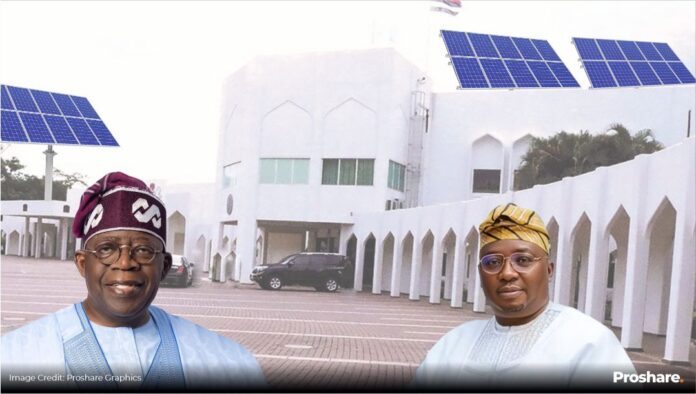
NIGERIA’S seat of government, the Aso Rock Presidential Villa, is to fully disconnect from the national electricity grid by next month, following the completion of its solar power project.
State House Permanent Secretary, Temitope Fashedemi, who disclosed this on Wednesday, February 11, while defending the State House 2026 budget before the Senate Committee on Special Duties, at the National Assembly complex in Abuja, told the Kaka Lawan-led committee that the solar installation was completed towards the end of last year and had been undergoing testing since December.
“We are hopeful that maybe by March we’ll be able to do a full cutover,” he explained, adding that the transition would deliver significant cost savings for the government, citing the State House Medical Centre, which completed its own solar installation in May last year and has since operated entirely without generator power, as proof of the project’s viability.
According to him: “I have to say that since that time, the generator in that State House Medical Centre has not been put on for one minute since May last year.
“Only a couple of months, we used three per cent from AEDC (Abuja Electricity Distribution Company), so the rest has been strictly from the solar and from the battery electric storage system.”
Recall that the Federal Government budgeted N10billion for the “Solarisation of the Villa with Solar Mini Grid” project last year, a development that attracted widespread criticism from Nigerians, who argued that installing solar panels at Aso Rock amounted to an admission that the administration cannot not address Nigeria’s irregular power supply.
This year’s Appropriation Bill provides an additional N7billion for the project.
However, Special Adviser to the President on Information and Strategy, Bayo Onanuga, cited the United States’ (US) White House’s use of solar energy as justification for the initiative, while Director General of the Energy Commission of Nigeria, Mustapha Abdullahi, said it was unsustainable for the Villa to continue to pay an estimated N47billion yearly electricity bill.
In February 2024, the Abuja Electricity Distribution Company (AEDC) listed the Presidential Villa as one of its top government debtors, with an outstanding bill of N923.87million, later reconciled to N342.35million, which President Bola Tinubu ordered to be settled immediately.
According to Fashedemi, the solar power testing phase had exposed systemic overbilling by AEDC, with transformers charging for electricity not supplied.
“What we have discovered in the course of all of this, especially during the testing phase, is that there’s been a lot of overbilling. When we’re testing it, a number of the transformers, we’re seeing that they were billing for electricity not supplied.
“So, we are using that period now to point it out to them and hopefully do some reconciliation about this legacy liability.”
He was optimistic that at the completion of the full cutover, the Villa’s ageing generators, installed when the complex was originally built, would no longer be needed, adding: “We’ve been having a lot of pressure from the service providers that we need to replace them.
“But we are happy that with the performance we are seeing at the State House Medical Centre, when we do the cutover, we will not need to do that. Maybe we just have a couple for backup in case of any eventuality.
“But we believe that the solar infrastructure will suffice.”
Published:

Related articles

Recent articles
