
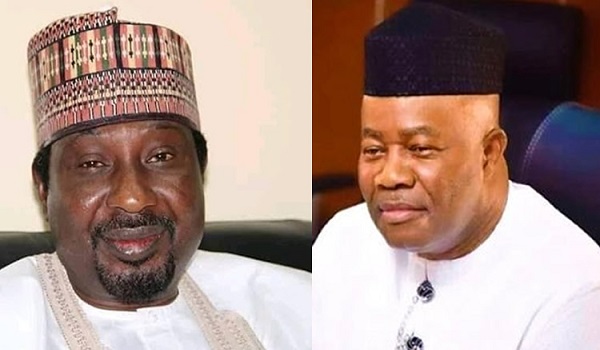
*Akpabio Overrules Deputy as Senate Steps Down Bill Over Missing Document
*Lalong Caught In Procedural Error
THERE was confusion within the leadership of the Nigerian Senate on Thursday, October 15, over amendment of the Electoral Act due to passed through Second Reading.
Chairman of the Senate Committee on Electoral Matters, Simon Lalong, was leading debate on the Bill, seeking to regulate the conduct of federal, state and area council elections in the Federal Capital Territory (FCT), which was listed for Second Reading, but could not proceed, as lawmakers discovered that the text of the proposed amendments was missing.
The controversy deepened after it emerged that the Committee had already conducted a public hearing on the Bill, even when it had not been read for the second time, a clear departure from parliamentary norms.
Deputy President of the Senate, Barau Jibrin, who was presiding, downplayed the omission, suggesting that senators could proceed by debating only the “general principles” of the proposed amendment, saying: “The nitty-gritty of the Bill is not necessary at this stage.
“We are only to discuss its general principle before the Second Reading.”
However, several senators questioned the rationale in debating a document they had not seen.
At that point, Senate President, Godswill Akpabio, stepped in to take over from his Deputy and suggested a closed door session, as according to him, Lalong had not touched the nitty-gritty of the reasons the amendment should pass Second Reading.
He said: “I want to know whether there are certain things that will convince us here of the need to make it (the report) to pass Second Reading.
“So, in my opinion, Senator Lalong, you have not touched the nitty-gritty of the reason why you want us to pass this for Second Reading.
“Yes, you are supposed to talk about general principles, and that will be okay. But what have you been able to tell us? I’m thinking that for us to proceed with this, we will not stop it immediately, but I think we should go into closed session, so that you can let us know the areas that you have been able to point out. Let’s not be taken by surprise when we go for a public hearing.
“Let it be that the members are aware of the areas that you wish to amend. But if you want to argue with me, go ahead.”
But rather than going into a closed-door meeting, the chamber’s microphone was switched off and the leadership, led by Senate Leader, Opeyemi Bamidele, approached the chair to meet with Akpabio.
At the end of the about 10 minutes meeting, Bamidele addressed the chamber and suggested that the day was not auspicious for executive session, saying: “I would like to most respectfully say that I believe the time today is not auspicious for us to go into executive session to discuss this Bill.
“Also because it is my conviction that there is a need for further consultation on this Bill before we can actually proceed.”
He further stressed the need to ensure his colleagues understood the general principles of the Bill, which are the things we are supposed to thoroughly debate at the Second Reading; hence he moved the motion for further consideration of the Bill be stepped down until another legislative day for further consultation.
The motion was seconded by the Minority Leader, Abba Moro.
Outside the chamber, murmurs continued over the committee’s decision to hold a public hearing on the unprocessed Bill, with several lawmakers describing the move as “premature” and “procedurally incorrect.”
One of them said: “It’s like putting the cart before the horse. The Senate hasn’t even considered the bill; how then do you gather public opinions on it? That’s not how lawmaking works.”
According to a legislative aide conversant with procedures of the chamber: “Committees are meant to act on Bills that have passed Second Reading. That’s when the Senate refers them for public input. Anything before that is out of order.”
At the end, Akpabio hinted that the leadership would revisit the procedural lapses to forestall recurrence, noting: “We must maintain the integrity of our legislative process.
“The Nigerian people expect transparency, diligence and order in how we make laws.”
According to its drafters, the Bill is designed to strengthen Nigeria’s electoral process and address the loopholes exposed during the 2023 general elections.
It seeks to guarantee early release of election funds to the Independent National Electoral Commission (INEC) to ensure logistical readiness; clarify electronic transmission of results and integrate a uniform digital register with QR-coded voter identification; and enhance internal democracy within political parties, with stricter rules for primaries and candidate substitutions.
The Bill also imposes tougher penalties for electoral offences, including vote-buying and falsification of results, reviews campaign financing limits to reduce undue influence of money in politics; protects the independence of INEC by insulating it from executive interference and ensuring transparent appointments of officials; and simplifies voter registration and dispute resolution through continuous registration and faster adjudication timelines.
Lalong, who is its Lead Sponsor, had earlier described the proposal as “a holistic reform package, not a piecemeal amendment,” designed to restore public confidence in Nigeria’s elections, adding: “If we get it right, we will restore public trust, reduce post-election disputes and strengthen INEC to function without interference.”


