
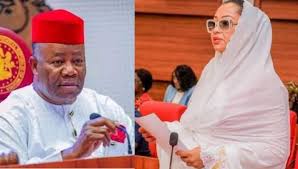
*Akpabio Vows Steady Hands, Bold Reforms, Compassionate Governance
SENATOR Natasha Akpoti-Uduaghan, representing Kogi Central, on Tuesday, October 7, returned to the Senate chamber after serving a six-month suspension.
Beaming with smiles, the lawmaker, accompanied by some activists and loyalists, including Aisha Yesufu, who was spotted in the gallery, while others were not allowed in, walked into the chamber and made her way to her seat after exchanging pleasantries with a few senators.
Her return marks the end of a suspension that had generated widespread public debate.
Recall that Akpoti-Uduaghan was suspended in March for six months over alleged misconduct, following her protest against the reassignment of her seat by the Senate President, Godswill Akpabio, on February 20.
As a result, her office, located in Suite 2.05 of the Senate Wing, sealed. The office was, however, unsealed last month by the Deputy Director of the National Assembly Sergeant-at-Arms, Alabi Adedeji, last month, paving the way for her return.
The plenary witnessed a large turnout of senators to legislative business.
Akpabio, in his welcome address, titled, ‘Steady Hands for a Great Nation,’ urged Nigerians and their leaders to embrace steady, purposeful leadership anchored on justice, compassion and accountability.
Akpabio congratulated President Bola Tinubu and all Nigerians on the country’s 65th independence anniversary, reminding lawmakers that the task of nation-building is an unending relay, saying the flame may flicker, but it must never die.
He lamented lives lost during the recess, including victims of the Niger River boat tragedy in Kogi State; worshippers slain in a Katsina mosque attack; 12 forest guards killed in Kwara; and destruction caused by floods across Bayelsa, Sokoto and Zamfara, calling for urgent federal and state collaboration to stop such disasters from becoming “annual calamities.”
He stated: “To every home afflicted by disasters, insecurity, hunger and hardship, we extend the hand of fellowship and prayer of comfort. We shall not flinch from the duty of relief and redress for our people.”
Pointing to Nigeria’s rising oil output as a sign of renewed investor confidence, the sente president, however, warned against squandering the gains, saying: “We must ensure that this blessing does not become another fleeting windfall, but a foundation for fiscal discipline, infrastructure renewal, and job creation.”
On domestic challenges, Akpabio, citing alarming figures of over 33 million Nigerians facing acute food insecurity, called for aggressive legislative action in agriculture, irrigation, mechanisation and rural roads, warning that hunger cannot be tackled with words only, but also through policy, budget and political will.
Listing terrorism, banditry, the rising cost of living and persistent electricity failures as urgent national trials, he said Nigerians do not look to lawmakers for lamentations, but for action, even as he urged bold reforms to broaden the tax base, stimulate investment, strengthen education and healthcare and create real opportunities for young Nigerians.
He underscored the senate’s constitutional role as the foundation of democracy, vowing to maintain a firm but constructive relationship with the Executive, adding: “Where policies raise our people, we shall lend our strength. Where they imperil them, we shall speak on their behalf.”
He stressed that the senate will remain open and accountable, welcome scrutiny and ensured public funds are spent for the public good, noting: “Those who seek to weaken the legislature, in truth, seek to wreck the substructure of democracy itself.”
He warned against turning politics into “a costume drama,” urging Nigerians to choose leaders based on integrity, competence and devotion to service, rather than noise or spectacle, adding that leadership is not a carnival and governance is not a stage for theatrics, as democracy will flourish only when ballots are cast, not for the loudest voice, but for the wisest head.
In conclusion, Akpabio charged his colleagues to legislate not only for the present, but also for generations to come, saying: “Let history record that in our time, we did not shirk from truth, nor flinch from responsibility, but urged our people toward leaders worthy of their trust.”
He assured that the 10th Senate would be remembered as “an instrument of transformation, a citadel of democracy and a beacon of hope.”


