
*Urges Hamas To Surrender Weapons
*France Joins Recognition Frenzy
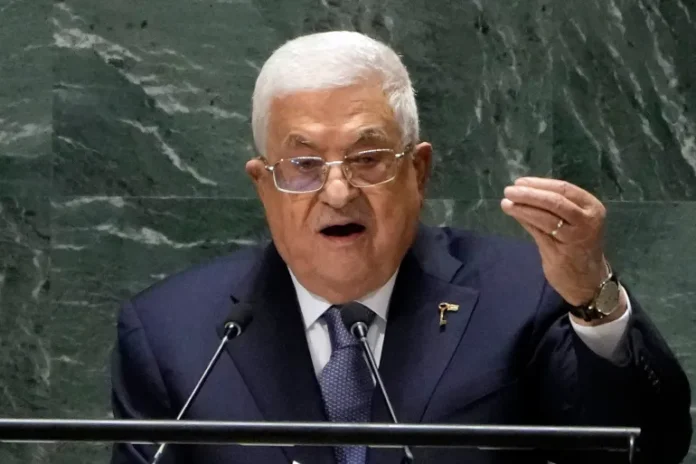
PALESTINIAN President, Mahmoud Abbas, has called for a permanent ceasefire and the immediate delivery of humanitarian aid to the Gaza Strip, as well as full United Nations (UN) membership for the State of Palestine.
In a video address delivered on Monday evening, September 22, during the launch of the High-Level International Conference for the Peaceful Settlement of the Question of Palestine and the Implementation of the Two-State Solution at the UN headquarters in New York, Abbas appreciated countries that have recognised the State of Palestine, urging all other nations to do the same.
The Palestinian Authority (PA) president also called for Hamas to surrender its weapons to his forces, while condemning the group’s deadly attack on Israel that sparked the current crisis.
Addressing a UN Summit on a two-state solution, he said: “Hamas will have no role in governing (Gaza). Hamas and other factions must surrender their weapons to the Palestinian Authority.
“We also condemn the killing and detention of civilians, including Hamas actions on October 7, 2023.”
According to Reuter and BBC reports, Abbas, speaking via video link, having been denied a visa to attend by the United States (US), made an effort to appeal directly to Israelis and Jews around the world during his virtual remarks at the UN two-state solution conference, saying that the PA already recognised Israel’s right to exist in 1988 and 1993, and continues to do so today.
He stated: “We reject any confusion, I repeat, any confusion, between solidarity with the Palestinian cause and the issue of antisemitism.
“We reject the latter proceeding from our values and principles.
“I call upon Israel to immediately sit at the negotiation table to put an end to this bloodshed and bring about just and comprehensive peace.
“I address the Israeli people saying, our future and yours banks on peace. Enough violence and war. Our generations deserve to enjoy freedom and security. Let the people of our region live in durable peace and good neighborliness,” he continues.
“I’d like to take this opportunity to address all Jews around the world, wishing them a good new year,” Abbas says, offering Rosh Hashanah greetings.
“And to our patient Palestinian people, the dawn of freedom and liberty is undoubtably coming.”
Abbas hailed the mediation efforts of Qatar, Egypt and the US to end the war in the Gaza Strip.
Meanwhile, France formally recognised a Palestinian State at the Summit, nearly two years into the war in Gaza, joining Britain, Canada and other Western allies, who made the same historic move on Sunday, September 21, and were rebuked by Israel.
While the announcement at the event convened by France and Saudi Arabia could boost the morale of Palestinians in their long search for statehood, it was not expected to deliver change on the ground.
The most far-right government in Israel’s history has declared there will be no Palestinian State, as it pushes on with its fight against militant group Hamas in Gaza following the October 7, 2023, attack on Israel that killed some 1,200 people.
Israel has become increasingly isolated and drawn global condemnation over its military conduct in Gaza, where over 65,000 Palestinians have been killed, according to local health authorities.
In recent weeks, Israel begun a long-threatened ground assault on Gaza City, with few prospects for a ceasefire.
“We must pave the way for peace,” French President, Emmanuel Macron, said at the beginning of a planned three-hour session at the UN.
“We must do everything within our power to preserve the very possibility of a two-state solution, Israel and Palestine living side by side in peace and security,” he said before announcing the diplomatic move, drawing lengthy applause from the audience.
Macron outlined a framework for a “renewed Palestinian Authority” under which France would open an embassy, subject to factors, such as reforms, a ceasefire and the release of all remaining hostages taken from Israel and held by Hamas in Gaza.
Andorra, Belgium, Luxembourg and San Marino were also expected to recognise a Palestinian State on Monday, ahead of this week’s UN General Assembly (UNGA), after Australia, Britain, Canada and Portugal did so at the weekend, followed by Malta earlier on Monday.
Israel has said such moves will undermine the prospects of a peaceful ending to the conflict in Gaza.
A delegation representing the State of Palestine has observer status at the UN, but no voting rights. No matter how many countries recognise Palestinian independence, full UN membership would require approval by the Security Council, where the US has a veto.
The two-state solution was the bedrock of the US-backed peace process ushered in by the 1993 Oslo Accords. The process suffered heavy pushback from both sides and has all but died.
No such negotiations over a two-state solution have been held since 2014.
The US and Israel boycotted Monday’s meeting. Israel’s UN Ambassador, Danny Danon, said Israel would discuss how to respond to the announcements of recognition after Prime Minister Benjamin Netanyahu returns to Israel next week.
“Those issues were supposed to be negotiated between Israel and the Palestinians in the future,” Danon told reporters ahead of the meeting.
Netanyahu is scheduled to meet US President, Donald Trump, on Monday in Washington before returning to Israel.
The US has told other countries that Palestinian recognition will create more problems, Secretary of State Marco Rubio said earlier this month.
Amid Israel’s intensified Gaza offensive and escalating violence by Israeli settlers in the West Bank, there is a growing sense of urgency among some nations to act now before the idea of a two-state solution vanishes forever.
France has driven the move, hoping that Macron’s announcement in July that he would recognise a Palestinian state would give greater momentum to a movement hitherto dominated by smaller nations that are generally more critical of Israel.
While the majority of European countries now recognise a Palestinian State, two of the continent’s largest economies, Germany and Italy, have signalled they are unlikely to make such a move soon.
Germany, long a strong supporter of Israel because of its responsibility for the Holocaust, has grown more critical of Israeli policy, while insisting that recognition of a Palestinian State should come at the end of a political process to agree on a two-state solution.
The German government spokesperson also said on Monday there must be no further annexations in Israeli-occupied territory.
Italy said recognising a Palestinian State could be “counterproductive.”
On the ground, Netanyahu has rejected numerous calls to end the campaign until Hamas is destroyed and has said he will not recognise a Palestinian State.
Israel is considering annexing part of the occupied West Bank as a possible response, as well as specific bilateral measures against Paris, Israeli officials have said, even though the recognitions are expected to be largely symbolic.
Annexation could backfire and alienate such countries, such as the United Arab Emirates (UAE), a global oil power and trade hub with wide diplomatic clout across the Middle East.
The UAE, the most prominent of the Arab states that normalised ties with Israel under the US-brokered Abraham Accords in 2020, has said such a move would undermine the spirit of the agreement.
The US has warned of possible consequences for those who take measures against Israel, including France, as host of the Summit.


