
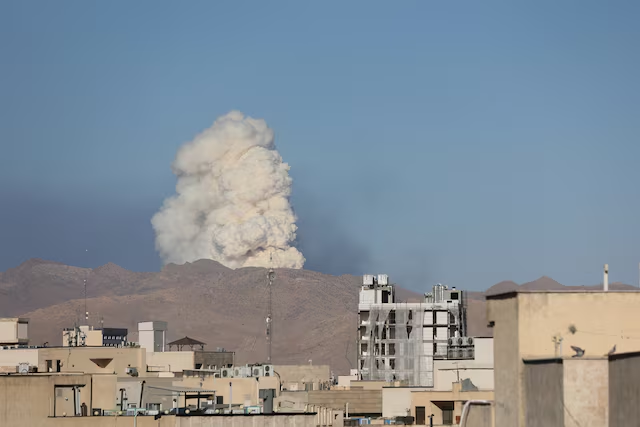
*Israel Strikes Key Iranian Nuclear Site
*Attack On Iran Nuclear Facilities: ‘I May, I May Not,’ Says Trump
IN continuation of the war in the Middle East, Iranian missiles hit an Israeli hospital, while Israel struck a key Iranian nuclear site on Thursday, just as United States President, Donald Trump, kept the world guessing about whether the US would join Israel in air strikes seeking to destroy Tehran’s nuclear facilities.
A week of Israeli air and missile strikes against its major rival has wiped out the top echelon of Iran’s military command, damaged its nuclear capabilities and killed hundreds of people, while Iranian retaliatory strikes have killed at least two dozen civilians in Israel.
The Israeli military said it targeted the Khondab nuclear reactor in Iran’s Arak overnight, including its partially-built heavy-water research reactor.
Heavy-water reactors pose a nuclear proliferation risk because they can easily produce plutonium, which, like enriched uranium, can be used to make the core of an atom bomb.
Reuters quoted Iranian media as reporting two projectiles hitting an area near the facility, which had been evacuated, and there were no reports of radiation threats.
Israel’s military said it also struck a site in the area of Natanz, which it said contains components and specialised equipment used to advance nuclear weapons development.
On Thursday morning, several Iranian missiles struck populated areas in Israel, including a hospital in the southern part of the country, according to an Israeli military official.
Trails of missiles and interception efforts were visible in the skies over Tel Aviv, with explosions heard as incoming projectiles were intercepted.
Israeli media also reported direct hits in central Israel.
Emergency services said five people had been seriously injured in the attacks and dozens of others hurt in three separate locations. People were still trapped in a building in a south Tel Aviv neighbourhood, they added.
Around a dozen mostly European and African embassies and diplomatic missions are located just a few hundred metres from the strike on Tel Aviv.
Images showed buildings extensively damaged in Ramat Gan near Tel Aviv and emergency workers helping residents, including children.
Soroka Medical Center in Beersheba, in southern Israel, reported it had sustained damage. Iran’s Revolutionary Guard said it was targeting Israeli military and intelligence headquarters near the hospital.
The worst-ever conflict between the two regional powers has raised fears that it will draw in world powers and further destabilise the Middle East.
According to Iran’s IRNA news agency, the attack was aimed at an Israel Defence Forces (IDF) “command and intelligence (IDF C4i) headquarters” and an army intelligence camp in the Gav-Yam Technology Park, adding: “The hospital was only exposed to the blast wave and did not suffer serious damage, but military infrastructure was a precise and direct target.”
The Gav-Yam Negev advanced technologies park’s website said it is “adjacent to the Ben Gurion University campus and the IDF C4i Branch campus.”
In his reaction in a post on X, Netanyahu said: “This morning, Iran’s terrorist tyrants launched missiles at Soroka Hospital in Beersheba and at a civilian population in the centre of the country.
“We will exact the full price from the tyrants in Tehran.”
Israeli media has also previously reported that an IDF campus is being built on this site.
The Israeli military confirmed it has carried out the attack on the nuclear reactor in Arak, saying it is “inactive.”
The Israel Defense Forces said the reactor is designed to produce high-yield plutonium, which is a material used to make nuclear weapons, adding: “The strike targeted the component intended for plutonium production, in order to prevent the reactor from being restored and used for nuclear weapons development.”
It asle said its latest strikes involved 40 fighter jets targeting dozens of military sites, including factories making raw materials, parts used to assemble ballistic missiles, and locations for building Iranian air defence systems and missiles.
Speaking to reporters outside the White House on Wednesday, Trump declined to say if he had made any decision on whether to join Israel’s air campaign, saying: “I may do it. I may not do it. I mean, nobody knows what I’m going to do.”
In later remarks, he said Iranian officials wanted to come to Washington for a meeting, adding: “We may do that. It’s a little late” for such talks.
Iranian Supreme Leader, Ayatollah Ali Khamenei rebuked Trump’s earlier call for Iran to surrender in a recorded speech played on television, his first appearance since Friday, vowing: “Any US military intervention will undoubtedly be accompanied by irreparable damage. The Iranian nation will not surrender.”
Iran denies it is seeking nuclear weapons and said its programme is for peaceful purposes only, but the International Atomic Energy Agency (IAEA) said last week Tehran was in breach of its non-proliferation obligations for the first time in 20 years.
Meanwhile, the foreign ministers of Germany, France and Britain plan to hold nuclear talks with their Iranian counterpart on Friday, June 20, in Geneva, Switzerland, to urge it to return to the negotiating table, a German diplomatic source told Reuters.
Israel, which is not a party to the international Non-Proliferation Treaty, is the only country in the Middle East believed to have nuclear weapons. It does not deny or confirm that.
Trump has veered from proposing a swift diplomatic end to the war to suggesting the US might join it.
A source familiar with internal discussions said Trump and his team were considering options that included joining Israel in strikes against Iranian nuclear installations.
But the prospect of a US strike against Iran has exposed divisions in the coalition of supporters that brought Trump to power, with some of his base urging him not to get the country involved in a new Middle East war, with senior US Senate Democrats urging him to prioritise diplomacy and seek a binding agreement to prevent Iran from attaining nuclear weapons, while expressing concern about his administration’s approach.
Trump has approved Iran attack plan, but has not made final decision on whether to strike the country, the BBC’s US partner, CBS, reports.
He held off from initiating strikes in case Iran agreed to abandon its nuclear programme, a senior intelligence source told CBS, is reportedly considering a US strike on Fordo, an underground uranium enrichment facility in Iran.
The news of Trump backing strike plans was first reported by the Wall Street Journal.
The war of words came as Iranians continued to jam roads out of the capital Tehran, a city of 10 million people, seeking sanctuary from Israeli attacks.
Israeli Prime Minister, Benjamin Netanyahu, said in a video on Wednesday that his country’s forces were “progressing step by step” towards eliminating threats posed by Iran’s nuclear sites and ballistic missile arsenal.
“We control the skies over Tehran. We are striking with tremendous force at the regime of the ayatollahs. We are hitting the nuclear sites, the missiles, the headquarters, the symbols of the regime,” he said.
Trump’s Defence Secretary, Pete Hegseth, told a Senate committee that the Pentagon was prepared to execute any order given by Trump.
His comments came amid a build-up of American forces in the Middle East. A carrier strike group, led by the USS Nimitz aircraft carrier, was steaming from south-east Asia to join another strike group, led by the USS Carl Vinson, already in the Gulf.
Various air assets, including refuelling tankers, were also seen on flight trackers moving from Europe, with reports of F-22 and F-35 strike aircraft following.
The US State Department said Secretary of State, Marco Rubio, would meet United Kingdom (UK) Foreign Secretary, David Lammy, in Washington DC on Thursday, June 19, for talks expected to focus on Iran.
The BBC understands that, so far, the US has not made a formal request to use the UK’s military bases in Diego Garcia or Cyprus to conduct strikes against Iran.
Normally, the US would first inform its ally if it intended to conduct offensive operations from those bases. A British source said it was believed “all options” were on the table in Washington, but there was no complete picture of America’s intent.
The US embassy in Jerusalem on Wednesday issued an evacuation plan for American citizens currently in Israel. It was unclear how many Americans were seeking to leave Israel or whether the US military would assist with the evacuation flights.
Since it launched its attack on Friday, Israel’s strikes on Iran have killed 585 people, according to Washington DC-based group, Human Rights Activists, which said that 239 were civilians and 126 were security personnel.
In retaliation, Iran has fired around 400 missiles at Israel, killing 24 people, all of them civilians, according to Israeli authorities.
Meanwhile, Iranian state television warned viewers to ignore an “irrelevant” clip calling for the public to “rise up” against the regime after an apparent hack of its satellite feed, saying: “If you notice irrelevant messages while watching TV, it is due to the enemy jamming satellite signals.”
Hackers apparently broke in and broadcast a video that accused the Iranian establishment of “failing” its own people, called on viewers to “take control of your future.”
It featured several clips of mass protests against the regime in 2022.


