
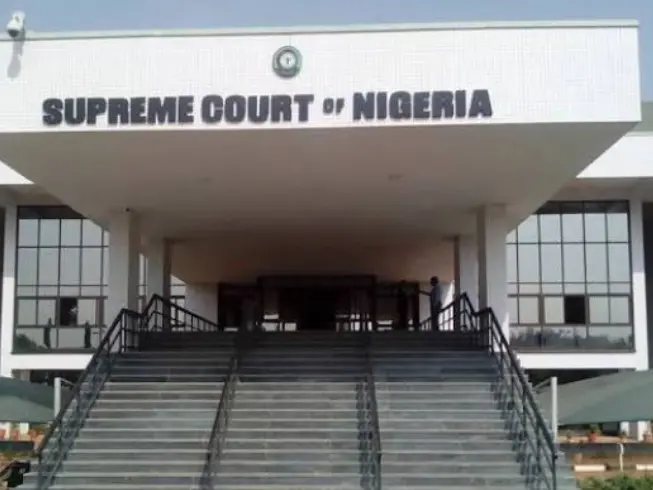
THE Supreme Court, on Friday, January 19, upheld the election of Governors Sheriff Oborevwori (Delta), Dapo Abiodun (Ogun), Abdullahi Sule (Nasarawa) and Inuwa Yahaya (Gombe).
In a series of judgment on the March 18, last year’s governorship election, the apex court affirmed Oborevwori of the People Democratic Party (PDP) as the duly-elected governor of Delta State.
Ovie Omo-Agege of the All Progressives Congress (APC), Ken Pela of Labour Party (LP) and Kenneth Gbagi of the Social Democratic Party (SDP) had challenged the governor’s victory in three separate petitions, seeking the nullification of his declaration by the Independent National Electoral Commission (INEC) as winner.
But the Justice John Okoro-led the five-man panel dismissed Omo-Agege/APC’s appeal and upheld the decision of the lower courts.
On Pela and Gbagi’s challenge, the court held that there was no merit in the appeals against the PDP and its candidate and accordingly dismissed them for lacking in merit.
The petitioners had earlier challenged the declaration of Oborevwori as governor at the governorship election petition tribunal and the court of appeal, both of which upheld his election.
At the apex court, Omo-Agege argued that the election was not conducted in substantial compliance with provisions of the Electoral Act, alleging that the results were not properly recorded at some polling units and the forms that contained some of the recorded results did not have serial numbers.
Gbagi had prayed the court to declare that Oborevwori was not eligible to contest the election, while Pela asked it to nullify the entire election and order a fresh one.
However, Justice Okoro, on behalf of Justices Mohammed Lawal Garuba and Uwani Abba Aji, respectively dismissed the three appeals for lacking in merit
On the Gombe election, Justice Kudirat Kekere-Ekun, in the lead judgment, dismissed the appeal by the Peoples Democratic Party (PDP) candidate.INEC declared Yahaya as winner of the election after scoring 342,821 votes to defeat his closest rival, PDP’s Jibrin Barde,who polled 233,131 votes.
PDP and its candidate filed a petition at the tribunal, claiming that Yahaya of the APC, was not re-elected by a majority of lawful votes.
PDP alleged cases of ballot box stuffing and thumb-printing by Yahaya’s supporters in nine of the state’s local councils. But the three-member panel of election tribunal, led by Justice S.B. Belgore, dismissed the suit.
Not satisfied with the verdict, Barde and PDP approached the appeal court, where the Justice T. N. Orji-Abadua-led panel upheld the governor’s victory and dismissed the appeal for lacking merit, having resolved all the issues in favour of the respondent and against the appellant.
Those decisions were unanimous upheld by the Supreme Court.
SIMILARLY, the court affirmed the election of APC’s Sule as Nasarawa State governor after a fierce legal and sentimental battle between him and PDP’s Emmanuel David Ombugadu. Justice Kekere-Ekun, who read the lead judgment, resolved the issues against the appellant and accordingly dismissed the appeal .
The appellate court had on November 23, last year reversed the sack Sule by the tribunal in its October 2 judgment, holding that the Justice Ezekiel Ajayi-led tribunal acted in grave error in using witness statements on oath not front-loaded, as required by law, to nullify the governor’s victory.
In the judgment delivered by Justice Uchechukwu Onyemenam, the appellate court said the tribunal was legally bound to act on witness statements filed along with the petition or front-loaded within 21 days stipulated by law and that no petition can lawfully be amended outside the 21 days allowed by law.
It also dismissed the over-voting allegation used to annul the election, saying there were not established by law, ruling that the petition was a nullity and invalid on the grounds that the jurisdictional issues raised by the governor were unlawfully ignored by the tribunal.
The middle court held that the tribunal denied the governor a fair hearing by not considering and making findings on the issues of jurisdiction raised at the hearing of the petition, saying such was fatal and rendered all the tribunal’s decisions invalid.
The court, therefore, reversed all orders made against the governor and INEC by the tribunal and affirmed Sule as the lawfully elected governor.
INEC had declared Sule as winner of the election, having polled 347,209 votes, as against Ombugadu’s 283,016 votes.
ON Ogun State, apex court, in affirming the election of Abiodun, dismissed an appeal by Ladi Adebutu of PDP.
Delivering the lead judgment, Justice Tijani
Abubakar, held that having dealt with the issues submitted for appeal, found the appeal was unmeritorious and accordingly dismissed it.
Adebutu had asked the court to set aside the election because INEC had initially cancelled elections in 99 polling units and consequently ordered that fresh elections to be conducted in those units, only for it to go ahead to declare Abiodun of the APC as winner of the election, disregarding the margin of the vote.
The governor had won the election with 13,000 votes difference, against the votes from the cancelled polling units 44,000.
The appeal court had in November last year also upheld INEC’s declaration of Abiodun as winner of the election, but Adebutu approached the Supreme Court.
THE court also affirmed the election of Kaduna State Governor, Uba Sani.
In the judgment, delivered by Justice Tijjani Abubakar, the court dismissed the appeal file by PDP’s Ashiru Isa.
The court of appeal in Abuja had in a unanimous judgment on November 24, last year, affirmed Sani’s election as governor.
PDP and Ashiru had challenged the outcome of the governorship election, alleging that Uba was not duly elected by a majority of valid votes cast and that the election was invalid by reason of corrupt practices and non-compliance with provisions of the Electoral Act 2022.
They further alleged that some polling unit results were wrongfully cancelled, insisting that there were inconsistencies in accreditation records from INEC.
But two of the three Judges, in a judgment on September 28, last year, dismissed the petition on technical grounds.
Justice Victor Oviawie, who led the panel and read the majority judgment, said the petition was deemed abandoned because PDP and its candidate did not file their pre-hearing application within the time prescribed by law.
THE Kebbi State governorship election has also been put to rest, as the court affirmed the election of Governor Nasir Idris of APC.
The five-man panel, led by Justice Kekere-Ekun, dismissed the appeal by PDP’s Aminu Bande for lacking in merit, thereby upholding the judgments of the lower courts.
The appellate court in Abuja had upheld Idris’s election in a unanimous judgment by the three-man panel after dismissing Bande’s appeal also for lacking of merit.
In its judgment delivered by Justice Ndukwe Anyanwu, the three-member panel resolved all the five issues for determination in favour of the governor and against the PDP and its candidate, ruling that the appellants failed to establish all the allegations brought against the governor in their petition.
It held that the allegations of forgery of testimonial brought against the deputy governor, Abubakar Tafida, could not be established, as required by law, while the issues of non-compliance with the provisions of the Electoral Act could not stand, because the appellants failed to prove how the allegations substantially affected the poll.
INEC had declared the election inconclusive due to “massive vote cancellation and over-voting” in 20 of the 21 local councils and fixed April 15 for a supplementary election, at the end of which Idris polled a total of 409,225 votes to beat Bande’s 360,940 votes.
But Bande and PDP rejected the result and filed a petition before the tribunal, alleging over-voting in some polling units, that Idris was not qualified to contest the poll and his deputy had submitted a fake secondary school testimonial to INEC.
However, in the judgment read by Chairman of the panel, Justice Ofem Ofem, the tribunal held that the petitioners failed to prove beyond doubt that the deputy governor presented a fake certificate to INEC.
Justice Ofem added that the evidence presented showed that the testimonial in question was duly signed and issued to him by the then principal of Sultan Abubakar College, Sokoto in 1982.
He described the documents presented by the petitioners as “iron cast evidence,” saying, “we state categorically that the third respondent did not forge certificate.”
On over-voting, Justice Ofem said out of the 59 polling units being questioned, irregularities were discovered in nine.


