
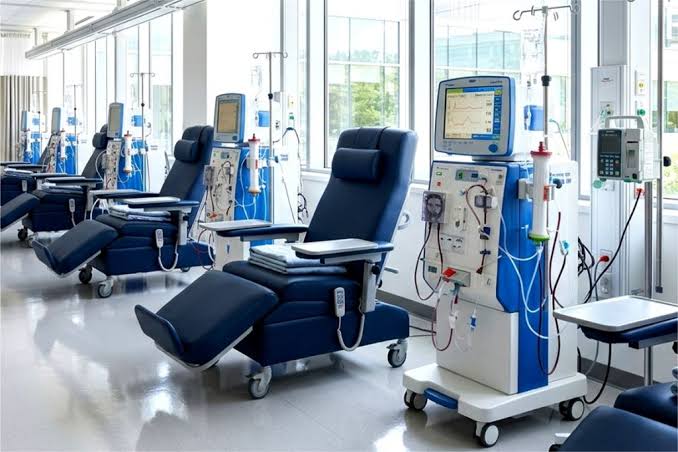
THE Redeemed Christian Church of God (RCCG), through its Christian Social Responsibility (CSR) arm, His Love Foundation, will on Thursday, September 24, inaugurate a new dialysis centre at the Federal Medical Centre (FMC), Asaba, Delta State.
Governor Sheriff Oborevwori is scheduled to inaugurate the Enoch and Folu Adeboye Dialysis Centre at 11 am.
The state-of-the-art facility is expected to improve access to specialised kidney care and boost FMC’s capacity to provide dialysis treatment for patients with kidney-related conditions.
The project is part of the Foundation’s healthcare interventions across the country, which has seen the inauguration of 15 dialysis centres nationwide, alongside other healthcare projects, including five intensive care units, three ambulances, a cardiac diagnostic unit and two X-ray facilities.
The Foundation also operates programmes in education, feeding, social enterprise, environmental architecture, prison impact and rehabilitation, all designed to address society’s social and humanitarian needs.
The inauguration comes on the heels of a recent successful robotic surgery to remove a cancerous tumour and the affected kidney from a patient in Abuja, the first of its kind in the country.
The Redeemer’s Health Village (RHV) at the Redemption City of God, Mowe, Ogun State, RoboMed Global and Nisa Premier Hospital, executed West Africa’s first tele-robotic surgery, a procedure involving using a robotic system to help surgeons remove a cancerous tumour and the affected kidney from a patient in Abuja.
The operation was performed remotely, with the surgeon controlling the robot from RHV, while the patient remained at Nisa Premier Hospital, thereby breaking the barriers of distance using specialist surgical expertise.
According to the News Agency of Nigeria (NAN), the procedure lasted about three hours, with brief pauses to verify equipment and communications systems.
Chief Executive Officer/Founder of Nisa Premier Hospital, Ibrahim Wada, described the operation as a demonstration of cross-institutional collaboration, adding: “This is what becomes possible when Nigerian institutions decide to build together.”
Professor of Urology and Transplantation and Co-founder of RoboMed Global, a US-based robotic surgery company, Obi Ekwenna-Davis, said the operation showed that telesurgery could be performed safely across locations, and “distance should never decide who receives safe surgery.”
He said the procedure lasted about three hours, with brief stoppages to ensure that the equipment and systems functioned properly, adding that the collaboration was significant as it marked the first time two hospitals in different parts of Nigeria successfully collaborated to provide surgical care to a patient.
Ekwenna-Davis noted that the sustainability of the initiative would depend on continuous training, adding that a robotic academy would soon be established to train at least 150 surgeons and other medical professionals within the next two years.
He said the programme had the support of the minister of Health and other government institutions, urging additional support from private and non-governmental organisations.
Earlier, Chief Executive Officer of RHV, which was established to promote innovation and provide world-class healthcare services at affordable costs, Adedamola Dada, said the development marked the first telesurgery in West Africa, adding: “What has happened today is a demonstration that Nigerians can access modern healthcare without travelling abroad.”
He said the initiative was not primarily profit-driven, but aimed at demonstrating what modern healthcare could offer Nigerians, in line with the vision of the General Overseer of RCCG, Pastor Enoch Adejare Adeboye.
Dada said the achievement had positioned the hospital as a gateway through which specialist skills could be transferred to patients across Nigeria, noting that the introduction of robotic surgery and telesurgery at RHV was aimed at reducing medical tourism and improving access to complex surgical procedures within the country.
He said measures had been put in place to address possible connectivity challenges through the use of reliable networks, explaining that weather conditions could sometimes affect connectivity, while the quality of equipment and availability of skilled personnel were also critical to the success of telesurgery.
Dada re-echoed that the hospital was establishing a robotic academy in collaboration with RoboMed Global to train doctors, surgeons, nurses, biomedical engineers and product specialists, urging government to support and sponsor medical professionals interested in acquiring robotic surgery skills, in the form of scholarships, so that within two to three years, Nigeria will have a lot of professionals who are capable of performing robotic surgery.
Chief Executive Officer and Founder, Nisa Premier Hospital, Ibrahim Wada, said the facility had been a centre for robotic surgery in West Africa since November 2025.
“Today, our patient received specialist surgical expertise from across the country without leaving Abuja. This is what becomes possible when Nigerian institutions decide to build together,” Wada said.
Also, Chairman, Board of RHV, Kunle Onakoya, described the development as historic, urging participants to recognise their roles in creating a milestone for Nigeria.
RHV is a faith-based 300-bed multispecialty hospital established by the RCCG.
Groote Schuur Hospital in Cape Town, South Africa, was Africa’s first public-sector hospital to offer robot-assisted surgery, using the Da Vinci system.
His Love Foundation has extended its interventions to all 36 states and the Federal Capital Territory (FCT) and impacted 650 local government areas..


