
*Umahi Apologises, Orders Contractors’ Arrest
THE Presidency has described the recent failure on the Benin-Agbor-Asaba Expressway as an isolated incident, insisting the Federal Government responded swiftly by deploying key stakeholders to the affected sections and demanding immediate action from the contractor.
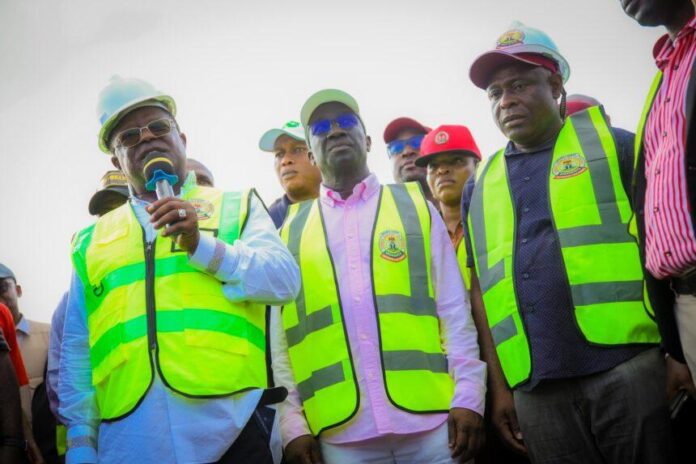
This is even as the Minister of Works, David Umahi, apologised to commuters and residents of Edo and Delta states over the deplorable condition of the Benin-Sapele Road and ordered the arrest of the contractor and concessionaire, as well as others found removing asphalt from federal roads without authorisation.
In response to the controversy over federal roads in both states, Special Adviser to the President on Media and Public Communications, Sunday Dare, disclosed that Tinubu had directed the redesign and total reconstruction of the road.
Speaking on a television programme on Wednesday, August 26, Dare said the incident should not be used to assess the state of road projects across the country.
Noting that several other federal roads had been completed or were progressing without similar complaints, the presidential aide stated: “I think that first, these are isolated cases. And we all know by the nature of road construction, during rainy season, you encounter problems like this.”
He acknowledged that government’s responsibility to identify roads requiring repairs and provide funding, while contractors were expected to execute the projects properly, saying: “Whatever played out yesterday, we had all the stakeholders there. And it’s important that even the contractor came out, even though he gave excuses, it showed a failure on their part.”
Dare said the rapid intervention by Umahi, National Assembly members and other stakeholders demonstrated government’s response to infrastructure challenges, adding: “Government has a responsibility to identify the roads that need to be fixed. Government has a responsibility to provide the funding. And then, the next responsibility goes to the contractors to do what is necessary.
“What we saw yesterday, the minister, the National Assembly members and other key stakeholders going there in record time, right on the spot.
“I think that’s what good governance is about, responding as quickly and as swiftly as possible, putting the blame where it is, and requesting for immediate action.”
He restated that the Benin-Asaba incident was not representative of all ongoing federal road projects, saying several roads had been fixed without similar complaints, saying: “I said these are isolated, but we have quite a number of other roads where there are no complaints, where the roads have been fixed.”
He urged motorists to endure some inconveniences while construction work progresses, recalling that he recently travelled along the Abuja-Lokoja corridor with about 65 journalists and observed completed sections of the road, including stretches where concrete construction was ongoing.
He explained that road projects were often constructed in sections, meaning motorists might temporarily use older portions of a highway while completed sections were brought into service, noting: “It’s like a house construction; a house is not built in a day, it’s progressive. Until the roof comes on, the rain will still pour down on the building.”
Dare said the Federal Government was currently undertaking major road projects across the country, including five legacy roads and about 320 roads nationwide, adding that the scale of the projects reflected Tinubu’s focus on infrastructure development.
Umahi, who earlier apologised to road users and on Tuesday, August 25, in Benin City, the Edo State capital, during an inspection tour of some major roads in the state, thanked the youths for remaining calm, despite the hardship caused by the road’s condition, saying their restraint helped to prevent a possible breakdown of law and order.
The minister expressed disappointment with the concessionaire handling the road, accusing the company of lacking the technical competence required to execute the project.
He said he had personally observed the removal of asphalt from the road during an earlier inspection with Governor Monday Okpebholo, and warned the contractor to desist from the act, noting that the ministry does not permit contractors to remove asphalt from federal roads without authorization.
Describing such as “destruction of public infrastructure,” Umahi directed all ministry controllers to arrest any contractor or concessionaire found removing asphalt from federal roads without approval.
He criticised the concessionaire’s handling of the project, saying its lack of technical capacity had subjected commuters and residents to untold hardship.
Reiterating that the Federal Government has a responsibility to ensure that concessionaires possessed the necessary technical competence before being awarded road projects, the minister re-echoed that the concessionaire lacked a reputation for competence and integrity before taking over construction of the Benin-Agbor Road.
He assured that President Bola Tinubu had taken note of the suffering of road users and had directed the ministry to do everything necessary to restore the road and ameliorate the suffering of motorists.
Umahi, while acknowledging that concession agreements were governed by law, however, said government could invoke overriding public interest where necessary to protect citizens and critical infrastructure.
He thanked Okpebholo for intervening in the rehabilitation of federal roads in Edo, assuring road users of immediate rehabilitation to bring relief to the people, in line with Tinubu’s directive, adding that government would prioritise the welfare and safety of the people.
In his response, Okpebholo appealed to residents and youths in the affected areas to remain patient and exercise restraint.
He said Edo’s strategic location made it a gateway to several regions, cautioning that unrest in the state could have consequences for the entire country.
Chief Executive Officer (CEO) of the concessionaire, Samuel Daramola, blamed the slow pace of work on heavy rains, saying the company had resorted to palliative works to allow traffic to move.
Daramola maintained that one of the first things the company did after taking over construction of the Benin-Agbor Road was to expand the road, noting that the company started with palliative works because of the numerous potholes on the road to create easier access for commuters.


