
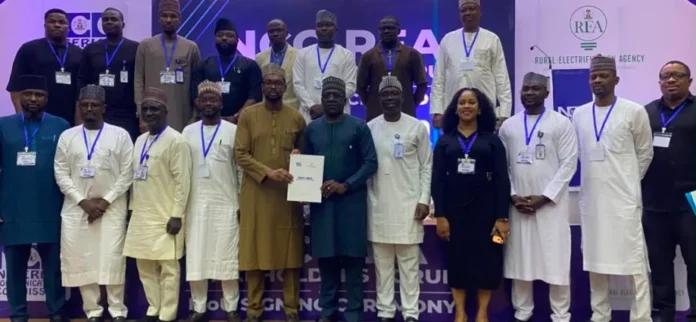
THE Nigerian Communications Commission (NCC) and the Rural Electrification Agency (REA) have signed a Memorandum of Understanding (MoU) to strengthen collaboration between the telecommunications and energy sectors with a view to expanding digital infrastructure and electricity access in underserved communities.
Speaking at the signing ceremony on Friday, July 24, in Abuja, during a stakeholder workshop, titled, ‘Unlocking the Energy–Telecoms Nexus for Scalable Digital Infrastructure in Nigeria,’ the Executive Vice-Chairman of NCC, Aminu Maida, said reliable electricity and digital connectivity were mutually reinforcing pillars of national development, adding that “when a community is provided with fast and reliable connectivity, it brings development, inclusion and opportunities.”
Maida stated that communities without electricity struggle to sustain telecommunications infrastructure, while communities without connectivity are unable to fully maximise the benefits of electricity; hence the collaboration would enable both agencies to coordinate infrastructure planning through data sharing.
According to the News Agency of Nigeria (NAN), Maida noted that the REA would provide the NCC with geospatial data on existing, newly electrified and planned electrification projects, including mini-grids and solar home system clusters, while NCC will share information on existing and planned Universal Service Provision Fund (USPF) projects to ensure both agencies work from a unified map of connectivity and energy gaps.
NCC’s Executive Commissioner, Technical Services, Abraham Oshadami, said the agreement was a major step towards improving telecommunications and electricity access, particularly in rural communities, noting that telecommunications infrastructure depended on reliable electricity, while electricity services increasingly rely on digital connectivity.
Oshadami said the MoU would enable both agencies to identify telecommunications base stations located near existing or planned mini-grids, allowing operators to draw power from nearby renewable energy installations.
He stated: “The base stations will remain operational even where there is no national grid supply because mini-grids can sustain connectivity in those locations.
“This will significantly improve access to telecommunications services in rural communities while supporting broader socio-economic development.”
Also speaking, REA’s Executive Director, Technical Services, Umar Umar, said the agreement established a formal framework for collaboration after years of both agencies pursuing similar objectives independently, adding that the partnership would focus on data sharing, joint infrastructure mapping and coordinated project implementation.
According to Umar, the agencies have also established an NCC-REA collaboration committee to identify priority locations and develop pilot projects for implementation, adding: “We are bringing together our telecoms and power coverage maps to identify viable locations where both sectors can complement each other.
“At the end of this process, we will develop precise, data-driven solutions and pilot projects that will guide future deployments.”
Umar said that the collaboration would also provide a platform for wider stakeholder participation in evaluating and strengthening implementation strategies.
The MoU is expected to improve coordination between the two agencies, as well as reduce infrastructure costs and accelerate the expansion of digital and electricity infrastructure to underserved and unserved communities across Nigeria.


