
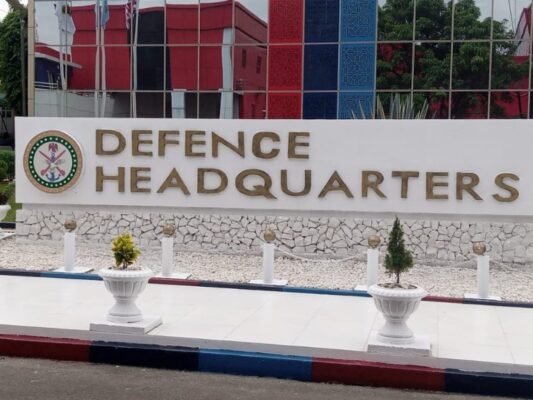
THE Defence Headquarters (DHQ), on Friday, July 3, clarified that United States (US) troops reported withdrawn from the Lake Chad Basin are different from the 200 deployed to Nigeria to carry out joint intelligence and training operations against ISIS and other terrorist elements within the country.
Recall that the Commander of US Air Forces in Africa, Gen. Dagvin R.M. Anderson, had announced that the country withdrew the majority of its military personnel deployed to Nigeria for a joint counterterrorism mission in the Lake Chad Basin, while maintaining intelligence sharing and other security cooperation with Nigerian authorities.
He was quoted as stressing during a virtual press briefing on the outcome of the African Chiefs of Defence Conference 2026, that the partnership between Washington and Abuja remained active, particularly in intelligence operations targeting the Islamic State (ISIS/Daesh).
Anderson disclosed that the specific mission that required the deployment of US troops has been completed, prompting the withdrawal of most personnel.
He, however, noted that the US would continue to provide intelligence assistance at the request of the Nigerian government, adding: “And so that operation in the Lake Chad Basin of Nigeria not only helped the countries in that immediate region, it also helps countries globally, as that disrupts the ISIS network.
“And so, we have withdrawn much of our forces that were just there for that operation, but are continuing the partnership that Nigeria has asked for to help continue with the intelligence sharing and the understanding that’s necessary to be able to prosecute these difficult tasks.”
The US Air Force commander described Nigeria as a key regional partner with a capable military, saying the collaboration between both nations had produced notable gains in the fight against ISIS, crediting intelligence cooperation between the two countries for enabling an operation that eliminated the second-highest-ranking figure in the global ISIS network.
He stated: “I think the partnership that we’ve shown recently with Nigeria, where Nigeria’s a very capable and large country, it’s got a strong economy; it’s got a large, educated population; it’s got a very capable military.
“But there are things that that we have learned in the counter-terrorist fight over several years that we were able to assist and integrate with them to help them with their intelligence and help with the intelligence sharing that eventually led to a cooperative effort to where we were able to bring some unique capabilities that the US brings and be able to prosecute together the number two leader within the ISIS or Daesh organisation who is responsible for much of their global operations, their global media, and their recruiting.”
In further clarification on the statement, Director of Defence Information (DDI), Maj-Gen. Samaila Uba, emphasized that the Nigeria-US joint partnership remains unchanged.
Uba said: “The Commander was primarily talking about the additional forces that came to execute the mission in Lake Chad. Initial US personnel are still in Nigeria.
“The partnership between Nigeria and the US is unchanged with key information sharing ongoing.
“As we saw in May, there are times that require additional forces to execute specific missions. Those forces are intended for short periods of time only.
“Nigeria and US continue to work closely together to disrupt and eliminate shared threats and that remains unchanged.
“It should, therefore, be noted that going forward where the need arises for peculiar competencies, personnel and resources it would be provided.”
In December, US and Nigerian forces launched a joint operation in the Lake Chad Basin area, which involved strikes against militants on Christmas Day, followed by the deployment of 200 soldiers two months later.
Senior Islamic State (IS) leader, Abu-Bilal al-Minuki, was killed during the months-long mission.


