
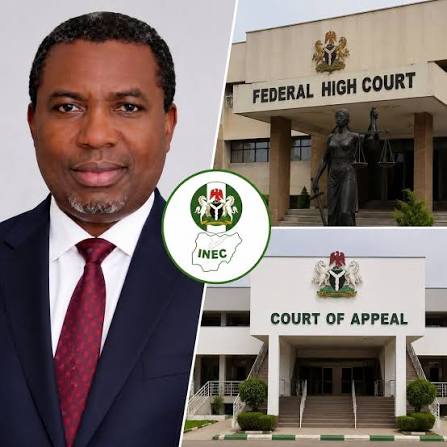
THE Court of Appeal, Abuja Division, has reserved judgment in two separate appeals over the timetable for the conduct of next year’s general elections released by the Independent National Electoral Commission (INEC).
This was announced by Justice Adebukola Bankole, who led the panel that heard the appeals, saying the date of the judgment will be communicated to parties involved.
Two political parties, Youth Party of Nigeria (YPN) and Social Democratic Party (SDP) approached a Federal High Court in Abuja, seeking the nullification of the election timetable.
In his ruling, Justice Mohammed Umar granted the reliefs sought in the suit by YPN and nullified the election guidelines, while Justice James Omotosho of another Federal High Court, also in Abuja, in the suit filed by SDP, granted some reliefs in favour of the party and some others in favour of INEC.
Dissatisfied with the two judgments, INEC approached the appellate court to set aside the judgments limiting its power regarding elections.
Its lead Counsel, Alex Izinyon (SAN), in his submission, argued that INEC has the power, as provided in the 1999 Constitution (as amended) and the Electoral Act to issue election guidelines.
According to him: “The Constitution, specifically, empowered INEC to organise, supervise and undertake elections and other political activities, as provided, and that the timetable provided is in consonance with the power donated by the 1999 Constitution and the enabling Act for INEC to do what it did in issuing elections timetables.
“The trial court erred in law because it failed to interpret, using the Supreme Court authorities and Court of Appeal decisions on the power already donated by the 1999 Constitution to INEC to arrange for elections including pre-election matters.
“Supreme Court and Court of Appeal have held that INEC has the power to organise and supervise elections, and this include timetable for elections to carry out political activities preceding the elections.
“The trial court failed to give effect to the phrase, ‘not later than 120 days and not more than 90 days,” which was a subject of contention at the trial court, and that not less than 120 days means it should not be more than, but it can be less than.
“But for the court to say that it must be exactly 120 days was too mathematical and not the intendment of the lawmakers, as any of the activities can be done before the 120 days and not more than.
“For the trial court to say it must be exactly 120 days is a mechanical application of the statue, which is contrary to the decisions of the apex court and the Court of Appeal.”
He contended that the same goes for the 90 days provisions, adding that the reliefs sought by the respondent at the trial court were declarative in nature.
Izinyon added: “There was no evidence by way of affidavit to show that they have commenced any primary or taken steps or that they have suffered any injury. Therefore, the court ought not to have granted any relief.
“The second appeal was filed by SDP in a judgment delivered by Justice James Omotosho, who granted some reliefs to the SDP and granted some also to the INEC.
“INEC appealed part of the judgment in that case, which limits their powers by saying that the days were short by few numbers of days, that INEC should go back and rectify this.”
Before the main argument, Izinyon moved three applications, urging the court to close the door against YPN on the ground that the party failed to file its respondent brief after service of the appellant briefs on them five days.
He argued that the court should hold that they have no written briefs in opposition to the appellants’ briefs, as they are prohibited by Paragraph 13 of the Practice Direction of the pre-election proceedings issued by the President of the Court of Appeal, which states that no time shall be extended for default under the same paragraph.
YPN’s Counsel, Akinwale Irokosun, when asked by the panel if the party filed any response to the motion, answered in the negative.
Izinyon later moved his application, and the court reserved ruling to be delivered alongside the main appeal.
In the second motion, Irokosun prayed the court for an extension of time to file the respondent brief out of time, but this was opposed by Izinyon, on the ground that there was no extension of time to file respondent brief when the time provided by the rules has elapsed.
He cited a number of Supreme Court and Court of Appeal cases to back his argument that no discretion can be exercised in that regard once a party failed to file respondent brief; hence the brief was incompetent, having been filed outside the five days period allowed.


